
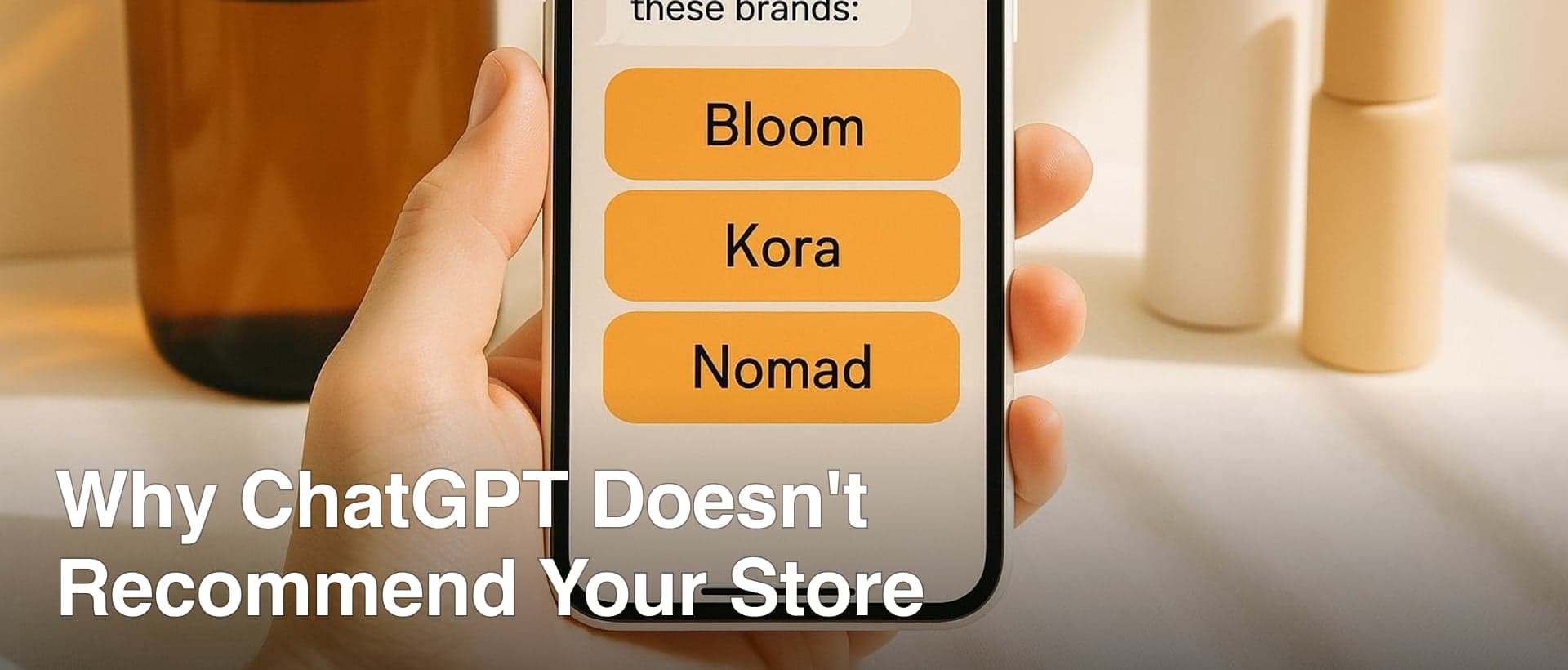
Open ChatGPT right now and ask it: "What's a good skincare brand for oily skin in India?" or "Best corporate gifting companies in Bangalore?" - whatever category you sell in.
Is your brand in the answer?
For most Indian D2C founders, it isn't. And here's what makes that sting: the person asking that question is the best lead you'll never see. They had intent, they had budget, they asked for a recommendation - and an AI handed them your competitor's name with the confidence of a trusted friend. No results page where you might rank fifth and still get the click. No ad slot to buy. One answer, a few names, and everyone else is invisible.
This is already happening at scale. ChatGPT alone handles billions of prompts a week, and a growing share of them are commercial: what to buy, which service to trust, which brand is best for a specific need. Google's own AI Overviews now answer the question directly at the top of the results page before a single traditional link appears. The way customers discover brands has structurally changed - and most stores are still optimizing for the old structure.
The good news: the reasons AI ignores your store are specific, diagnosable, and fixable. That fix has a name - answer engine optimization, or AEO - and because almost nobody in Indian ecommerce is doing it yet, the brands that move first get an advantage that was never available in crowded classic SEO.
Why doesn't ChatGPT recommend your store?
Quick Answer: AI assistants only recommend what they can verify. If your site has no content that directly answers shopper questions, no structured data machines can parse, and no independent mentions on reviews, forums, or publications, the AI has nothing citable about you - so it names competitors who gave it evidence to work with.
It helps to understand what actually happens when someone asks an AI for a recommendation. The model doesn't consult a private ranking of brands. For most commercial questions in 2026, it does something surprisingly familiar: it runs web searches in the background, retrieves the pages that rank for those searches, reads them, and composes an answer from the sources it judges credible. SEO researchers call this "query fan-out" - one user prompt fans out into several hidden searches.
That mechanism explains the invisibility. When the AI fans out "best skincare for oily skin India" into background queries, it retrieves listicles, review roundups, forum threads, and brand pages that directly address that question. If none of those retrieved pages mention you - because your site talks about your ingredients but never answers the actual question, and no third party has written about you - then from the AI's point of view, you don't exist. It isn't rejecting your brand. It never encountered it.
There's a second, quieter reason: ambiguity. AI systems cross-check. If your brand name is spelled differently across your site, your marketplace listings, and your social profiles, or your "about" information contradicts your LinkedIn page, the machine treats you as uncertain data. Uncertain data doesn't get recommended - confident answers are built from consistent sources.
And a third: most ecommerce content was written for a human who is already on the page, not for a machine deciding whether to cite the page. "Discover our range of luxurious, dermatologist-approved formulations" tells an AI nothing it can quote. "Our niacinamide serum is formulated for oily, acne-prone skin and is priced at ₹599 for 30ml" is a sentence a machine can lift into an answer. The difference between those two sentences is, in miniature, the difference between SEO-era copy and AEO-era copy.
What is AEO, and how is it different from SEO?
Quick Answer: SEO earns you a position in a list of links; AEO earns you a mention inside the AI's answer itself. SEO optimizes for crawlers and rankings. AEO optimizes for retrieval and citation - making your content the source an AI quotes when it composes a recommendation. You need both, but they reward different writing.
Classic SEO is a competition for position: ten blue links, and being third still pays. AI answers are closer to a competition for existence: the answer names two or three options, and everything else might as well not be there. That's a harsher game, but it also means the reward for playing it well is disproportionate - a citation in an AI answer is closer to being the recommendation than to being a result.
The practical differences show up in how you write. SEO content targets keywords; AEO content targets questions, phrased the way people actually ask them in conversation - longer, more specific, more contextual. "product photography Mumbai" is a keyword. "How much should a 50-product catalog shoot cost for a small brand in India?" is a prompt. AI engines are fed prompts, and they retrieve content that matches the shape of the question.
Structure matters more too. AI systems favor content they can extract cleanly: a question as a heading, followed immediately by a direct, self-contained answer of a few sentences, then the supporting detail. Bury your answer in paragraph six of a meandering essay and the machine may retrieve your page yet quote someone else's clearer sentence. This very post is built that way deliberately - every section opens with a quotable answer - because publishing in the format is half the argument for the method.
One more difference founders find counterintuitive: AEO leans heavily on things you don't fully control. Search rankings can be earned largely on your own site. AI citations weigh third-party evidence - what Reddit threads, review platforms, comparison articles, and news mentions say about you - because the machine is trying to verify you from outside. That changes where the work happens, as we'll see below.
How do AI engines actually choose which brands to name?
Quick Answer: Through retrieval and corroboration. The AI fans your question out into web searches, pulls the top results, and names brands that appear in credible retrieved sources - especially those confirmed from multiple independent angles: the brand's own answer-style content, structured data, and third-party reviews, forums, and publications all agreeing.
Think of the AI as a cautious researcher with thirty seconds. It skims what the web already says about a question and repeats the consensus of sources it trusts. That gives you a concrete checklist of what it needs to find:
Your own citable content. Pages that answer real questions directly, with specifics - prices, timelines, comparisons, use cases. Category and product pages that state plainly what the product is, who it's for, and what it costs.
Machine-readable structure. Schema markup - FAQ, Product, Organization - is how you hand the machine your facts in its native format. A product with clean schema (name, price, availability, ratings) is dramatically easier to include in an answer than one whose details live only in styled page text.
Independent corroboration. This is the layer most brands skip. AI engines visibly lean on community and review sources - Reddit and Quora threads, comparison posts, review platforms - because independent voices are harder to fake than brand copy. A single genuine thread where real users discuss your product can do more for AI visibility than ten pages of your own site.
Consistency across the web. Same brand name, same description, same facts everywhere - your site, marketplaces, social profiles, directories. Every inconsistency is a reason for a cautious researcher to leave you out of the answer.
Notice what's absent from that list: domain age, ad spend, follower counts. This is why the window is open for smaller Indian brands. The retrieved sources for most Indian commercial queries are still thin - a few outdated listicles, sparse forum activity. A brand that seeds that space with genuinely useful answers and earns a handful of authentic community mentions can become the consensus almost by default, because there barely is one yet.
How do you make your store show up in AI answers?
Quick Answer: Six moves: publish pages that answer real shopper questions in quotable form; add FAQ and Product schema; make every key page state its facts plainly; build authentic third-party mentions on forums, reviews, and publications; keep brand data identical everywhere; and measure AI-referred traffic so you know what's working.
Here's the working sequence we use:
1. Mine the real questions. Google's People Also Ask boxes, Quora, Reddit threads in your category, and - the underrated goldmine - your own customer support messages and sales calls. People write to support the same way they prompt ChatGPT: full questions, real context. Your inbox is prompt research.
2. Answer them the way this post does. One question per section, phrased as asked, answered immediately in two to four self-contained sentences, then expanded. Add a genuine FAQ block on product and category pages - not keyword stuffing, actual questions with actual answers.
3. Add the schema layer. FAQPage markup on question content, Product markup with price and availability on every product, Organization markup that nails down who you are. This is a few hours of developer work that most Indian stores simply haven't done, which is exactly why it still differentiates.
4. Earn the outside evidence. Encourage detailed reviews. Participate honestly where your customers discuss the category - answer questions on Reddit and Quora as a knowledgeable voice, not an ad. Pitch comparison and roundup writers in your niche. This layer compounds slowly, so it starts now.
5. Fix your identity. Audit every place your brand appears. One name, one description, one set of facts. Boring work, disproportionate payoff.
6. Measure it. Google Analytics 4 now separates AI-assistant traffic into its own channel, so you can see visits arriving from ChatGPT, Perplexity, and friends. Turn it on before you start, so you have a baseline - and periodically run your key buying prompts in the AI tools yourself and note who gets named. That's your rank tracker now.
None of these steps is exotic. What's rare is doing them systematically - which is precisely the gap. We wrote about the same pattern in operations: growing brands lose not to smarter competitors but to earlier systemization, a theme we covered in how D2C brands scale operations without hiring. Discovery is now another operational system, and it rewards whoever builds it first.
How long before AEO shows results?
Quick Answer: Structured answer content can surface in AI responses within weeks, because AI engines retrieve fresh pages on every query instead of waiting for rankings to shift. The third-party evidence layer - reviews, community mentions, press - builds over a few months. Treat AEO as a compounding system, not a campaign.
The honest timeline has two speeds. The on-site work - answer-formatted content, schema, consistency - can pay off surprisingly fast, precisely because retrieval is live: publish a genuinely better answer to a question people ask, and the next fan-out search for it can find you. We've seen well-structured pages picked up by AI answers well before they climbed classic rankings for the same query.
The corroboration layer is slower and can't be rushed without faking it - and faking it is a bad idea, since AI companies actively tune against manufactured consensus. A realistic plan: on-site foundation in the first month, community and review momentum building over the following quarter, and compounding from there as each cited answer makes the next citation more likely.
The strategic point outruns any single timeline: AI-mediated discovery is growing, not shrinking. Every month your category's AI answers name only your competitors is a month of compounding advantage handed to them. The cost of starting now is small; the cost of starting after your rival becomes "the brand ChatGPT recommends" is much larger.
What should you do next?
Run the diagnostic you started this post with, but properly: write down the ten questions a ready-to-buy customer would ask an AI in your category, ask them across ChatGPT, Perplexity, and Google's AI mode, and record which brands get named. That sheet is your AEO baseline - and usually a bracing read.
Then check the mechanics: does your site answer any of those ten questions directly, on a page a machine could quote? Does your product schema validate? Does anyone independent mention you where AI engines look? Those three checks locate the gap; the six moves above close it.
If you'd rather have it done than learn it: AEO-ready structure is built into every website we ship and maintain - answer-formatted content, full schema, the measurement setup - it's part of how we build for the clients we build for. Ask us for an AI visibility audit and we'll send back your baseline sheet, the gaps, and what closing them would take. Either way, run the ten-prompt test this week. You can't win an answer you've never seen.