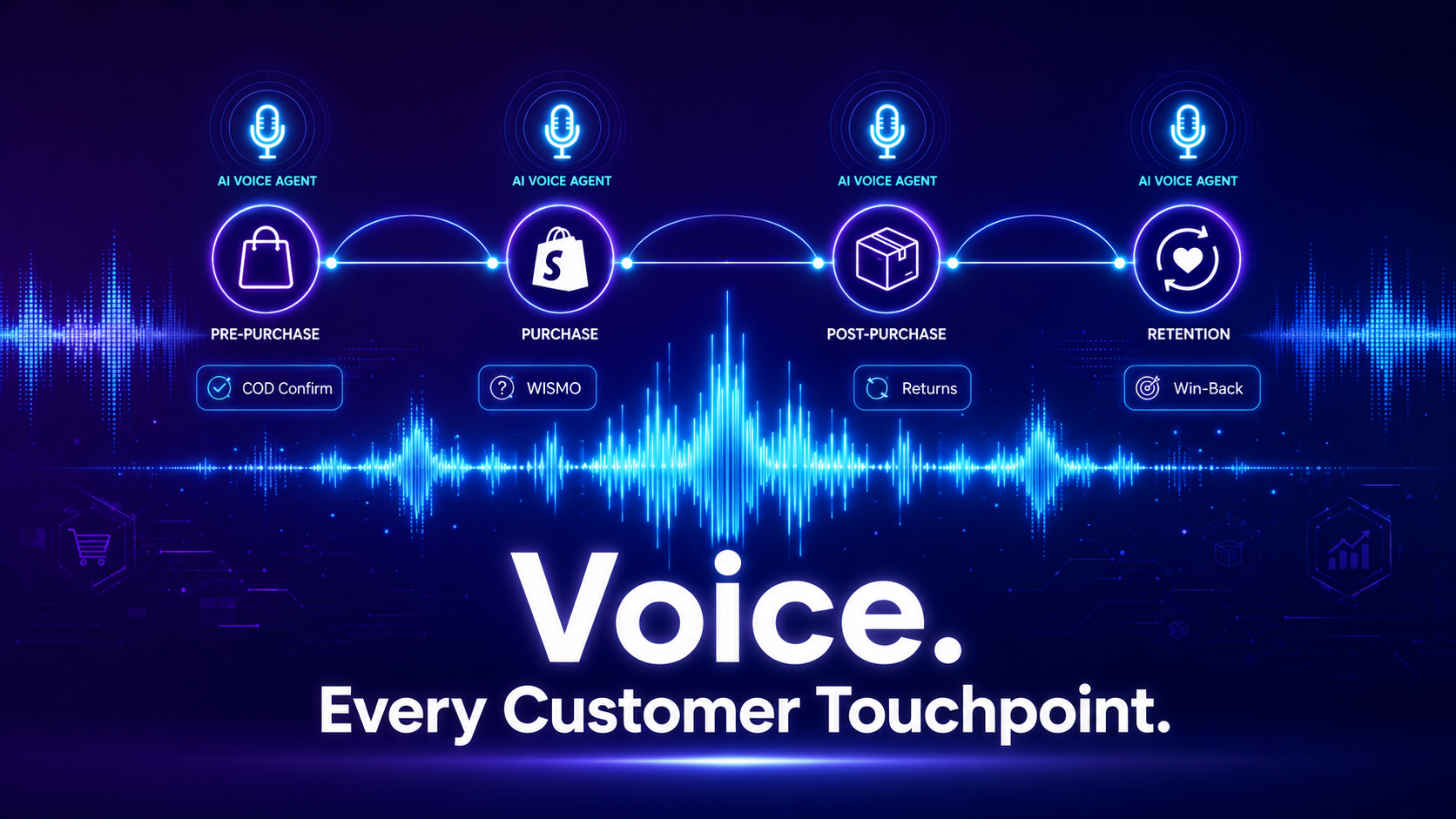
The first generation of voice AI in ecommerce was not impressive.
It was a slightly smarter IVR. Press 1 for order status. Press 2 for returns. Hold music. Transfer to agent. Resolution rate: low. Customer satisfaction: lower.
Most brands tried it, got burned, and went back to chat and email.
That was a reasonable response - at the time.
But the technology has moved substantially since then. The AI voice agents being deployed on Shopify DTC brands today are not IVR replacements. They are operationally connected, conversationally capable systems that can:
- Access live order, shipment, and customer data from Shopify in real time
- Understand natural language queries without rigid menu navigation
- Execute actual resolutions - not just collect information and transfer
- Hand off to human agents with full context when a situation requires it
- Handle thousands of concurrent calls without a queue
The ROI case has also changed.
Voice is no longer just a cost reduction play. In the right use cases, voice agents actively drive revenue - recovering abandoned calls, confirming COD orders before costly RTOs, rescuing failed payments, and winning back churned customers.
This blog maps the 9 highest-ROI use cases for AI voice agents across the full ecommerce customer journey - from pre-purchase to post-purchase to retention. For each, we cover what the voice agent does, why it creates measurable ROI, which deployment model fits, and what data connections it needs to work properly.
The Three Deployment Models
Before the use cases, define the three deployment models clearly. Every use case maps to one of these.
Autonomous Voice
The voice agent handles the full conversation and resolution end-to-end without human intervention.
Best for: High-volume, rule-rich, data-available intents where resolution logic is clear and emotional stakes are low.
Examples: Order status, delivery tracking, COD confirmation, payment reminders, standard return initiation.
Hybrid Voice
The voice agent handles the intake, context gathering, and initial response. A human agent steps in for the resolution or confirmation step - but enters the conversation fully briefed, not cold.
Best for: Situations where policy exceptions, judgment calls, or moderate emotional complexity are likely but not guaranteed.
Examples: Delivery escalations, complaint intake, complex exchange requests, retention calls for at-risk customers.
Agent Assist
The voice agent listens to a live call between a human agent and the customer. It surfaces real-time suggestions, relevant data, policy reminders, and recommended next actions to the agent on a side screen or earpiece - but does not speak to the customer.
Best for: High-value customer calls, sensitive escalations, and situations where quality and consistency matter more than speed.
Examples: VIP complaint handling, large-order disputes, brand recovery calls after a major fulfilment failure.
The Customer Journey Map
The 9 use cases are organised across four stages of the ecommerce customer journey:
| Journey stage | Use cases covered |
|---|---|
| Pre-purchase | 1. Product and availability queries |
| Purchase and fulfilment | 2. COD order confirmation, 3. Payment failure recovery |
| Post-purchase | 4. Order tracking/WISMO, 5. Delivery issue resolution, 6. Return and exchange initiation |
| Retention | 7. Abandoned call recovery, 8. Post-delivery NPS, 9. Win-back and reorder nudges |
Use Case 1: Product and Availability Queries
Journey stage: Pre-purchase · Deployment: Autonomous
A customer calls or initiates a voice interaction to ask about a product - sizing, availability, compatibility, delivery timeline, or whether a specific variant is in stock. The voice agent understands the natural language query, pulls live inventory data from Shopify in real time, answers accurately without scripted menus, and if the item is out of stock proactively offers alternatives or captures the customer on a back-in-stock alert.
Why ROI: Pre-purchase calls that go unanswered or end in a queue drop-off are lost revenue. An autonomous voice agent answering product queries 24/7 converts calls that would otherwise drop into revenue opportunities.
Data connections: Shopify product catalogue (live inventory, variants, pricing), CMS or product information for detailed specs and FAQs.
Use Case 2: COD Order Confirmation
Journey stage: Purchase and fulfilment · Deployment: Autonomous
For Shopify brands operating in markets with high COD volumes - particularly India, Southeast Asia, and parts of the Middle East - COD confirmation is one of the highest-ROI voice agent applications available today.
The voice agent calls the customer shortly after a COD order is placed and confirms the order details (item, quantity, address, amount), verifies the customer intends to accept the delivery, flags orders where the customer asks to cancel, modify, or does not pick up - before the order is packed and shipped - and tags the order in Shopify based on outcome: confirmed, cancelled, modified, or unreachable.
Why ROI: COD return-to-origin (RTO) is one of the most expensive operational problems in Indian DTC ecommerce. RTO rates of 20–40% are common in certain categories and geographies. Each RTO costs the brand outbound shipping, return shipping, re-packaging and restocking, plus the opportunity cost of inventory locked in transit. A voice agent that catches unintentional or fraudulent COD orders before fulfilment eliminates a large portion of that cost. Even a 10–15 percentage point reduction in COD RTO rate has material impact on contribution margin at scale.
Data connections: Shopify order events (new COD order webhook), Order details, Shopify order tagging, Logistics partner API (to prevent fulfilment until confirmed).
Use Case 3: Payment Failure Recovery
Journey stage: Purchase and fulfilment · Deployment: Autonomous or Hybrid
When a payment fails at checkout or on a subscription renewal, the voice agent proactively calls the customer to notify them of the failed payment in a conversational, non-alarming way; offer to retry the payment via a secure link sent over SMS or WhatsApp during the call; offer alternative payment methods if the original method fails; for subscriptions, pause rather than cancel if the customer is temporarily unable to pay.
Why ROI: Failed payment recovery is pure recovered revenue. For subscription-based Shopify brands, a failed payment that goes unrecovered is immediate churn. For one-time purchase brands, it is an abandoned cart that the customer intended to complete. Voice outreach for payment recovery consistently outperforms email-only recovery flows because it creates a real-time, human-feeling interaction that drives immediate action.
Data connections: Payment gateway webhooks, Shopify customer and order data, Secure payment link generation, SMS or WhatsApp integration.
Use Case 4: Order Tracking and WISMO
Journey stage: Post-purchase · Deployment: Autonomous
WISMO - Where Is My Order - is consistently the highest-volume inbound support intent for Shopify DTC brands, often representing 30–45% of all support contacts.
The autonomous voice agent identifies the customer by phone number or order ID, pulls live shipment data from the logistics partner API, gives the customer a precise, current status update, proactively explains delays and provides a revised ETA without the customer needing to ask, and offers rescheduling on the call if the delivery has failed.
Why ROI: At scale, WISMO calls are expensive to handle manually. Every WISMO call handled autonomously by a voice agent is a support cost eliminated without degrading the customer experience - and often improving it, because the voice agent has live data that a human agent would need to manually look up.
Data connections: Shopify order data, Logistics partner API (real-time scan events, ETA, delivery status), Delivery rescheduling API.
Use Case 5: Delivery Issue Resolution
Journey stage: Post-purchase · Deployment: Hybrid
When a delivery fails, is delayed beyond threshold, or is reported as missing or damaged, the customer contacts support in a state of moderate-to-high frustration.
The hybrid voice agent takes the inbound call, identifies the customer and order, pulls real-time logistics data to understand the current situation, and handles standard resolution paths autonomously: known delay (explain, provide updated ETA, offer compensation voucher if delay exceeds policy threshold), failed delivery (offer rescheduling or pickup point options), item not received but marked delivered (initiate investigation and set callback expectation). It escalates to a human agent for damage claims, high-value orders, or situations where the customer's sentiment indicates high escalation risk.
Why ROI: Delivery issues are the primary driver of negative reviews, refund requests, and customer churn for Shopify DTC brands. A hybrid voice agent that resolves standard delivery issues quickly - with live data and a clear recovery path - prevents the escalation to costly manual resolution and protects long-term LTV.
Data connections: Shopify order and customer data, Logistics partner API, Compensation or voucher issuance system, Helpdesk integration for escalation with full call summary.
Use Case 6: Return and Exchange Initiation
Journey stage: Post-purchase · Deployment: Autonomous
The voice agent handles standard return and exchange requests end-to-end on the call: confirms return eligibility based on order date, item category, and your return policy; walks the customer through the reason for return; initiates the return in Shopify and generates the return label; confirms refund timeline or exchange processing window; sends the return label to the customer via WhatsApp or email during or immediately after the call.
Why ROI: Returns are inevitable. The cost is in how they are handled. A poorly handled return creates a refund request, a negative review, and a lost customer. A fast, frictionless return handled autonomously on a voice call creates the opposite: a customer who trusts the brand enough to reorder. Research on post-purchase experience consistently shows easy returns are one of the strongest drivers of repeat purchase in DTC ecommerce.
Data connections: Shopify order data, Return policy rules, Logistics return label generation API, WhatsApp or email integration, Shopify order update.
Use Case 7: Abandoned Call Recovery
Journey stage: Retention · Deployment: Autonomous
When a customer calls support and drops the call before reaching an agent - either due to queue length, hold time, or simply giving up - that dropped call is a dissatisfied customer who did not get help.
The voice agent proactively calls back within a defined window after the abandoned call, with a personalised opening that acknowledges the missed connection, ready to resolve the most likely intent based on the customer's recent order activity (e.g., if they have an order in transit, the agent leads with tracking information).
Why ROI: Abandoned calls are a double cost: the customer did not get resolved, and the brand lost the opportunity to prevent whatever comes next - a chargeback, a negative review, a competitive switch. Proactive abandoned call recovery converts a frustrated non-resolution into a handled, logged, and often positive interaction. Brands running this report significant reductions in repeat contact rates and measurable improvement in CSAT for customers initially in the abandoned call pool.
Data connections: Telephony platform (missed/abandoned call detection), Shopify order and customer data, Helpdesk (to check if the issue was resolved via another channel before calling back).
Use Case 8: Post-Delivery NPS and Feedback Collection
Journey stage: Retention · Deployment: Autonomous
Two to three days after confirmed delivery, the voice agent calls the customer to confirm the order was received and in good condition, asks a single NPS-style question conversationally ("On a scale of 1 to 10, how was your experience with us?"), and routes appropriately:
- High score (9–10): invite the customer to leave a review and offer a loyalty reward or next-order incentive
- Low score (1–6): acknowledge the experience, apologise conversationally, and immediately route the feedback into a human recovery workflow - not a generic email chain
- Log the NPS score, verbatim feedback, and outcome against the order and customer record in Shopify and the CRM
Why ROI: Most Shopify brands collect NPS passively - a survey link buried in a post-purchase email that gets a 3–5% response rate from already-satisfied customers. A voice call after delivery gets response rates that are dramatically higher because it is personal, immediate, and conversational. More importantly, it catches detractors before they post a negative review. A detractor who gets a proactive recovery call within 48 hours of delivery is significantly more likely to update or withhold a negative review than one who receives a generic follow-up email three days later.
Data connections: Shopify order fulfilment events (delivered status trigger), Customer phone number and order details, CRM or Shopify customer record, Review platform integration, Helpdesk routing for low-score escalation.
Use Case 9: Win-Back and Reorder Nudges
Journey stage: Retention / reactivation · Deployment: Autonomous or Hybrid
For customers who have not reordered within a defined window after their last purchase - or who have explicitly churned - the voice agent runs a personalised outbound win-back call: opens with a reference to the customer's last order (product name, delivery date) to establish immediate relevance; shares a time-limited incentive (a discount, a bundle offer, or early access to a new product relevant to their purchase history); if the customer engages, offers to place the reorder on the call directly or sends a one-click purchase link via WhatsApp; if the customer indicates dissatisfaction with their last experience, routes to hybrid mode for a human agent to recover the relationship.
Why ROI: Reactivating a lapsed customer costs a fraction of acquiring a new one. For Shopify DTC brands in categories with natural repurchase cycles - consumables, supplements, apparel, home goods - a voice-led win-back campaign that converts even a small percentage of lapsed customers into reorders has a dramatically positive impact on revenue per marketing rupee. Voice outperforms email and SMS for win-back because it forces a real-time response.
Data connections: Shopify customer and order history, Cohort or segmentation logic, Discount or offer generation, WhatsApp or SMS integration, Helpdesk routing for hybrid escalation.
The 9 Use Cases at a Glance
| # | Use Case | Journey Stage | Deployment | Primary ROI Driver |
|---|---|---|---|---|
| 1 | Product and availability queries | Pre-purchase | Autonomous | Converts pre-purchase drop-offs into sales |
| 2 | COD order confirmation | Purchase | Autonomous | Reduces RTO and COD fraud losses |
| 3 | Payment failure recovery | Purchase | Autonomous / Hybrid | Recovers revenue from failed transactions |
| 4 | Order tracking and WISMO | Post-purchase | Autonomous | Eliminates highest-volume support cost |
| 5 | Delivery issue resolution | Post-purchase | Hybrid | Prevents churn from fulfilment failures |
| 6 | Return and exchange initiation | Post-purchase | Autonomous | Reduces return friction, drives repeat purchase |
| 7 | Abandoned call recovery | Retention | Autonomous | Converts frustrated drop-offs into resolutions |
| 8 | Post-delivery NPS and feedback | Retention | Autonomous | Catches detractors before public reviews |
| 9 | Win-back and reorder nudges | Retention / reactivation | Autonomous / Hybrid | Reactivates lapsed customers at low cost |
How to Prioritise: Where to Start With Voice Agents
Not every use case should be deployed simultaneously. The right sequence depends on your brand's specific cost structure, volume distribution, and operational maturity.
Prioritise on three factors: Volume (how frequently does this situation occur?), Cost of inaction (what does it cost when this is handled manually or not at all?), Data readiness (are the Shopify and logistics integrations already available?).
Recommended starting sequence for most Shopify DTC brands
Sprint 1 (Weeks 1–6): The high-volume, data-available wins
- Use Case 4: WISMO and order tracking
- Use Case 2: COD confirmation
- Use Case 6: Return initiation
Sprint 2 (Weeks 6–12): The revenue recovery layer
- Use Case 3: Payment failure recovery
- Use Case 7: Abandoned call recovery
- Use Case 8: Post-delivery NPS
Sprint 3 (Week 12+): The retention and growth layer
- Use Case 9: Win-back and reorder nudges
- Use Case 5: Delivery issue resolution (hybrid mode)
- Use Case 1: Pre-purchase product queries
This sequencing ensures you prove ROI early, build operational confidence, and expand from cost reduction into revenue generation systematically.
Where InovaBeing Sits in This Landscape
Most voice AI vendors sell a voice model. InovaBeing builds the operational layer that makes the voice model useful.
The difference is meaningful.
A voice model can understand language and generate a response. But it cannot tell a customer their exact order status unless it is connected to Shopify in real time. It cannot confirm a COD order and update Shopify tags and prevent fulfilment until it has live order data and write-back access. It cannot route a low-NPS caller to a human recovery agent unless it is connected to the helpdesk and the decision layer.
InovaBeing builds the integration infrastructure, the decision layer, and the operational intelligence that sits between the voice model and the live Shopify stack. That is why our voice agent deployments resolve accurately and consistently - not just conversationally.
The three deployment models - Autonomous, Hybrid, and Agent Assist - all run on the same operational intelligence layer. The voice interaction is the front end. The decision layer, the Shopify integration, and the real-time context fetcher are the engine.
Conclusion: Voice Is Not a Channel. It Is an Operations Layer.
The brands that will win with voice AI are not the ones who "add a voice bot" to their support stack.
They are the ones who treat voice as an operational layer - connected to live data, mapped to specific use cases, and integrated into the decision layer that runs their post-purchase and retention operations.
Nine use cases. Three deployment models. One operational intelligence layer underneath. That is the architecture of a voice-led DTC operation in 2026.
Ready to deploy your first voice agent use case? In 60 minutes, InovaBeing will map your current inbound call and support volume by intent, identify your top 2–3 voice agent use cases by ROI potential, show you what the integration looks like on your Shopify stack, and give you a Sprint 1 deployment plan with clear success metrics. Book a Voice Agent Use Case Workshop.