
The Tool Sprawl Problem Every Scaling DTC Brand Recognises
Picture a Monday morning for the operations lead of a mid-size Indian Shopify D2C brand doing ₹3–5 crore in monthly revenue.
They open their laptop. Twelve browser tabs.
- Shopify admin - to check order volume and fulfilment status
- Gorgias or Freshdesk - to review the overnight support ticket queue
- ShipRocket or Delhivery dashboard - to check carrier performance and pending dispatches
- WhatsApp Business - to handle customer escalations
- Klaviyo or Mailchimp - to check email campaign performance from last night
- Google Analytics - to review traffic and conversion from yesterday
- A warehouse management spreadsheet - to track stock levels
- Tally or Zoho Books - to cross-reference invoice data
- A returns management tool - to check pending return requests
- A vendor portal - if they run a multi-brand or marketplace model
- Their phone - for WhatsApp threads with the warehouse team
- A Slack or internal chat - for cross-team communication
Every one of these tools has data. None of them talk to each other in real time. Every decision this operations lead makes requires manually pulling context from multiple tabs, reconciling inconsistencies between systems, and making a call with incomplete information.
This is not a people problem. This is an architecture problem.
And it is costing every scaling DTC brand on Shopify in three ways that compound quietly:
- Decision latency - by the time the right data is assembled, the moment for the best decision has passed
- Data inconsistency - when inventory in Shopify does not match the warehouse spreadsheet, which does not match the ERP, wrong decisions get made with confidence
- Revenue leakage - customer queries that fall between systems go unanswered, orders that should trigger automations do not, and retention opportunities that depend on connected data never fire
The fix is not more tools. The fix is one decision layer that connects all of them.
Why Disconnected Systems Are a Structural Revenue Problem
The cost of data silos in ecommerce operations is not abstract. It shows up in measurable, trackable revenue and operational losses:
- WISMO queries account for up to 35% of all support volume - and the primary reason agents cannot resolve them instantly is that order data lives in Shopify, carrier data lives in a separate logistics dashboard, and the helpdesk cannot access either without switching tabs
- Inventory inaccuracies caused by disconnected ERP and Shopify data result in overselling, stockout surprises, and delayed fulfilment - each one a direct retention risk
- Post-purchase automation that depends on delivery confirmation fails when the carrier API is not connected to the marketing automation platform - so the sequence fires on a timer instead of a real event, arriving days early or days late
- Support agents who cannot see order history, return status, and communication history in one view take longer to resolve tickets and make more errors - directly impacting CSAT and repeat purchase probability
- Sellers on 2+ integrated platforms generate 17.5x the GMV of single-channel sellers - the integration advantage is not marginal
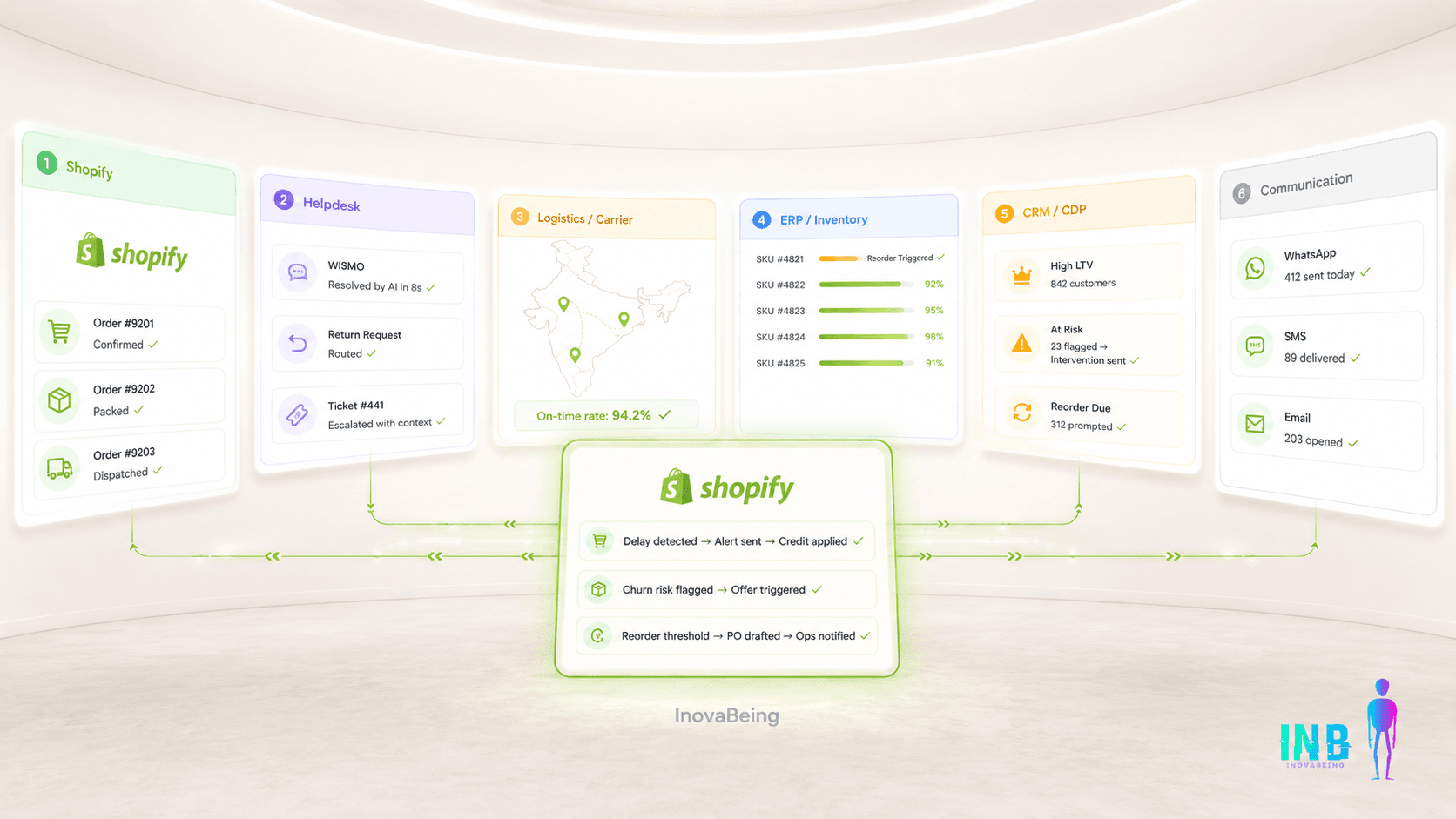
The dominant pattern for mid-market Shopify brands in 2026 is a hub-and-spoke architecture via middleware - connecting Shopify and all backend systems through a central integration layer that owns the mapping, transformation, and data flow between them.
The question is not whether to build this architecture. Every brand beyond a certain scale needs it. The question is how to build it intelligently - so the unified data layer does not just pass information between systems, but actively generates decisions and actions from it.
The 6 Systems That Must Be Connected
System 1: Shopify (Commerce Operating Layer)
Shopify is the centre of gravity - the system of record for orders, customers, products, inventory levels, and checkout data.
What Shopify generates that the rest of the stack needs:
- Real-time order creation events (
orders/create) - Inventory level updates (
inventory_levels/update) - Customer data and full purchase history
- Fulfilment status updates
- Return and refund events
- Payment and transaction data
Shopify's Admin API (GraphQL - the recommended standard in 2026) and its webhook system are the primary integration surface. Every downstream system should listen to Shopify webhooks for real-time event triggers - not poll on a schedule.
System 2: Helpdesk / Support Platform
Your helpdesk - Gorgias, Freshdesk, Zendesk, or a custom setup - is where customer relationships are managed at scale.
The critical integration requirement: the helpdesk must pull complete Shopify order context - order history, fulfilment status, return status, previous interactions - directly into every ticket view. An agent who has to leave the helpdesk to check Shopify is operating at half speed.
Modern ecommerce helpdesks like Gorgias are purpose-built for this - pulling complete order history and customer data directly into tickets, enabling agents to modify orders, issue refunds, and track shipments without leaving the platform.
System 3: Logistics / Carrier Platform
Your logistics layer - ShipRocket, Delhivery, or a direct carrier API - is where physical fulfilment happens.
The critical integration requirement: carrier tracking data must flow in real time into both Shopify and the helpdesk so support agents can see live carrier status without switching tools. The majority of WISMO queries are unanswerable at first contact precisely because this connection does not exist.
What the logistics layer generates that the rest of the stack needs:
- Real-time shipment status events (picked up, in transit, out for delivery, delivered, failed delivery)
- Carrier performance data by route, region, and time period
- Delivery success rates and average delivery time by pin code
- Failed delivery and RTO rates - a critical indicator of address quality and COD fraud
System 4: ERP / Inventory Management
For brands beyond early stage, an ERP or dedicated inventory management system - Zoho Inventory, Unicommerce, NetSuite, SAP, or a structured custom system - is the system of record for actual inventory levels, purchase orders, supplier data, and financial reconciliation.
The Shopify–ERP sync is the most critical and most commonly broken integration in the DTC tech stack. When Shopify shows a product as "In Stock" but the ERP shows zero units - because the sync runs on a 4-hour batch schedule - the resulting oversells and customer disappointment are entirely preventable.
The recommended pattern in 2026 is bidirectional real-time sync via webhooks: Shopify pushes order events to the ERP, and the ERP pushes inventory updates back to Shopify.
System 5: CRM / Customer Data Platform
Your CRM or CDP - Klaviyo, HubSpot, a dedicated CDP, or a custom customer data layer - holds the longitudinal view of every customer: full purchase history, communication preferences, lifecycle stage, LTV trajectory, and engagement history.
The critical integration requirement: customer data must be enriched in real time by every interaction across every system. A customer who contacts support should have that interaction reflected in their CRM profile immediately - so the next post-purchase email does not ignore the fact that they just filed a return.
System 6: Communication Platform
Your communication layer - WhatsApp Business API, SMS gateway, email platform, and push notification system - is the execution surface for every customer-facing action the decision layer generates.
The critical integration requirement: the communication platform must receive triggers based on real events, not fixed timers. A delivery confirmation message that fires because the carrier API confirmed delivery is categorically more effective than one that fires 48 hours after an estimated delivery date.
The Architecture: How One Decision Layer Connects All Six
The goal is not to make all six systems talk to each other in a mesh of point-to-point integrations. That creates a fragile, unmaintainable web where every system change breaks multiple connections.
The correct architecture is hub-and-spoke - with an AI-powered decision layer at the centre.
[Shopify]                ─┐
[Helpdesk / Support]     ─┤
[Logistics / Carrier API]─┼─► [UNIFIED DATA PIPELINE] ─► [AI DECISION LAYER] ─► [ACTION WORKFLOWS]
[ERP / Inventory]        ─┤
[CRM / CDP]              ─┤
[Communication Platform] ─┘
Each system connects to the central pipeline - not to each other. The pipeline normalises and unifies the data. The AI decision layer reads the unified data and generates decisions. The action workflows execute those decisions back through the appropriate system.
Layer 1: The Unified Data Pipeline
The pipeline is the integration middleware that connects all six systems and normalises their data into a single canonical model.
In 2026, the dominant implementation patterns are:
iPaaS (Integration Platform as a Service) - tools like Celigo, Boomi, Workato, MuleSoft, or open-source n8n. These platforms own the mapping, transformation, retry logic, and observability for every data flow.
Event-driven architecture - Shopify webhooks publish events (orders/create, inventory_levels/update, fulfillments/create) into a message broker (Kafka, AWS EventBridge, Google Pub/Sub). Downstream services consume independently. More engineering-intensive but the highest-performance pattern at scale.
The canonical data model is the most important design decision. Before connecting any systems, define a neutral schema - a standard definition of what an Order, Customer, InventoryRecord, SupportTicket, and ShipmentEvent look like in your unified layer. Both Shopify and every backend system map into this model. This prevents either system from dictating the shape of your data.
Layer 2: The AI Decision Layer
The decision layer sits on top of the unified data pipeline. It reads the unified data stream and applies intelligence to generate decisions and trigger actions.
The decision layer answers questions no individual system can answer alone:
Scenario A: An order has been in "In Transit" for 36 hours with no carrier scan update. The customer is a high-LTV segment buyer. The carrier route has a 23% elevated delay rate this week. → Decision: Proactively send a delay alert with a revised ETA and a ₹100 store credit. Do not wait for the customer to contact support.
Scenario B: A customer just received their third order from a specific SKU category. Their purchase interval is 28 days. Today is day 25. → Decision: Trigger a personalised reorder prompt via WhatsApp with a one-tap reorder link.
Scenario C: A support ticket has been open 4 hours with no response. The customer has LTV above ₹15,000. The issue is a delivery marked delivered by carrier but not received by customer. → Decision: Escalate immediately to a human agent, pre-load the full order and carrier history into the ticket, send an interim acknowledgement to the customer.
Scenario D: Inventory for SKU #4821 in the ERP just fell below the reorder threshold. Lead time from supplier is 12 days. Current sell-through projects a stockout in 9 days. → Decision: Trigger a purchase order recommendation to procurement and update the Shopify storefront to show a low stock warning.
None of these decisions are possible if the systems are disconnected. Every one of them is automatic if the unified decision layer is in place.
Layer 3: Action Workflows
| Decision Type | Execution System | Workflow |
|---|---|---|
| Customer delay alert | Communication Platform | WhatsApp/SMS with carrier data + revised ETA |
| Reorder prompt | Communication Platform | Personalised WhatsApp with one-tap reorder link |
| Support escalation | Helpdesk | Priority update + agent assignment + pre-loaded context |
| Inventory reorder | ERP | Purchase order draft + procurement team alert |
| Post-delivery sequence | Communication + CRM | Event-triggered personalised message sequence |
| Churn risk intervention | CRM + Communication | Segmented retention offer based on LTV tier |
| Carrier performance alert | Operations Dashboard | Route-level alert to ops lead |
| Return processing | Shopify + ERP + Communication | Initiation + routing + customer update |
Every workflow is triggered by a real event from the unified data pipeline - not by a manual action or a scheduled batch process.
The Implementation Roadmap: Four Phases
Phase 1: Data Audit and Canonical Model Definition (Weeks 1–2)
Deliverables:
- Complete inventory of every tool in your current stack - what data it holds, what events it generates, what it currently connects to
- Identification of every manual data transfer happening today - spreadsheet exports, copy-paste between tabs, manual Shopify lookups in the helpdesk
- Definition of your canonical data model - neutral schema for Order, Customer, Product, InventoryRecord, SupportTicket, ShipmentEvent
- Prioritised list of integration gaps by revenue impact
The most common finding at this stage: the Shopify-to-logistics disconnect is responsible for 60–70% of preventable support volume. Fix this first.
Phase 2: Core Integration - Shopify + Logistics + Helpdesk (Weeks 3–5)
This is the highest-impact integration trio and the fastest path to measurable ROI.
What gets connected:
- Shopify Admin API → Helpdesk: full order history, fulfilment status, return status visible inside every support ticket without tab switching
- Carrier/logistics API → Shopify: real-time shipment status updating Shopify order fulfilment records
- Carrier/logistics API → Helpdesk: live carrier status inside support tickets without leaving the platform
- Shopify webhook events → Communication Platform: real-time order confirmations and fulfilment notifications triggered by actual events, not timers
Measurable outcomes within 30 days:
- WISMO first-contact resolution improves significantly
- Proactive delay alerts go live before customers ask
- Post-purchase sequences fire on real delivery events
Phase 3: ERP and Inventory Sync (Weeks 6–8)
What gets connected:
- ERP inventory levels → Shopify storefront: bidirectional real-time sync via webhook, eliminating the batch-update lag that causes oversells
- Shopify order events → ERP: every order immediately reflected for financial reconciliation and inventory deduction
- ERP purchase order data → Decision Layer: supplier lead times and incoming stock feeds the demand forecast model
- Returns data → ERP: refund events reconciled automatically, no manual entry required
Measurable outcomes: oversell incidents drop to near zero, inventory accuracy improves across all systems, finance reconciliation time drops - no more end-of-week manual export-and-match.
Phase 4: AI Decision Layer and Full Automation (Weeks 9–12)
What goes live:
- Demand forecasting model trained on unified order, inventory, and supplier data
- Customer behaviour model for LTV segmentation, churn risk scoring, and reorder prediction
- Fulfilment performance model for carrier-route risk scoring and proactive delay intervention
- Support intelligence model for ticket categorisation, root-cause identification, and escalation routing
- Full post-purchase automation: personalised, event-triggered sequences across WhatsApp, SMS, email
- Operations dashboard: real-time unified view of all KPIs across all systems in one place
By the end of Phase 4, a decision that previously required an operations lead to spend 20 minutes across 12 browser tabs takes 0 seconds - the AI decision layer has already made it and executed the workflow.
Common Integration Mistakes That Destroy Value
Mistake 1: Point-to-Point Instead of Hub-and-Spoke
Connecting Shopify directly to the helpdesk, the helpdesk to logistics, logistics to the ERP creates a fragile mesh. Every API update breaks multiple integrations at once.
The fix: all systems connect to the central pipeline only. New tools plug into the pipeline, not each other.
Mistake 2: Batch Sync Instead of Real-Time Events
Running inventory sync on a 4-hour schedule means your Shopify storefront is stale for up to 4 hours after every sale. At 50+ orders per day this creates daily oversells.
The fix: use webhooks for real-time event triggers wherever the system supports them. Batch sync is for reconciliation and audit only - never the primary mechanism for operational data.
Mistake 3: No Canonical Data Model
When Shopify calls a field order_id, the ERP calls it transaction_reference, and the helpdesk calls it ticket_order_number - every integration needs a custom field mapping. When any system updates, every mapping breaks.
The fix: define the canonical model first. A neutral schema every system maps into, before a single line of integration code is written.
Mistake 4: Intelligence Without Action Workflows
Many brands build the integration layer, get a unified data view, and stop. The dashboard shows the data. Humans still make and execute every decision manually.
The fix: unified data is fully valuable only when the AI decision layer acts on it automatically. The integration layer is the foundation. The AI workflows are the engine. Without both, you have expensive infrastructure requiring manual operation.
Before and After: A Real Shopify Brand
Before: The 12-Tab Monday Morning
| Task | Time | Systems Touched | Error Risk |
|---|---|---|---|
| Check overnight orders | 8 min | Shopify + logistics | Medium |
| Review WISMO tickets | 15 min | Helpdesk + Shopify + logistics | High |
| Check inventory | 12 min | Shopify + ERP spreadsheet | High |
| Review carrier performance | 10 min | Logistics dashboard only | Medium |
| Post-purchase comms | Ad hoc, manual | Klaviyo + Shopify | High |
| Total | 45+ min | 6+ systems | High throughout |
After: The Unified Decision Layer
| Task | Time | How It Works | Error Risk |
|---|---|---|---|
| Overnight orders | 0 min | AI flagged anomalies automatically | Near zero |
| WISMO tickets | 2 min | AI resolved; escalations pre-loaded | Near zero |
| Inventory check | 0 min | Real-time sync; reorders auto-triggered | Near zero |
| Carrier performance | 0 min | Decision layer monitors; alerts proactive | Near zero |
| Post-purchase comms | 0 min | Event-triggered on delivery confirmation | Near zero |
| Total | 2 min | One dashboard | Near zero |
The 45 minutes recovered every morning is 195 hours per year - nearly 5 full working weeks - returned to the operations lead for decisions requiring human judgment.
How InovaBeing Builds This for Shopify DTC Brands
The unified decision layer is the core of what we deploy for every Shopify DTC client. We do not sell individual integrations. We build the full architecture.
- System Audit and Canonical Model - We map your current stack, identify every data silo, quantify the revenue cost of each disconnection, and define your canonical data model before writing a line of code.
- Core Integration Pipeline - We connect your Shopify store, helpdesk, logistics/carrier APIs, and communication platform through a central pipeline using real-time webhooks.
- ERP and Inventory Sync - Bidirectional real-time Shopify–ERP sync that eliminates inventory inaccuracies and automates financial reconciliation. Pre-built connectors for Zoho Inventory, Unicommerce, Tally, and custom systems.
- AI Decision Layer - Demand forecasting, customer behaviour, fulfilment performance, and support intelligence models deployed across the unified pipeline. Trained on your data, not generic benchmarks.
- Action Workflows - Automated workflows executing AI decisions through the right system - zero manual intervention required.
- Operations Dashboard - A single real-time dashboard surfacing every KPI that matters in one view.
Full deployment: 8–12 weeks. No platform migration. No enterprise contract. Built for Shopify DTC brands at ₹1 crore to ₹50 crore monthly revenue.
Conclusion: One Decision Layer Is the Difference Between Reacting and Leading
The 12-tab operations morning is not an inconvenience. It is a structural competitive disadvantage.
Every minute spent assembling data manually is a minute not spent on decisions that compound. Every decision made with incomplete or out-of-date information has a downstream cost - in customer experience, inventory efficiency, support quality, and retention.
The brands that build a unified decision layer in 2026 are not just operating more efficiently. They are creating a structural intelligence advantage over every competitor still running disconnected systems - an advantage that deepens every month as the AI models train on richer, more connected data.
Your systems already generate the data. The question is whether that data is connected, unified, and acted upon - or sitting in 12 separate tabs waiting for a human to manually assemble it into a decision.
The decision layer is the bridge between the data you already have and the operational intelligence that compounds into a moat.
Ready to audit your current stack and identify where disconnections are costing you revenue? Book a Technology Diagnostic with INovaBeing.