Every Shopify brand has a post-purchase strategy. Order confirmation emails go out. Tracking links get sent. Maybe there is a WhatsApp flow or an SMS sequence.
But most of the time, those communications are built on a fundamental lie.
Not an intentional one. A structural one. The message says "your order is on its way" - but the ops team does not actually know if it is. The tracking link fires because the order was marked fulfilled, not because it physically left the warehouse. The support agent says "it's in transit" because that is what the system shows, even though the package has not moved in 36 hours.
This is the real post-purchase problem. Not the communication. The operational truth underneath it.
We have already written about post-purchase experience as a hidden conversion lever - the stats, the customer expectation gap, the compounding effect of getting it right. That piece focuses on what great post-purchase communication looks like and why it drives repeat purchase.
This blog goes one layer deeper: why post-purchase communication fails at the source, and why the fix is not a better email sequence - it is operational visibility.
What "Where Is My Order?" Is Actually Telling You
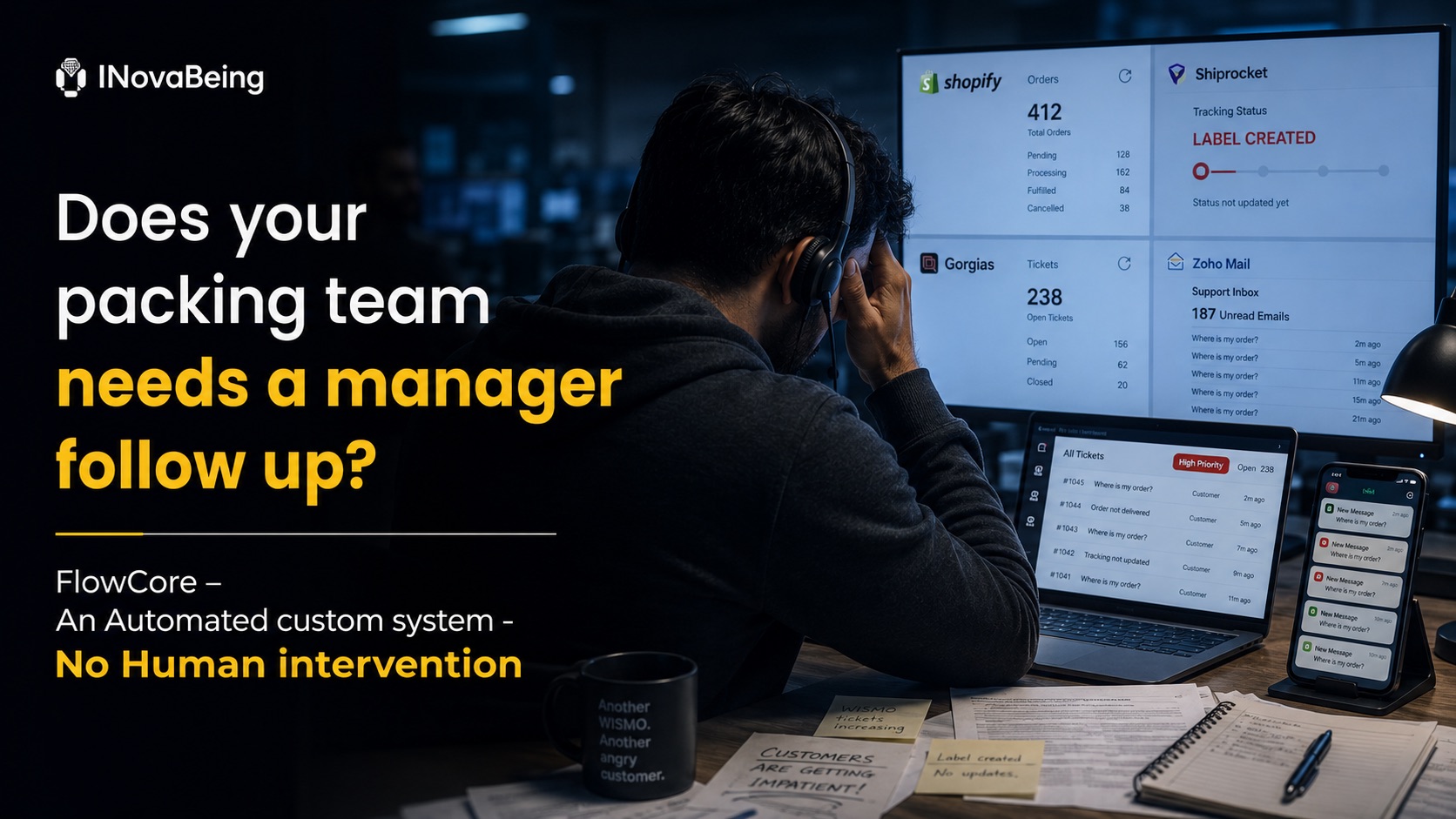
WISMO is widely treated as a support metric. Ticket volume. Response time. Resolution rate. These are the numbers most brands track.
But WISMO is not primarily a support problem. It is an operational signal.
When a customer asks where their order is, one of the following is usually true:
- The order was marked fulfilled before it physically shipped.
- The tracking status has not updated and nobody internally knows why.
- There was an exception - a stock issue, a warehouse delay, a carrier hold - that was never surfaced outside of ops.
- The customer was given a standard delivery window that was never adjusted when fulfillment ran late.
In every one of these cases, the customer did not fail. The communication did not fail. The operational data layer failed. The system had no clean, real-time picture of what actually happened between order placement and delivery, so it could not communicate anything accurate.
Support teams working from incomplete operational truth do one of two things: they guess, or they stall. Guessing produces wrong reassurances that damage trust further when they turn out to be false. Stalling produces "we are checking on this" responses that frustrate customers who already know something is wrong.
Neither outcome is a support failure. Both are downstream effects of ops running without a unified operational timeline.
The Gap Between Fulfillment Status and Operational Reality
Most Shopify brands operate with a significant gap between what their systems report and what is actually happening in fulfilment.
Shopify shows three meaningful statuses for most orders: unfulfilled, fulfilled, and partially fulfilled. That is not a criticism of Shopify - it is the commerce layer, not the operations layer. But it means that everything happening between those two states is essentially invisible to anyone outside the warehouse.
What actually happens between "order placed" and "fulfilled" in a real fulfilment operation:
- Order received and queued for picking.
- Pick list generated and assigned.
- Items picked - with possible exceptions if stock does not match.
- Items packed - with possible holds for damaged goods or address issues.
- Shipping label generated - which is when most systems fire "fulfilled."
- Physical handover to carrier - which may happen hours or a day after label generation.
- Carrier scan and first tracking event - which is when tracking actually becomes real.
Shopify marks an order as fulfilled at label generation. The customer gets a tracking link. But the package may not physically move for another 12 to 24 hours. The tracking link shows nothing. The customer checks it and panics.
This is not a communication design problem. The email went out exactly as designed. The problem is that the trigger point - label generated - does not reflect operational reality, and nobody in the system knows what is actually happening until a carrier scan appears.
Brands with multiple warehouses or 3PLs have this problem at a larger scale. Each location has its own processing rhythm, its own handover timing, its own exception patterns. Without a unified operational timeline sitting across all of them, every piece of post-purchase communication is working from guesswork.
Why Support Cannot Fix What Ops Has Not Surfaced
When a WISMO ticket lands in a support queue, the agent opens the order and sees what the system shows. In most cases they see:
- Order status: fulfilled
- Tracking number: present
- Carrier status: label created or in transit
They do not see:
- Whether the order was actually picked and packed or just labelled
- Whether there was a stock exception that caused a partial hold
- Whether the warehouse has a processing backlog today
- Whether the carrier has flagged the shipment for any reason
- Whether an internal ops note exists about this order
So the agent does what they can. They copy the tracking link. They tell the customer to wait 24 to 48 hours. They close the ticket.
The customer checks again tomorrow. Nothing has changed. A second ticket comes in. This time they want a refund.
Guides on ecommerce support operations consistently highlight the same root cause: support agents in high-WISMO environments are not inefficient - they are working without the operational context they need to actually resolve tickets. The fix is not better training or faster response times. It is giving support a real operational view of each order's journey.
The same is true for AI agents. An AI that can only see what a human agent sees will produce the same quality of answers a human agent produces. AI WISMO resolution is not better than human WISMO resolution when both are working from the same incomplete operational data. The intelligence layer only becomes useful when the data layer is honest.
Post-Purchase as an Operations Accountability System
Here is the reframe that changes everything about how a Shopify brand should think about post-purchase.
Post-purchase communication is not just a CX output. It is an operational accountability system in disguise.
When every stage of fulfilment - pick, pack, handover, carrier scan, exception - is tracked with a real timestamp and owner, two things become possible that were not possible before:
1. Communication becomes accurate instead of assumed.
The system knows when the order was physically handed to the carrier, not just when the label was generated. It knows if an exception occurred and was resolved. It knows the realistic delivery window based on actual carrier data, not the generic estimate set at checkout. Every customer-facing communication can now say something true instead of something approximate.
2. Operational failures become visible and measurable.
When fulfilment timelines are tracked in detail, the business can see: average time from order to pick, average time from pick to carrier handover, exception rate by warehouse, and which part of the process is causing the most post-purchase communication failures. These are not abstract operational metrics. They are direct predictors of WISMO ticket volume, refund rate, and repeat purchase rate.
That second point is where post-purchase stops being a support cost and starts being a growth lever - not because the emails get better, but because the operations producing those emails become transparent, measurable, and improvable.
The Three Post-Purchase Failures That Are Always Ops Problems
1. The phantom fulfilment. Order is marked fulfilled. Tracking link sent. Package has not physically left the building. Customer checks tracking repeatedly. Ticket arrives 48 hours later. Agent has no context. Refund issued while the order is still in the warehouse.
Root cause: label generation was used as the fulfilment trigger. Operational handover was never tracked.
2. The silent exception. An item in a multi-SKU order is out of stock. The warehouse holds the entire order, waiting for a decision. No communication goes to the customer. No internal escalation is triggered. The order sits. Three days later, an angry customer calls. Support sees "unfulfilled" and has no explanation.
Root cause: exceptions have no surfacing mechanism. They live inside ops and never reach the systems that talk to customers or support.
3. The generic delay. Carrier picks up the package but something goes wrong - lost scan, regional delay, weather hold. The tracking page shows "in transit" and nothing more for five days. No proactive outreach goes to the customer because nobody internally knows there is a problem.
Root cause: carrier monitoring is passive. The business only discovers a delivery issue when the customer reports it, not before.
All three of these failures share the same structure: an operational event occurred, was not captured or surfaced, and the customer found out before anyone inside the business did. Post-purchase communication cannot solve that. Only operational visibility can.
What Changes When Ops Has a Unified Timeline
When a brand moves from fragmented fulfilment tracking to a single operational timeline per order - one that captures every stage from placement to delivery with real timestamps and exception flags - three things shift in the post-purchase experience:
Communication becomes proactive, not reactive. The system knows when a delay is forming before the customer asks. It can trigger an honest, early update that manages expectation rather than a defensive response that arrives after frustration.
Support becomes precise, not approximate. When a ticket arrives, the agent - human or AI - can see the full operational journey of that order. Not just "fulfilled." Pick time, pack time, handover time, carrier events, exception notes. They can give a specific, accurate answer in the first response and close the ticket without a follow-up.
Operations becomes accountable, not invisible. When fulfilment stages are tracked, they can be measured. Average pick-to-ship time. Exception rate. Carrier handover lag. These numbers connect directly to post-purchase ticket volume, refund rate, and repeat purchase behaviour. Leadership can now see the operational levers that move post-purchase outcomes - and invest in improving the ones that matter most.
Recognising the Pattern in Your Own Brand
If your post-purchase experience is underperforming, the most important diagnostic question is not "are our emails good enough?" It is: does the system have accurate operational data to send those emails from?
Signals that suggest the ops data layer is the real problem:
- Tracking links regularly send customers to pages showing "label created" for more than 24 hours.
- Support agents routinely copy tracking links as the primary response to WISMO tickets.
- Exceptions - stock holds, split shipments, warehouse delays - are resolved inside ops but never communicated to the customer.
- Post-purchase communication flows are triggered by Shopify status changes, not by real operational events.
- Your team discovers carrier delays from customer tickets, not from internal monitoring.
If three or more of these are true, the post-purchase experience problem is not a CX design problem. It is an operational infrastructure problem. And it will not be fixed by a better email sequence, a new tracking page, or more support headcount.
Conclusion
Post-purchase experience is an operations output, not a marketing output. The fulfilment timeline - pick, pack, exception handling, physical handover, carrier monitoring - has to be tracked as a structured, real-time operational record per order before any communication built on top of it can be honest.
That record becomes the single source of truth for every post-purchase touchpoint: what the customer is told, what the support agent sees, what the AI agent responds with, and what leadership measures when they want to understand why post-purchase performance is improving or deteriorating.
Post-purchase stops being a guessing game and becomes an accountable, measurable part of the operations system.
If your Shopify brand is buried in WISMO and your support team is fighting a losing battle with incomplete ops data, book an AI Ops Audit. We will map the specific operational visibility gaps producing your post-purchase failures, and what a unified operational timeline would change.