
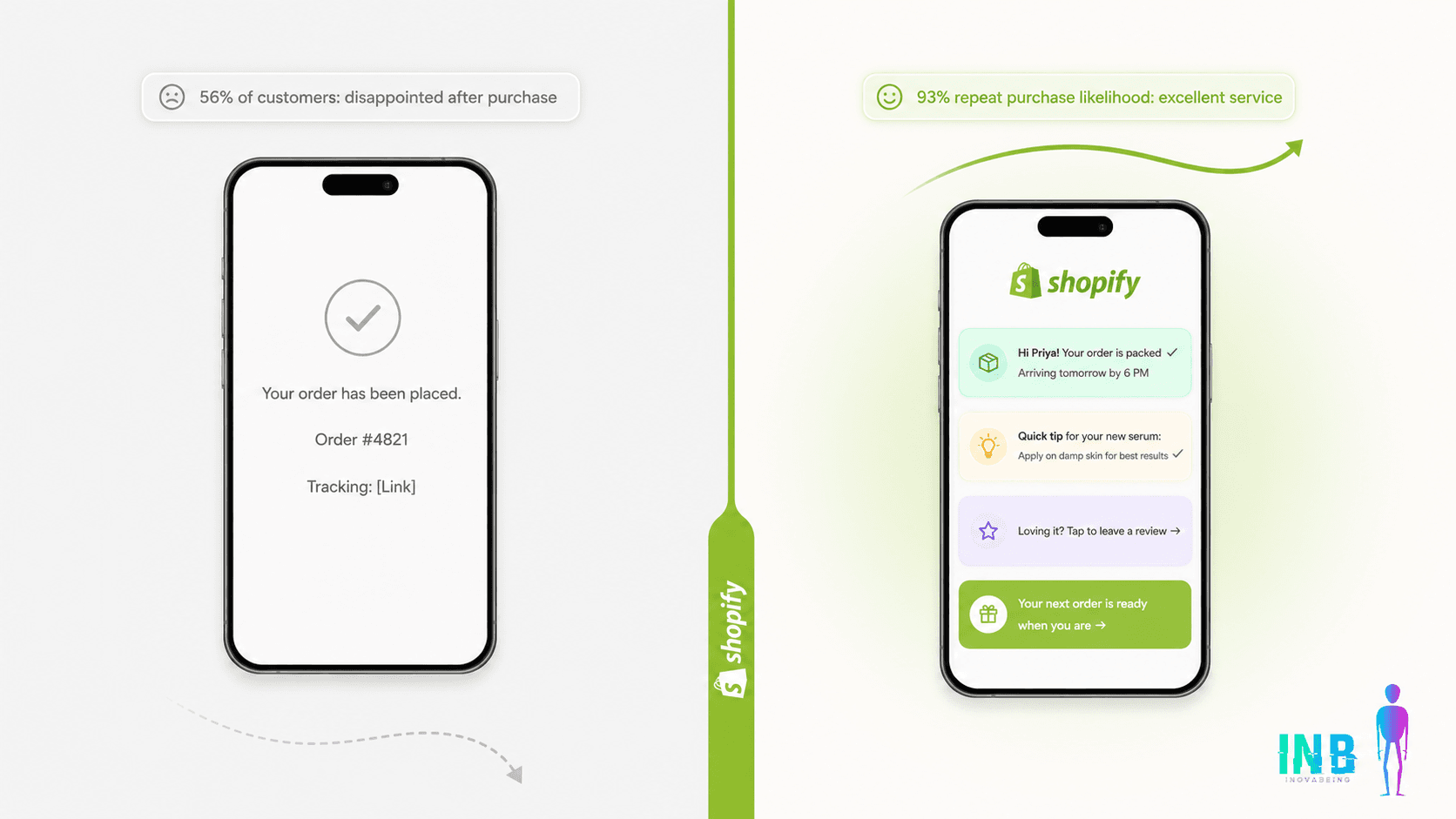
The Conversion Problem Nobody Talks About
Every Shopify founder obsesses over the same funnel.
Traffic → Product Page → Add to Cart → Checkout → Purchase.
They run A/B tests on headlines. They optimise checkout flows. They reduce cart abandonment with email sequences. They chase the 2.5% to 3% Shopify average conversion rate and celebrate when they inch past it.
And then the customer buys. The funnel ends. The obsession stops.
That is the mistake.
Because the moment a customer completes a purchase is not the end of the conversion journey. It is the beginning of the most valuable conversion you will ever make - turning a one-time buyer into a repeat customer.
And here is the data that makes this urgent:
- 56% of customers say they are disappointed with their post-purchase experience
- Only 17% of consumers feel that businesses actually care about what happens after they buy
- First-time buyers receiving personalised post-purchase communications show 45% higher second-purchase rates
- 56% of shoppers become repeat buyers following personalised experiences
- 93% of customers are likely to make repeat purchases from companies that offer excellent post-purchase service
Do the math on those numbers. Over half your customers are disappointed after they buy. Less than one in five feel you care about them post-purchase. And yet personalised post-purchase communication nearly doubles the probability of a second sale.
The gap between those two data points - the disappointment and the opportunity - is the hidden conversion lever.
Most brands are sitting on it. The ones who activate it are compounding revenue without spending a rupee more on acquisition.
Why "Post-Purchase" Is Still a Conversion Event
The traditional conversion funnel ends at checkout. This framing is both outdated and expensive.
Here is the correct way to think about it:
Pre-purchase conversion = turning a visitor into a buyer (costs you CAC every single time)
Post-purchase conversion = turning a buyer into a repeat buyer (costs you a fraction of CAC, converts at 60–70% vs. 1–2% for new visitors)
The second conversion is dramatically cheaper, dramatically more likely to succeed, and dramatically more valuable over time - because repeat customers spend 25% more per order and 140% more over their lifetime than customers who only buy once.
Yet most Shopify brands invest 90% of their CRO budget on pre-purchase optimisation and almost nothing on post-purchase experience.
This is not a marketing problem. It is a prioritisation problem. And it creates a window of opportunity for the brands that get this right - because your competitors are almost certainly in that 56% who are disappointing their customers after purchase.
The 5 Post-Purchase Moments That Drive (or Kill) Conversion
Post-purchase experience is not one event. It is a sequence of moments - each one a micro-conversion opportunity. Miss them and you lose the customer. Nail them and you compound lifetime value with every order cycle.
Moment 1: The Order Confirmation (0–5 Minutes After Purchase)
This is the highest-open-rate communication you will ever send. Confirmation emails have open rates above 70% - compared to 20–25% for standard marketing emails.
What most brands send: a transactional receipt with an order number and a tracking link placeholder.
What the best brands send: a personalised confirmation that acknowledges the specific product, sets a clear delivery expectation, introduces the brand story in one line, and plants the seed for the next interaction.
The micro-conversion here: building enough trust and warmth in the first 5 minutes that the customer is already looking forward to their next interaction with your brand - before the product has even shipped.
Moment 2: The Shipping and Tracking Window (Day 1–3)
This is the highest-anxiety window in the customer lifecycle. The purchase is made. The money is gone. The product is not there yet. Every hour of silence is a tiny erosion of confidence.
Brands that proactively send tracking updates - without the customer having to ask - eliminate this anxiety entirely. Brands that go silent create it.
The micro-conversion here: proactive communication during this window increases brand trust scores by a measurable margin and directly reduces the WISMO support load that otherwise consumes your team's time.
Moment 3: The Delivery Confirmation (Within 2 Hours of Delivery)
This is the highest-satisfaction moment in the customer lifecycle. The product has just arrived. Excitement is at peak. The customer is literally holding your brand in their hands.
Most brands miss this window entirely - they send a delayed "Hope you love your order!" email 24–48 hours after delivery, when the excitement has faded.
The micro-conversion here: a timely, personalised delivery confirmation message - triggered by carrier confirmation, not a fixed timer - that includes a usage tip, a review invite, or a complementary product recommendation converts at dramatically higher rates than any cold marketing message.
Post-purchase upsells on the thank-you page convert at 3–8%, and one-click upsell acceptance rates reach 5–12% - with 94% of customers reporting no negative impact on their experience. This is the zero-friction AOV play that most Shopify brands have not activated.
Moment 4: The 7-Day Review Window
A customer who has been using a product for 7 days has a real, informed opinion. They are at peak relevance for a review request.
Most brands ask for a review 2 days after delivery - before the customer has meaningfully used the product. The review rates are low, the content is shallow, and the customer feels pressured.
Seven days is the inflection point. The product has been used. The experience is clear. And a well-timed, low-friction review request - one tap, not a form - converts at significantly higher rates.
Reviews are not just social proof. User-generated content delivers 102% conversion lifts on product pages - making every review a pre-purchase conversion asset for future customers.
The micro-conversion here: each review collected is a permanent conversion asset that compounds over time.
Moment 5: The Reorder or Cross-Sell Window (Day 21–45)
For consumable products - skincare, supplements, food and beverage, pet care - there is a predictable consumption rate. A 30-day supply of a product has a 30-day reorder window. Brands that send a timely, personalised reorder prompt at day 25 capture the purchase at the moment of highest intent.
For non-consumable products - apparel, home goods, electronics - the equivalent is a new arrival alert based on purchase history, a seasonal recommendation, or a bundle offer tied to what they already own.
The micro-conversion here: loyalty program members make 67% more purchases than non-participants, and paid or tiered loyalty programs increase purchase frequency by up to 43% and basket size by 62%. The reorder window is the right moment to introduce the loyalty proposition.
The Gap Between What Customers Expect and What Brands Deliver
Here is the uncomfortable truth at the centre of this blog.
The post-purchase experience gap is not a technology problem. Every Shopify brand has access to Klaviyo, Omnisend, or a dozen other automation tools. The technology exists.
The gap is a design and attention problem.
Brands design their pre-purchase funnel with obsessive precision - every CTA tested, every image optimised, every checkout field counted. Then the customer buys and falls into a generic, untouched post-purchase flow that was set up once in 2022 and never updated.
The data is stark: only 17% of consumers feel businesses actually care about what happens after they buy.
That 83% who feel uncared for? They are your customers too. And they are making their repeat purchase decision - or their non-repeat purchase decision - based entirely on that feeling.
In 2026, the expectation baseline has been set by Amazon, Myntra, and Nykaa. Customers expect:
- Immediate order confirmation with real delivery windows
- Proactive tracking updates without having to ask
- Delivery confirmation within hours, not days
- A return process that takes minutes, not days
- Post-purchase communication that feels like it knows what they bought
Meeting these expectations is no longer a differentiator. It is table stakes. Exceeding them - with personalisation, timing, and intelligence - is where conversion happens.
What AI-Powered Post-Purchase Experience Looks Like on Shopify
The barrier most Shopify D2C brands cite for not doing post-purchase well is capacity. A lean team cannot manually personalise communications for every customer segment, monitor carrier APIs for every order, and trigger review requests at exactly day 7 for every delivery.
This is precisely where AI removes the constraint.
Personalised Confirmation at Scale
The AI reads the order data - product, order value, customer cohort (first-time vs. repeat), location - and generates a personalised confirmation message. Not a mail-merge with a name. A genuinely contextualised message that reflects what the customer actually bought and who they are.
First-time buyer of a skincare product gets: product usage guidance, delivery expectation, and a single line about the brand's founding story.
Repeat buyer of the same product gets: a loyalty acknowledgement, an early-access offer on a new product, and a referral invite.
Same automation. Different experience. Better conversion.
Proactive Tracking Intelligence
The AI connects to Shopify's order management system and the carrier's tracking API. It monitors every order in real time. The moment a status changes - shipped, out for delivery, delayed, delivered - it triggers the appropriate communication.
A delay does not wait for the customer to notice and complain. The AI sends a proactive update before the customer has reason to worry, with an accurate revised ETA and a goodwill gesture if the delay exceeds the promised window.
This single capability reduces inbound WISMO support volume by 60–80% - and, more importantly, turns a potential churn moment into a trust-building moment.
Event-Triggered Post-Delivery Sequence
The AI monitors delivery confirmation from the carrier. The moment delivery is confirmed, it starts the post-delivery sequence:
- 2 hours post-delivery: delivery confirmation + product tip or usage guide
- Day 4–5: complementary product recommendation, segmented by category
- Day 7: review request - one-tap, frictionless, timed to real usage
- Day 14–21: loyalty trigger or referral invite for first-time buyers; VIP offer for repeat buyers
- Day 25–30 (consumables): reorder prompt, personalised to the specific product and predicted consumption cycle
Every trigger is based on a real event or a real data point - not a fixed calendar schedule. This is the difference between automation and intelligence.
Post-Purchase Upsell Activation
On the Shopify thank-you page, the AI activates a contextual upsell - not a random product, but a genuinely complementary item based on what was just purchased. One-click acceptance, no re-entering payment details.
At a 5–12% acceptance rate across your monthly order volume, this is incremental AOV with zero additional acquisition cost and no friction to the core purchase experience.
The Conversion Compounding Effect
Here is what makes post-purchase experience uniquely powerful as a conversion lever: it compounds.
Every positive post-purchase interaction builds a data point. Over time, the AI learns which products have the highest reorder rates, which communication timings drive the most engagement, which customer segments respond to loyalty offers versus referral invites, and which post-delivery messages generate the most reviews.
Each cycle makes the next cycle more effective. The repeat purchase rate improves. The review volume grows. The referral rate increases. Each of these directly impacts pre-purchase conversion - because better reviews mean better product page conversion, and referred customers are 4x more likely to purchase and carry a 16% higher lifetime value than customers from other channels.
This is the compounding loop:
Post-purchase experience → Repeat purchase → More data → Better personalisation → Higher repeat rate → More reviews → Better product page conversion → Higher pre-purchase conversion → Lower effective CAC → More margin to invest in experience → Better post-purchase experience.
Every Shopify brand that activates this loop creates a compounding advantage that is extremely difficult for competitors to replicate quickly. It is not a campaign. It is infrastructure.
The InovaBeing Post-Purchase Intelligence Stack
At InovaBeing, we deploy AI-powered post-purchase operations for Shopify D2C brands - built as an intelligent layer on top of your existing Shopify setup, without requiring a platform migration or a 6-month implementation.
What we build:
- Personalised Confirmation Engine - Event-triggered order confirmation messages, segmented by customer cohort, product category, and order value. Deployed via WhatsApp, SMS, and email. Goes live within days of integration.
- Proactive Tracking Intelligence - Real-time carrier API monitoring connected to Shopify. Proactive status updates sent automatically at every status change. WISMO queries handled by AI in under 12 seconds, 24/7, in Hindi and English.
- Post-Delivery Conversion Sequence - A fully personalised, event-triggered post-delivery communication flow - delivery confirmation, product tips, cross-sell recommendations, review requests, and loyalty triggers - all timed to real events, not fixed calendars.
- Thank-You Page Upsell Activation - Contextual, one-click post-purchase upsell on the Shopify thank-you page. Configured to the right complementary products for each SKU. Converts at 5–12% with zero negative impact on checkout experience.
- Returns-to-Loyalty Converter - AI-powered returns flow that initiates via chat or voice, routes intelligently to the right resolution, and follows up with a retention-focused offer.
We deploy the full post-purchase intelligence stack for Shopify D2C brands in 3–4 weeks. No platform migration. No enterprise contract. No 6-month wait.
The Numbers That Make the Case
Shopify D2C Store - Baseline:
- 600 orders per month
- Average order value: ₹2,200
- Current repeat purchase rate: 22%
- Post-purchase experience: generic, unoptimised
- Monthly revenue: ₹13,20,000
After AI Post-Purchase Intelligence (Conservative Estimates):
| Lever | Impact | Monthly Value |
|---|---|---|
| Repeat rate: 22% → 35% | 78 additional repeat customers × ₹2,200 | +₹1,71,600 |
| Post-purchase upsell at 6% acceptance | 36 upsells × ₹800 avg upsell value | +₹28,800 |
| Review volume increase (+40 reviews/month) | Product page conversion lift of 8% | +₹1,05,600 |
| Returns-to-exchange conversion at 25% | 15 exchanges saved × ₹2,200 | +₹33,000 |
| Total monthly uplift | +₹3,39,000 |
Annual incremental revenue: ₹40,68,000+ from the same 600 monthly orders. No new ad spend. No new product lines. Just post-purchase experience that works the way customers expect it to - and a compounding loop that gets stronger every month.
Conclusion: The Funnel Does Not End at Checkout
The brands winning on Shopify in 2026 have understood something that their competitors have not yet acted on:
The checkout is not the finish line. It is the starting line of the most valuable relationship in your business.
Every customer who buys from you has already demonstrated intent, trust, and willingness to pay. The post-purchase experience is what determines whether that trust compounds into a second order, a fifth order, a referral, and a review - or whether it quietly evaporates because you sent them a tracking number and moved on.
The hidden conversion lever is not hidden because it is hard to find. It is hidden because most brands are not looking past the checkout.
The brands that look - and build the intelligence layer to act on what they see - are the ones that turn a 22% repeat purchase rate into 35%, a ₹2,200 AOV into ₹2,800, and a one-time buyer into a brand advocate.
That transformation starts with the first message you send after the order is placed.
Ready to activate the post-purchase conversion lever for your Shopify store? Book a Technology Diagnostic with INovaBeing.