There is a specific frustration that shows up reliably at 5-20M ARR for Shopify D2C brands. It sounds like this:
"We have outgrown Shopify's native flows. But the enterprise OMS options are built for companies ten times our size and cost three times our current ops budget. So we have built something in between - and it barely holds together."
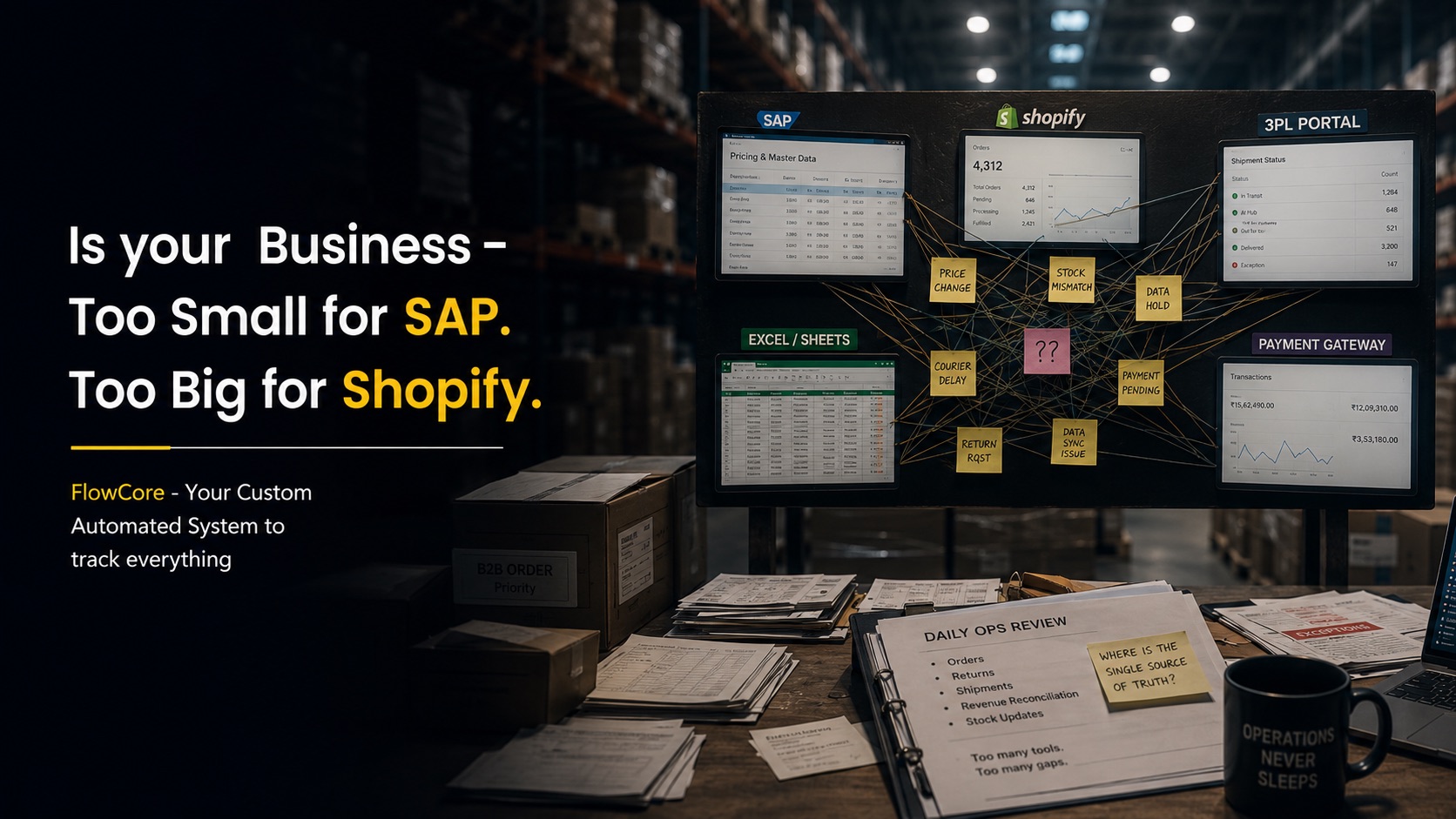
That in-between state is what this blog is about. The patchwork. The custom scripts. The partial WMS that handles 70% of cases. The Shopify apps that almost do what you need. The Google Sheets that fill the gaps between all of them.
It is a common, expensive, and entirely understandable place to be stuck. And understanding why it happens - and what it actually costs - is the first step toward getting out of it.
How the Patchwork Gets Built
No brand sets out to build a patchwork ops stack. It assembles itself, one pragmatic decision at a time.
At 1-5M ARR, Shopify plus a few apps is genuinely enough. The team is small, the catalog is manageable, and the operational complexity, while real, can be handled with some manual process and a lot of institutional knowledge.
Then growth happens. And with it, specific operational gaps start appearing:
- Shopify's multi-location routing logic is not sophisticated enough for the brand's fulfilment network.
- There is no way to surface exception queues - orders at SLA risk, stock mismatches, partial fulfilment decisions - without manual checking.
- The 3PL integration works most of the time, but edge cases fall through and require manual reconciliation.
- Reporting shows revenue and fulfilment status but not operational health - exception rates, time-to-ship, reship costs.
Each gap gets solved individually. A developer writes a custom script for the routing logic. A Shopify app handles some of the fulfilment automation. A spreadsheet captures the exception cases. A second app manages the 3PL sync.
The patchwork grows. Each piece was a reasonable solution to a real problem. Together, they create a new problem: a fragile, expensive, partially integrated ops stack that requires significant maintenance, creates data inconsistencies between tools, and breaks unpredictably at scale.
Why Enterprise OMS Is Not the Answer
The logical next step, when the patchwork becomes too painful, is to look at proper enterprise OMS solutions. SAP. Oracle. Manhattan Associates. NetSuite OMS. These are the systems that large retailers and global brands use to manage complex order operations.
The problem is not that these systems are bad. The problem is that they were built for a completely different operational reality.
Enterprise OMS systems are designed for:
- Businesses with large, dedicated IT teams to implement and maintain them.
- Operations that follow rigid, pre-defined workflows rather than the fast-moving, frequently-changing flows of D2C commerce.
- Budgets that can absorb six-figure implementation costs and ongoing licensing fees that dwarf the entire ops budget of a 5-20M ARR brand.
- Timelines measured in months or years for implementation, not weeks.
A 5-20M ARR Shopify D2C brand needs none of those things and can afford none of those costs. Enterprise OMS is not too powerful. It is the wrong shape. Built for volume and rigidity, not for the speed, flexibility, and Shopify-native reality of modern D2C operations.
Industry content on enterprise AI for ecommerce consistently makes the same observation: the tools built for Fortune 500 retail operations do not translate cleanly to D2C brands, which have fundamentally different operational models, faster iteration cycles, and a much tighter relationship between ops decisions and customer experience outcomes.
The Real Cost of the In-Between State
Staying in the patchwork is not a neutral position. It has real, ongoing costs - most of which are invisible in standard financial reporting.
Maintenance overhead. Custom scripts break. App updates conflict. Integrations drift out of sync. Every piece of the patchwork requires ongoing attention from developers or ops managers who are also trying to do their actual jobs. That maintenance cost is real but rarely tracked as a line item.
Data inconsistency. When four tools each hold part of the operational picture - orders here, inventory there, exceptions in a spreadsheet, 3PL status in a portal - the data never fully agrees. Teams spend time reconciling instead of deciding. Leadership makes ops decisions from reports that are always slightly wrong.
Scaling brittleness. The patchwork was assembled for current volume. It breaks at different points under different conditions. Campaign spikes, new channel launches, SKU expansions - each one tests a different seam in the stack. The brand never knows which seam will fail next.
Opportunity cost. Every hour the ops team spends managing the patchwork - fixing sync issues, reconciling data, manually handling cases the system cannot route - is an hour not spent on the decisions that actually move the business forward. That opportunity cost is impossible to quantify but very real in practice.
The growth ceiling. Perhaps the biggest cost: the patchwork creates a soft ceiling on growth. The brand can scale to a point, but beyond that point, the patchwork becomes the bottleneck. Every new campaign, channel, or product adds more complexity to a stack that is already at its limit.
What "Enterprise-Grade" Actually Means for D2C
The language of enterprise operations gets misunderstood in the D2C context. Enterprise-grade does not mean expensive, complex, or built for large organisations. It means capable, reliable, and structurally sound at scale.
For a 5-20M ARR Shopify D2C brand, enterprise-grade operations means four specific things:
A single operational source of truth. One place where order state, inventory reality, exception status, and fulfilment timelines are held - not distributed across four tools with partial views and inconsistent data.
Rules-based decision making. Routing logic, prioritisation, exception handling, and escalation thresholds that are encoded in the system and run consistently - not dependent on which person is available or which spreadsheet is most current.
Proactive exception management. The system surfaces problems before they become costs. Orders likely to breach SLA today. SKUs that are misallocated across locations. Exceptions that have been sitting unresolved for more than a defined threshold. These are visible as queues, not discovered as complaints.
Measurable operational performance. Time-to-fulfil by warehouse. Exception rate by SKU. Reship cost by root cause. SLA compliance by channel. These metrics connect operational decisions to financial outcomes - and make it possible to improve ops systematically rather than reactively.
None of these capabilities require SAP. None of them require a six-month implementation or an enterprise licensing budget. They require a system that was built for the operational reality of modern Shopify D2C brands - not retrofitted from an enterprise retail model.
The Patchwork Diagnostic
Here is a practical way to assess whether your current ops stack is in patchwork territory.
Data trust test: Ask three different people on your ops team where stock for your top-selling SKU currently stands. If you get three different numbers from three different sources, you have a data trust problem that the patchwork is failing to solve.
Exception visibility test: How do you currently know which orders are at SLA risk today? If the answer is "we check manually" or "we find out when tickets arrive," you have no proactive exception management.
Routing logic test: Where does your order routing logic currently live? If it is a custom script, a developer's head, or a spreadsheet that one person maintains, it is fragile, opaque, and likely inconsistent.
Maintenance time test: How many hours per week does your ops or dev team spend maintaining integrations, fixing sync issues, or manually reconciling data between tools? If the answer is more than a few hours, the patchwork is consuming significant capacity that should be going elsewhere.
Scaling confidence test: If order volume doubled tomorrow, would your current ops stack handle it - or would it break at a predictable point? If you already know where it would break, that is the seam that needs to be addressed before the next growth phase.
What Brands in This Stage Actually Need
The 5-20M ARR Shopify D2C brand does not need enterprise software. It needs an operational intelligence layer that is:
- Shopify-native: Built to work with Shopify's data model, not force the brand to operate outside it.
- Integration-first: Designed to sit across existing tools - 3PLs, WMS, support systems, carrier APIs - rather than replace them all.
- Rules-configurable without a developer: Ops managers should be able to update routing rules, exception thresholds, and prioritisation logic without raising a ticket every time.
- Operationally transparent: Every order's journey should be visible in one timeline. Every exception should surface to the right queue with the right context. Every routing decision should be explainable.
- Measurably connected to outcomes: The system should produce the operational metrics that connect to financial performance - so leadership can see ops health the same way they see marketing performance.
That is the gap an operational intelligence layer fills. Not SAP. Not a Shopify app bundle. The structural ops backbone 5-20M ARR D2C brands need - without the implementation cost, the rigidity, or the enterprise complexity they do not.
The Moment to Move Is Before the Next Growth Phase
The patchwork tends to be tolerable until it suddenly is not. One campaign that exposes a routing failure. One warehouse integration that breaks during a product launch. One ops lead who leaves and takes the institutional knowledge with them.
At that point, the cost of staying in the patchwork becomes undeniable. But fixing it reactively - in the middle of a growth push, with a broken stack and an understaffed team - is significantly harder and more expensive than addressing it before the next phase begins.
The 5-20M ARR stage is exactly the right moment to replace the patchwork with a cohesive operational backbone. The brand has enough volume and complexity to justify the investment. It has not yet hit the ceiling that the patchwork will eventually create.
Conclusion: Too Small for SAP. Too Big for Shopify.
That phrase captures the exact stage we are talking about. Modern Shopify D2C brands at 5-20M ARR sit in a real gap - their current stack is no longer enough, and the next obvious thing up the chain is built for a completely different kind of business.
The answer is not to grow into the enterprise model. It is to build an operations layer designed for what you actually are - a fast-moving, integration-heavy, Shopify-native D2C brand that needs structural ops capability without enterprise scaffolding.
If your brand is in this gap and the patchwork is starting to feel like the bottleneck rather than the solution, book an AI Ops Audit. We will run the patchwork diagnostic on your actual stack, identify the specific seams that will break next, and show you what a Shopify-native operational backbone would look like in your business.