There is a version of growth that looks strong from the outside and is quietly brittle on the inside.
The brand is scaling. Revenue is moving. Campaigns are working. The ops team is keeping up - just about. But the reason they are keeping up is not a system. It is two or three people who know how everything actually works.
They know which SKUs to prioritise when stock is tight. They know which 3PL to call when an order is stuck. They know the unwritten rules about which customers get priority treatment, which exceptions get escalated, and which situations require a founder decision.
This knowledge is real, valuable, and completely unencoded.
It lives in those people's heads. In their WhatsApp messages. In the spreadsheet only they fully understand. In the judgment calls they make dozens of times a day without anyone noticing - until they are not there to make them.
This is the real ops scaling problem at 1-5M ARR. Not the volume. The fragility.
Why Hiring More Ops People Does Not Fix This
The instinctive response to ops pressure is to hire. Another coordinator. Another fulfilment manager. Another person to "own" the exceptions queue.
And it works - temporarily. The new hire shadows the existing team, absorbs the unwritten rules, learns the spreadsheet, and becomes another node in the informal ops network.
But three things happen as a result:
The knowledge problem compounds. Now there are more people holding pieces of the ops picture in their heads. The informal network grows larger and more complex. Onboarding becomes harder because there is more institutional knowledge to transfer, and less of it is written down.
The cost structure hardens. Each hire adds fixed payroll. As order volume fluctuates - campaigns, seasonality, slow periods - the cost base does not flex. The brand gets locked into a headcount structure that was sized for a peak, not an average.
The fragility multiplies. More people means more single points of failure. When someone leaves - and at this growth stage, people do leave - the gap they create is not just a capacity gap. It is a knowledge gap. The brand loses the informal decision logic that kept operations running.
We have written separately about the broader argument for non-linear scaling and AI-driven operational leverage. This blog is not about that argument. It is about the specific structural problem that makes ops fragile at 1-5M ARR - and why the fix is encoding decisions into a system, not adding more people to hold them.
The Decision Problem Nobody Talks About
Most ops scaling conversations focus on volume. How many orders can the team process? How fast can they fulfil?
Volume is a real constraint. But the deeper constraint at 1-5M ARR is decision volume - the number of judgment calls required to keep operations running correctly every single day.
Here is what that looks like in practice:
- Which orders should ship today when stock is partially available?
- Should this order be split across two locations or held until the full item set is available?
- This VIP customer's order has an exception - who decides what happens next?
- The 3PL flagged a problem with this shipment - what is the protocol?
- Marketing launched a flash sale; fulfilment capacity is at limit - what gets prioritised?
In a brand running on informal ops, every one of these questions goes to a person. Sometimes the founder. Sometimes the ops lead. Sometimes whoever is available and experienced enough to make the call.
These decisions are not random. They follow logic - the brand's actual priorities, policies, and rules. But that logic is not written down anywhere. It exists as accumulated judgment in the people who have been doing this long enough to know what the right call is.
That is not a system. That is institutional knowledge masquerading as a system. And the difference becomes visible the moment those people are unavailable, overloaded, or gone.
What Fragile Ops Actually Costs
Fragile ops does not announce itself as a structural problem. It shows up as a collection of symptoms that feel like normal growth pain:
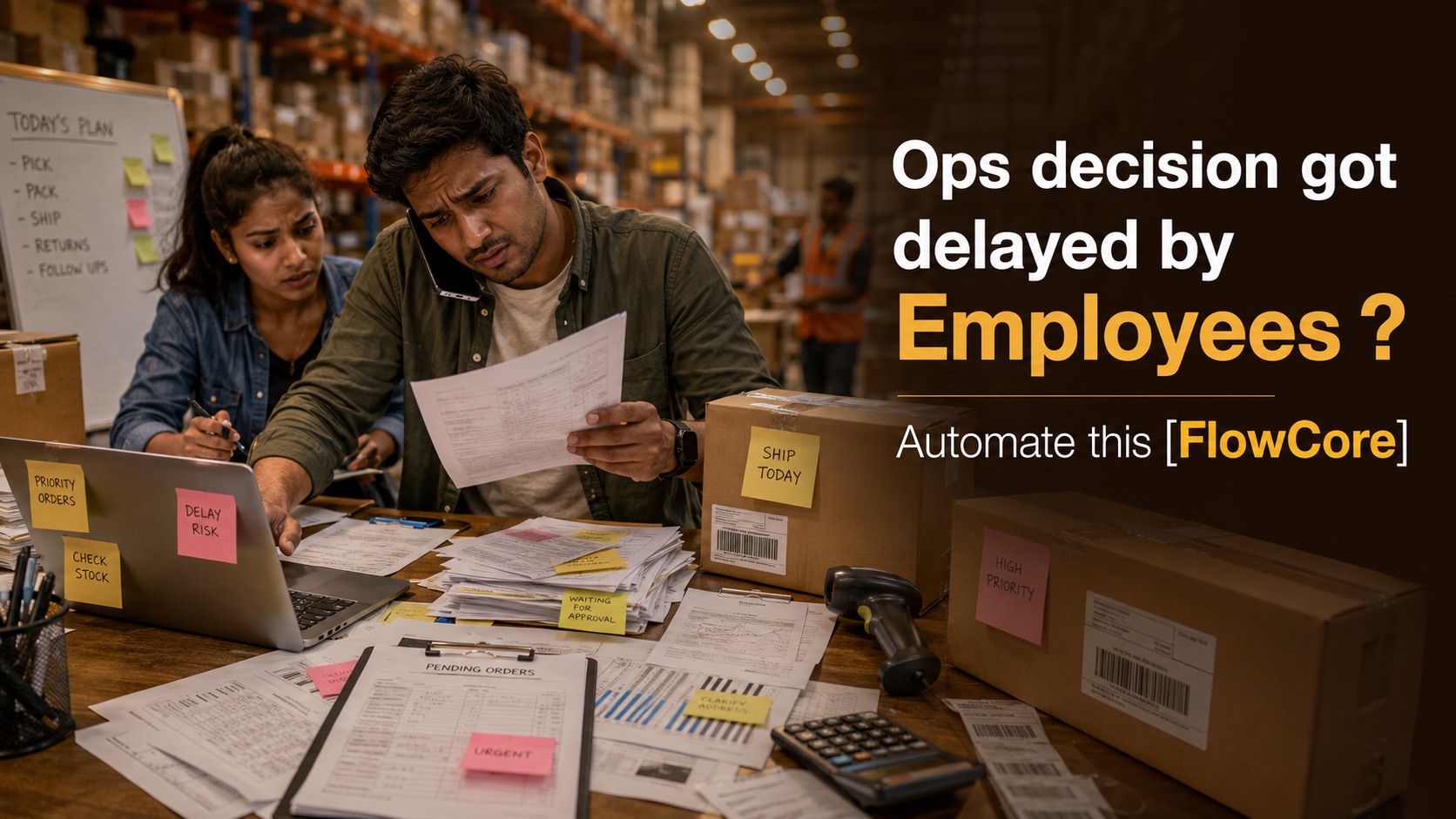
Fulfilment delays during campaign spikes. When order volume jumps suddenly, the decision bottleneck tightens. More exceptions arrive faster than the ops team can process them. Orders that should have shipped today sit waiting for a call that has not been made yet.
Quality drops when key people are absent. When the person who knows the routing rules takes a day off, or is sick, or leaves, the team defaults to guesswork. Errors rise. Exceptions pile up. The founder gets pinged.
Onboarding takes months, not weeks. Because so much ops knowledge is informal and unwritten, new hires take a long time to become effective. They are not learning a system. They are learning a person's accumulated judgment, which cannot be transferred quickly or reliably.
Growth campaigns create ops anxiety. When the marketing team plans a big push, the ops team knows it will create pressure - but cannot predict exactly where or how, because there are no encoded rules to fall back on. The instinct is always to have more people on hand "just in case."
The founder never fully steps back from ops. Because the informal decision network eventually routes hard exceptions upward, the founder stays embedded in day-to-day ops decisions long past the point when they should have been free from them.
Each of these is a real cost. Some are financial - delays, errors, reship costs. Some are strategic - the founder's time, the brand's ability to run big campaigns with confidence. All of them trace back to the same root cause: operational decisions living in people instead of a system.
The Difference Between a Headcount Problem and a Decision Encoding Problem
These two problems feel identical from the inside. Both produce the same symptoms: the team is overwhelmed, things are falling through, more people seem like the answer.
But they have different root causes and very different fixes.
A headcount problem means there is genuinely more work than the team can process - even with good systems, clear rules, and encoded decision logic. The team is operating efficiently; there is simply more volume than current capacity can handle. The fix is additional capacity.
A decision encoding problem means the team is spending most of their time making judgment calls that could - and should - be handled by a system with the right rules. The bottleneck is not capacity. It is the absence of encoded logic. The fix is not more people. It is turning informal decision knowledge into operational rules that run without human intervention.
At 1-5M ARR, most Shopify brands have a decision encoding problem, not a headcount problem. They hire to solve the symptom and leave the root cause intact. The result is more people holding more unencoded knowledge, and a system that is larger but no less fragile.
What Encoding Decisions Actually Means
Encoding is not a technical concept. It is a practical one.
It means taking the judgment calls that currently live in your ops lead's head and making them explicit, repeatable, and system-driven.
For example:
- Routing logic: Instead of "Sarah decides which warehouse ships each order," the system knows: if Stock A is available in Location 1 and Location 1's SLA for this region is better, route there. If not, escalate to ops.
- Prioritisation rules: Instead of "Marcus knows which orders to push first," the system knows: VIP orders ship within 4 hours. Campaign-linked orders have a 6-hour SLA. All others are FIFO.
- Exception handling: Instead of "ask the founder," the system knows: if an exception is under a certain threshold, apply the default resolution. If it is above the threshold, surface it to ops with all relevant context pre-loaded.
None of these rules are complex. Most of them already exist - informally - inside the ops team. The work is not inventing new logic. It is capturing the logic that already works and putting it somewhere the system can use it instead of asking a person every time.
When that happens, something important shifts. Order volume can double without the decision volume doubling with it. The system handles the standard cases. People handle the genuine exceptions. And genuine exceptions are a fraction of total order volume - not the majority of it.
The Single-Point-of-Failure Test
Here is a practical way to measure how fragile your current ops structure is.
Ask: If your most experienced ops person left tomorrow, what would break?
If the answer is "a lot" - routing decisions, exception handling, supplier contacts, 3PL relationship management, fulfilment prioritisation - then your ops system has single points of failure embedded in people, not encoded in a system.
That is not a people problem. Those people are doing excellent work. The problem is that the brand has never extracted their knowledge from their heads and put it into a structure that runs independently of them.
The next question is: If order volume doubled next month, would the system scale - or would you need to hire first?
If the answer is "hire first," the brand is in the decision encoding problem zone. Growth is gated not by market demand or marketing budget - but by the ops team's capacity to make manual decisions at scale.
What Changes When Decisions Are in the System
When a 1-5M ARR Shopify brand moves from informal, person-dependent ops to a system with encoded routing, prioritisation, and exception logic, four things change structurally:
Campaigns stop creating ops anxiety. The team knows that a 3x volume spike will be handled by the system up to the point of genuine capacity limits - not by whoever is available to make calls that day.
Onboarding becomes faster and more reliable. New ops hires learn the system, not a person. The rules are visible, testable, and improvable. Knowledge transfer stops depending on time and relationships.
The founder exits day-to-day ops. When exceptions only surface after the system has exhausted its encoded resolution logic, the volume of founder escalations drops dramatically. The founder sees genuine strategic exceptions, not routine edge cases.
Growth decisions get cleaner. Leadership can now ask: "Do we have the operational capacity to run this campaign?" and get a data-backed answer based on system capacity and current exception rates - not a gut check from the ops lead.
This is what operational leverage actually looks like at 1-5M ARR. Not replacing people with AI. Replacing informal, fragile, person-dependent decision-making with a system that holds the logic, runs the standard cases, and hands off only the genuine exceptions.
Five Signs Your Ops Runs on People, Not a System
- The ops lead is the single point of truth for fulfilment decisions most days.
- A campaign launch requires ops briefings because the team needs to know what to prioritise "by hand."
- Onboarding a new ops person takes more than 6 weeks before they can make independent decisions.
- Exception handling routes to the founder or a senior person more than a few times a week.
- When you imagine doubling order volume tomorrow, your first thought is "we would need more people."
Three or more of these means the ops system is person-dependent. The knowledge is real and valuable - it just needs to move from heads into a system before the next growth phase makes the fragility too expensive to ignore.
Conclusion
The hidden fragility inside most 1-5M ARR Shopify brands is not a volume problem. It is a decision encoding problem.
The routing rules, prioritisation logic, exception thresholds, and escalation paths that keep ops running exist - just not where the system can use them. They live in your ops lead's head, in WhatsApp threads, in spreadsheets only one person fully understands.
The next growth phase exposes that. Either the brand encodes the logic into the operational layer and breaks the headcount-volume coupling, or it keeps hiring to absorb the symptom while the root cause compounds.
If your Shopify brand is at 1-5M ARR and growth is starting to feel like it requires another ops hire, the question to ask first is not "how many people do we need?" - it is "which of our recurring decisions could a system make if we encoded the rules?" Book an AI Ops Audit - we will map your highest-leverage decisions, show you what encoding them would look like, and what scale that unlocks.