The Hiring Trap Every Scaling DTC Brand Falls Into
Here is the growth pattern that plays out inside almost every DTC brand that reaches ₹1–2 crore in monthly revenue:
Orders go up. Support tickets go up. Returns go up. WISMO queries go up. Post-purchase communication volume goes up. Inventory management complexity goes up.
And so the founder does the most logical thing: they hire.
A support agent. Then another. Then a logistics coordinator. Then a marketing executive to manage post-purchase flows. Then a data analyst to make sense of the numbers. Then an operations manager to coordinate all of the above.
By the time the brand is doing ₹5 crore per month, there is a 12-person team - and the founder is spending more time managing people than building the business. Payroll has become the single largest fixed cost. And the margin that was supposed to expand with scale has instead compressed, because every new revenue milestone required a new hire to sustain it.
This is the linear headcount trap. Revenue scales. Headcount scales with it. Margin stays flat or shrinks. The business grows in size but not in structural strength.
The brands breaking out of this pattern in 2026 are not doing it by working harder or hiring smarter. They are doing it by building an operational leverage layer - an AI-powered infrastructure that handles the high-volume, repeatable, time-sensitive work that currently requires human headcount, at a fraction of the cost and at unlimited scale.
89% of retailers have adopted AI in some form. Only 7% have reached fully scaled integration. The 7% are not just more efficient. They are structurally more profitable - and the gap between them and everyone else is compounding every quarter.
The Operational Leverage Equation
Before the playbook, the framework.
Operational leverage is the ratio of output growth to input growth. A business with high operational leverage can double its output - orders processed, customers served, queries resolved, decisions made - without doubling its inputs (people, time, cost).
In traditional DTC operations, this ratio is close to 1:1. Double the orders, double the support staff. Double the customer base, double the marketing execution team. This is why most DTC brands plateau - not because they run out of customers, but because they run out of margin to fund the headcount required to serve them.
AI changes this ratio structurally.
Consider the numbers:
- 84% of ecommerce businesses are integrating or planning to integrate AI - with key use cases in customer service, inventory, and marketing automation
- Companies using AI personalisation earn 40% more revenue than those without it
- AI-powered demand forecasting reduces inventory levels by 20–30% and cuts logistics costs by 5–20%
- To scale from 500 to 5,000 orders daily, automation reduces manual effort and allows brands to handle higher volumes without proportionally increasing manpower
- 68% of small businesses using AI regularly save ₹40,000–₹1,60,000 per month in operational costs
- In 2026, AI is compressing what used to be a 3–4 person marketing team into a single operator
The operational leverage equation for a Shopify DTC brand deploying AI across its operations looks like this:
| Function | Without AI | With AI | Leverage Ratio |
|---|---|---|---|
| Customer support (500 queries/month) | 2–3 FTE agents | 1 agent + AI handling 80% | 3:1 |
| Post-purchase communication | 1 marketing exec | Fully automated, 0 FTE | ∞ |
| WISMO resolution | 1 dedicated agent | AI resolves in <12 seconds | 5:1+ |
| Inventory management | 1 ops coordinator | AI monitors + triggers reorders | 4:1 |
| Demand forecasting | External consultant | AI model, real-time | 10:1+ |
| Returns processing | 1 part-time agent | AI initiates + routes + resolves | 4:1 |
Across the full operations stack, a Shopify DTC brand doing ₹3–5 crore monthly revenue can run at the operational output of a 15-person team with a 5–6 person team - and expand to ₹15 crore without a proportional headcount increase.
That is not a projection. That is the structural output of deploying AI across the right operational functions.
The 5 Functions Where AI Replaces Linear Headcount Growth
Not every business function benefits equally from AI automation. The highest-leverage functions for DTC brands on Shopify are the ones that share three characteristics:
- High volume - they happen hundreds or thousands of times per month
- Repeatable - the inputs and outputs follow predictable patterns
- Time-sensitive - the value of the output degrades rapidly if not delivered quickly
Here are the five functions that meet all three criteria - and where AI delivers the highest operational leverage for Shopify DTC brands.
Function 1: Customer Support and WISMO Resolution
The linear headcount problem: at 500 orders per month, a brand receives approximately 150–200 support contacts. At 2,000 orders per month, that is 600–800 contacts. At 5,000 orders, it is 1,500–2,000. Every growth milestone requires another support hire.
The AI leverage play: an AI agent connected to Shopify's order management API and your logistics provider handles WISMO queries, return initiations, order confirmations, and delivery status updates without human involvement. AI voice agents handle inbound support calls - for DTC brands doing 50+ calls a day, that is a significant cost saving.
The leverage ratio: AI handles 75–85% of all support volume automatically. A brand growing from 500 to 5,000 orders per month needs one additional support agent - not five - because AI absorbs the volume growth.
Function 2: Post-Purchase Communication and Retention
The linear headcount problem: executing personalised post-purchase communication - delivery confirmations, product tips, review requests, reorder prompts, loyalty triggers - for 2,000 customers per month requires either a dedicated CRM executive managing complex automation rules, or generic batch emails that nobody opens.
The AI leverage play: an event-triggered AI communication layer connected to Shopify, your carrier API, and your CRM executes every post-purchase touchpoint automatically - personalised by customer cohort, product category, order value, and real delivery events. Zero headcount. Unlimited scale.
DTC brands require 20–30 social posts per week, 8–15 email campaigns per month, and 4–8 content pieces per month to compete in 2026 - a volume impossible for small teams without AI automation.
The leverage ratio: the entire post-purchase communication function runs with 0 additional FTE regardless of whether the brand is processing 200 or 20,000 orders per month.
Function 3: Inventory Management and Demand Forecasting
The linear headcount problem: managing inventory across multiple SKUs, multiple warehouses, and multiple sales channels requires constant human monitoring. As SKU count and order volume grow, so does the complexity - and the headcount required to manage it.
The AI leverage play: an AI demand forecasting model trained on your sales history, seasonal patterns, and supplier lead times monitors inventory in real time, predicts stockouts before they happen, triggers reorder recommendations automatically, and syncs stock levels across Shopify and your ERP without batch delays.
AI-driven automation reduces inventory levels by 20–30% (freeing working capital) and cuts logistics costs by 5–20%. Brands deploying AI demand forecasting achieve 94% forecasting accuracy.
The leverage ratio: inventory management that previously required 1–2 full-time operations coordinators runs on AI monitoring with human oversight for exceptions only.
Function 4: Returns Processing and Resolution
The linear headcount problem: returns are one of the most labour-intensive operational functions in DTC. Every return requires a customer communication, a reason capture, a routing decision, a quality check coordination, and a financial reconciliation.
The AI leverage play: an AI-powered returns flow initiates returns via chat or voice, captures the reason conversationally, routes to the right resolution automatically, triggers the financial workflow in the ERP, and sends the customer a resolution confirmation - all without human involvement for the 80% of returns that follow standard patterns.
The leverage ratio: returns processing headcount stays flat as return volume grows. A brand scaling from 100 to 1,000 returns per month needs one part-time returns coordinator - not five.
Function 5: Marketing Execution and Content Operations
The linear headcount problem: competing in DTC in 2026 requires a volume of marketing content that no small team can produce manually - email campaigns, WhatsApp sequences, social content, blog posts, ad creative variations.
The AI leverage play: AI compresses the 3–4 person marketing execution team into a single operator. Copy generation, campaign sequencing, A/B test creation, personalised message variants by customer segment - all executed at AI speed and volume, with the human operator focusing on strategy, brand voice, and performance review.
The leverage ratio: marketing execution output scales with order volume and customer base growth without proportional headcount increases.
The Non-Linear Growth Model: What It Looks Like in Practice
Brand: Indian skincare D2C on Shopify Current state: ₹2 crore monthly revenue, 8-person team
| Function | Current Headcount | Current Cost/Month |
|---|---|---|
| Customer support | 3 agents | ₹1,20,000 |
| Operations / inventory | 2 coordinators | ₹1,00,000 |
| Marketing execution | 2 executives | ₹1,20,000 |
| Returns processing | 1 part-time | ₹30,000 |
| Total ops headcount cost | 8 people | ₹3,70,000/month |
Target state: ₹8 crore monthly revenue
Without AI - linear headcount model:
| Function | Headcount Needed | Projected Cost/Month |
|---|---|---|
| Customer support | 10–12 agents | ₹4,50,000 |
| Operations / inventory | 6 coordinators | ₹3,00,000 |
| Marketing execution | 6 executives | ₹3,60,000 |
| Returns processing | 3 full-time | ₹1,20,000 |
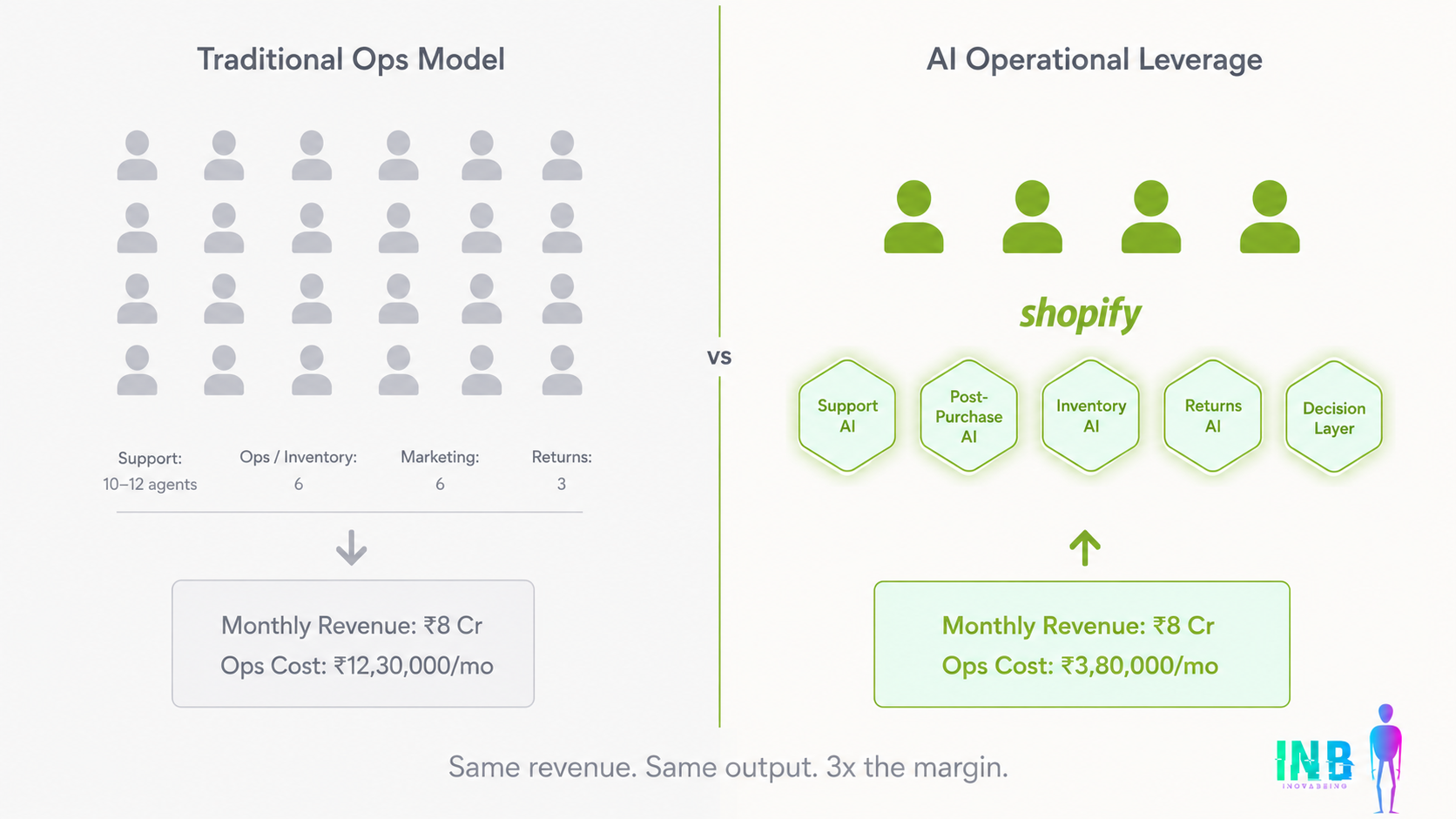
| Total | 25–27 people | ₹12,30,000/month |
With AI operational leverage:
| Function | Headcount Needed | Cost/Month |
|---|---|---|
| Customer support | 1 agent + AI | ₹80,000 + AI layer |
| Operations / inventory | 1 coordinator + AI | ₹60,000 + AI layer |
| Marketing execution | 1 operator + AI | ₹70,000 + AI layer |
| Returns processing | 0.5 FTE + AI | ₹20,000 + AI layer |
| AI layer | - | ₹1,50,000/month |
| Total | ~4 people + AI | ₹3,80,000/month |
Savings at ₹8 crore revenue: ₹8,50,000 per month in avoided headcount cost.
Annual saving: ₹1,02,00,000 - over ₹1 crore - from the same revenue base, with better operational quality, faster response times, and 24/7 availability.
That ₹1 crore does not disappear. It goes back into product development, marketing investment, or founder returns - compounding the business rather than funding a payroll that grows in lockstep with revenue.
The 3 Principles of Non-Linear Scaling
Building operational leverage is not just about deploying AI tools. It requires three structural principles that determine whether AI creates genuine leverage or just adds another layer of complexity.
Principle 1: Automate the Repeatable Before You Hire for the Exceptional
The most common mistake scaling DTC brands make is hiring for volume before they have automated the repeatable work within that volume.
Every support queue contains a mix of queries: 70–80% are repeatable - WISMO, return status, delivery confirmation, basic product questions. 20–30% are genuinely complex - lost packages, wrong items, damaged products, fraud disputes. Most brands hire agents to handle the entire queue, when they should be deploying AI to handle the 70–80% and hiring exceptional people to handle the 20–30% that actually requires judgment.
The principle: map every operational function by repeatability before making a hiring decision. If a task follows a predictable input-output pattern more than 70% of the time, it should be automated before headcount is added.
Principle 2: Build for 10x Before You Need It
The operational infrastructure a brand builds at ₹2 crore monthly revenue determines the ceiling it hits at ₹10 crore. Brands that build just enough infrastructure to handle today's volume always hit a wall - because retrofitting AI and automation into a system built around manual headcount is harder and more expensive than building it right the first time.
The principle: when deploying AI operations, build for 10x your current order volume. The marginal cost of handling 10,000 orders per month in an AI-powered system is a fraction of the marginal cost in a headcount-dependent system. Build the ceiling high while the foundation is being laid.
Principle 3: Measure Output Per Rupee, Not Output Per Person
The traditional productivity metric - output per person - is the wrong measure for an AI-augmented operations team. It creates pressure to justify every hire by individual output, when the real question is how much operational output the entire system - human plus AI - is producing per rupee of cost.
The principle: measure operational leverage as total output (orders processed, queries resolved, returns handled, campaigns executed) divided by total operational cost (salaries plus AI tooling). This metric tells you whether your investment in AI is generating leverage - and by how much.
A brand with ₹3,80,000 monthly operational cost handling ₹8 crore in revenue has an operational leverage ratio of 21:1. A brand spending ₹12,30,000 to handle the same revenue has a ratio of 6.5:1. The first brand has structurally more margin to reinvest, more resilience to demand shocks, and a lower break-even point.
What the Best Shopify Brands Are Doing in 2026
The 7% of retailers who have reached fully scaled AI integration are not doing anything exotic. They have systematically applied AI to the five high-leverage functions - support, post-purchase, inventory, returns, and marketing execution - in a deliberate sequence that builds compounding value.
Here is the playbook they are running:
Month 1–2: Automate the highest-volume repeatable function first - for most Shopify DTC brands, that is customer support and WISMO. Deploy an AI agent connected to Shopify and your logistics API. Measure the reduction in support volume handled by humans.
Month 2–4: Deploy event-triggered post-purchase intelligence - connect your carrier API to your communication platform. Build personalised, event-triggered post-delivery sequences. Activate the thank-you page upsell.
Month 3–5: Integrate ERP and inventory AI - connect your ERP to Shopify via real-time webhook sync. Deploy the demand forecasting model. Eliminate the inventory coordinator's manual reorder workload.
Month 4–6: Automate returns processing - deploy the AI returns flow. Measure return-to-exchange conversion rate, average resolution time, and post-return repeat purchase rate.
Month 6+: Build the unified decision layer - connect all systems into the unified pipeline. Deploy the AI decision layer. At this point, the brand has operational leverage across every function - and can scale revenue significantly without a proportional increase in operational headcount or cost.
The Compounding Advantage: Why Starting Early Matters
Operational leverage from AI is not a switch you flip. It is a system that improves over time as the AI models train on your specific data - your customers, your SKUs, your carrier routes, your support patterns.
A brand that starts building this system at ₹2 crore monthly revenue has 18 months of model training by the time they reach ₹10 crore. Their demand forecast is accurate to 94% because it has been trained on their specific seasonal patterns, marketing calendar, and supplier lead times. Their customer behaviour model knows the reorder cycle for every SKU category in their catalogue. Their support AI resolves 85% of queries automatically because it has been trained on thousands of their specific customer interactions.
A competitor who starts building at ₹10 crore starts from zero. They spend 6–12 months getting the system to the accuracy level the early mover had 18 months ago. Meanwhile the early mover's models have continued improving.
This is the compounding advantage. It is not just about cost savings today. It is about the operational intelligence gap that widens every month between the brands that started early and the ones that waited.
How InovaBeing Deploys Operational Leverage for Shopify DTC Brands
We have built the complete operational leverage stack for Shopify DTC brands - deployed in a structured sequence that delivers measurable ROI at every phase.
- AI Support and WISMO Layer (Weeks 1–3) - AI voice and chat agents connected to Shopify and your logistics provider. Resolves 75–85% of support volume automatically. Available 24/7 in Hindi and English. WISMO resolution in under 12 seconds.
- Post-Purchase Intelligence (Weeks 2–4) - Event-triggered personalised communication across WhatsApp, SMS, and email. Carrier API connected for real delivery event triggers. Thank-you page upsell activated.
- Inventory and Demand AI (Weeks 4–7) - Bidirectional Shopify–ERP sync via real-time webhook. Demand forecasting model trained on your data. Automatic reorder triggers. Stockout prediction.
- Returns Intelligence (Weeks 5–8) - AI-powered returns initiation via chat and voice. Intelligent routing to exchange, refund, or store credit. Returns processing time reduced from days to hours.
- Unified Decision Layer (Weeks 8–12) - All systems connected into the unified data pipeline. AI decision layer deployed across the full dataset. Operations dashboard live.
Full deployment: 10–12 weeks. No platform migration. No enterprise contract. Operational leverage from week 3 onward. Built for Shopify DTC brands at ₹1 crore to ₹50 crore monthly revenue.
Conclusion: The Last Unfair Advantage in DTC
In a market where every product can be copied, every ad can be outspent, and every price can be undercut, the last genuinely durable advantage in DTC is operational leverage.
The brand that can serve 10x the customers with 2x the cost has a structural profit advantage that compounds every quarter. The brand that can scale revenue from ₹2 crore to ₹20 crore without scaling payroll from 8 people to 80 people has a margin advantage that no competitor can close quickly - because it is embedded in systems, data, and AI models that took 18 months to build and train.
This is not the future of DTC. It is the present. The 7% who have fully scaled AI integration are already running at this advantage. The 89% who have adopted AI in some form but not scaled it are still running at near-linear headcount ratios - and the gap is widening every month.
The window to build this advantage without playing catch-up is now. Not when you hit ₹5 crore. Not when the support team is overwhelmed. Not when the operations coordinator hands in their notice because the manual work has become unmanageable.
Now - while the foundation can be built right, the models can start training early, and the compounding advantage starts accumulating from the first order the AI handles.
Ready to build operational leverage into your Shopify DTC brand? Book a free AI Ops Diagnostic with InovaBeing.