There is a specific fear that shows up the moment a Shopify founder starts getting serious about AI.
It is not usually, "Will AI work?"
It is, "If we automate too much, do we lose control of the business?"
That fear is valid.
Because the worst version of AI adoption in ecommerce is not under-automation. It is unmanaged automation. It is when returns get auto-approved with no margin logic. It is when campaigns keep pushing a SKU that operations cannot fulfil. It is when fraud filters reject good customers. It is when support workflows become "efficient" on paper and damaging in reality.
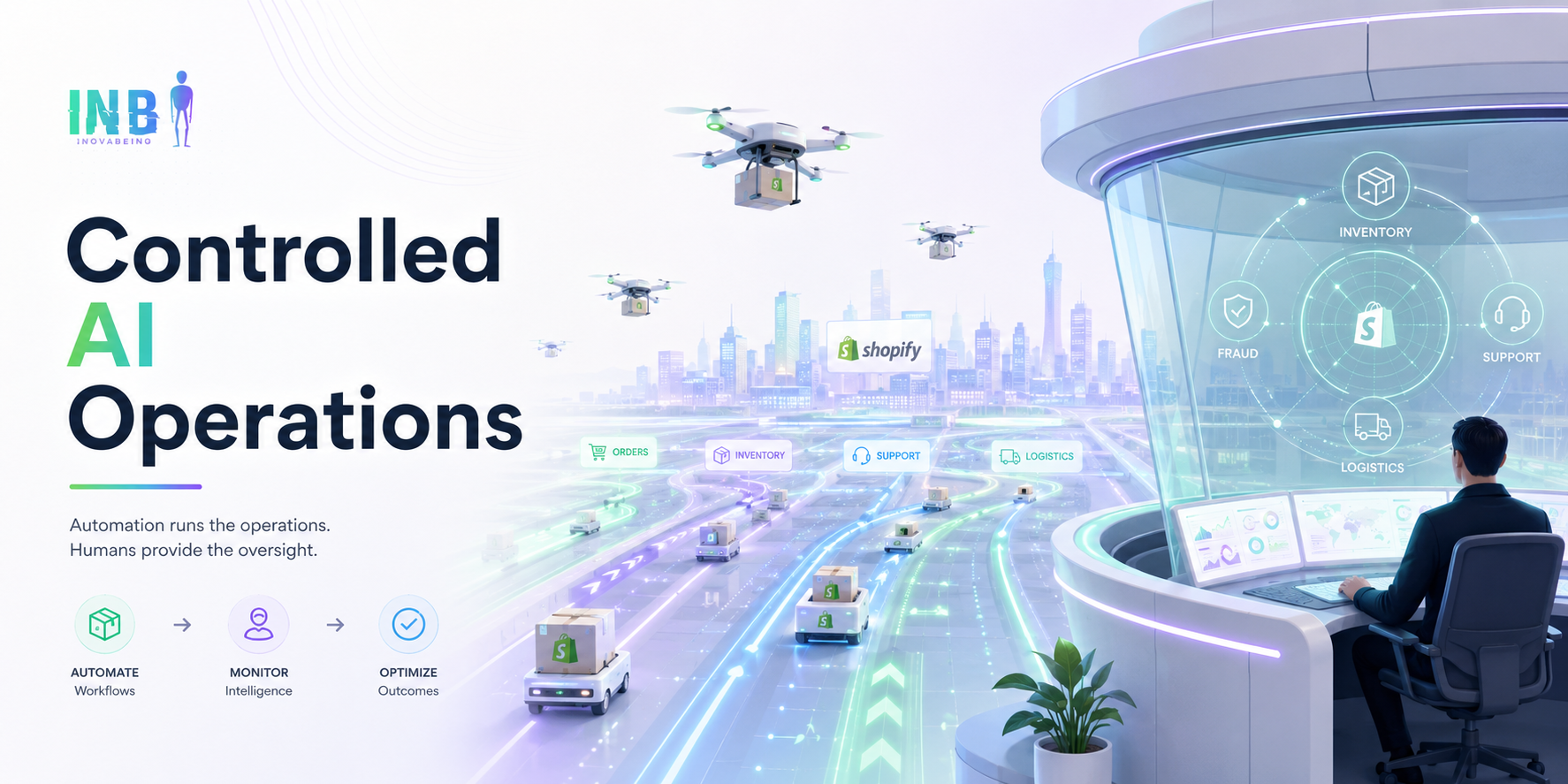
The brands getting this right in 2026 are not the ones trying to remove humans from the system. They are the ones building a better operating model - one where AI handles the high-volume, repeatable, time-sensitive work, humans stay in charge of exceptions and judgment, and a live decision layer coordinates both across Shopify, support, logistics, and marketing.
That is the shift happening now.
AI is no longer just writing product descriptions and summarising support tickets. It is moving into forecasting, fraud screening, routing, SLA protection, demand planning, returns handling, and campaign coordination across the operational core of the business.
The question is no longer whether Shopify brands should use AI in operations.
The real question is this:
What should be automated, what should be augmented, and what should stay fully human?
That is the framework this blog answers.
What Changed in 2026
In the early wave of ecommerce AI, most brands used it on the surface layer of the business: product recommendations, ad copy, product descriptions, or chatbot FAQs. Those use cases mattered, but they did not fundamentally change how the operation ran.
In 2026, AI is moving deeper into the operational system itself.
Across the market, AI is now being applied to inventory forecasting, fraud detection, delivery coordination, customer service prioritisation, search, pricing, and other daily workflows that directly affect cost, speed, and customer experience.
This is why the conversation has shifted.
The mature question is no longer, "Which AI tool should we add?"
It is, "How do we build a controlled, trustworthy operating system where AI makes the business faster without making it chaotic?"
That is where leading brands separate themselves from AI tourists.
They do not deploy automation randomly. They classify operational work into three buckets - Automate, Augment, Keep human - and then they build controls around each one.
The Five AI Operations Trends Reshaping Shopify Brands
1. Inventory Forecasting Is Becoming Continuous, Not Periodic
Inventory forecasting used to be a planning exercise done weekly or monthly. In 2026, AI is pushing this closer to a live system. Forecasting models now incorporate demand patterns, seasonality, campaign impact, SKU-level trends, and stock signals continuously, allowing teams to detect stockout risks earlier and plan replenishment faster.
For Shopify brands, this matters because inventory mistakes are expensive in both directions. Overstock locks up cash. Understock kills conversion and customer trust.
The operational shift is not just "better forecasting." It is real-time inventory awareness feeding back into merchandising, campaign planning, and fulfilment promises.
2. Fraud Detection Is Getting Smarter and More Context-Aware
Fraud systems in 2026 increasingly rely on behavioral signals, transaction context, and device-level patterns rather than crude binary rules alone.
That creates a major operational opportunity for Shopify brands. Old fraud logic often created a painful trade-off: block fraud and reject too many good customers, or loosen controls and eat chargebacks and RTO losses.
AI-based fraud scoring improves that balance by evaluating risk with more context, reducing losses while also lowering false positives in stronger systems.
The winning brands do not hand over final authority blindly. They use AI to score, prioritize, and route suspicious orders - then define thresholds for when humans review, when OTP confirmation is required, and when orders can be auto-cleared.
3. Support Operations Are Becoming SLA-Aware and Priority-Driven
Customer support is also moving away from simple queue management. AI systems are increasingly used to classify tickets, detect urgency, assist agents, and route customers based on live signals such as order value, sentiment, shipping status, and likelihood of escalation.
This is important because not every ticket carries the same business impact. A delayed order from a repeat high-LTV customer is not operationally equal to a routine query from a first-time low-value buyer.
Leading Shopify brands now treat support as a prioritisation problem, not just a volume problem. That is a fundamentally different operating model.
4. Routing and Fulfilment Are Becoming More Dynamic
AI is increasingly used to optimise logistics decisions, delivery coordination, and operational routing based on live conditions such as carrier performance, geographic demand, delivery risk, and fulfillment constraints.
This matters because fulfilment is no longer a back-office execution layer. It directly shapes reviews, repeat purchase, refund rates, and support volume.
A more intelligent routing layer can reduce avoidable failures before they become expensive customer-facing problems.
5. Human Oversight Is Becoming a Competitive Advantage, Not a Sign of Weak Automation
One of the most important shifts in 2026 is philosophical.
The strongest operators no longer see human oversight as proof that AI is incomplete. They see it as the design principle that keeps AI economically useful and operationally safe.
That is the difference between automation theatre and operational maturity.
The goal is not to erase humans. The goal is to reserve human attention for the moments where judgment, brand context, negotiation, empathy, and trade-offs matter most.
The InovaBeing Framework: Automate, Augment, Human
This is the framework Shopify brands need if they want to deploy AI without creating a mess.
Bucket 1: Automate
These are tasks AI should handle end-to-end because they are: high volume, repetitive, rules-rich, time-sensitive, expensive to process manually.
For Shopify brands, typical examples:
- WISMO queries
- Basic order tracking updates
- Delivery delay notifications
- Standard return initiation
- Basic fraud pre-screening
- Inventory threshold alerts
- Ticket tagging and categorisation
- FAQ-level product questions
These are ideal automation candidates because the operational downside of slowness is high and the decision logic is usually structured enough to encode safely.
Bucket 2: Augment
These are workflows where AI should support the human, not replace them.
Examples:
- Replenishment recommendations
- Fraud review queues
- Agent assist during support calls
- Suggested refund or exchange decisions
- Campaign throttling recommendations
- Customer priority scoring
- Suggested carrier switching during regional disruptions
In these cases, AI is best used as a speed and judgment multiplier. It surfaces signals, patterns, and recommended actions quickly, but a human still confirms the final move.
Bucket 3: Keep Human
These are the areas where full automation creates more risk than leverage.
Examples:
- High-emotion escalations
- Brand-sensitive customer recoveries
- Supplier disputes
- Exception-heavy returns or fraud cases
- Policy trade-offs with significant margin impact
- Major pricing or promotional decisions
- Strategic trade-offs across channels or categories
These decisions involve context beyond structured signals. They require judgment, negotiation, empathy, and sometimes deliberate deviation from the rulebook.
The mistake many brands make is trying to automate these too early. That is usually where trust breaks.
A Practical Table for Shopify Teams
| Operational area | Typical workflow | Best model | Why |
|---|---|---|---|
| Support | WISMO, order status, FAQs | Automate | High volume, repetitive, time-sensitive |
| Support | Escalations, angry customers, retention recovery | Human | Requires judgment and empathy |
| Fraud | Initial risk scoring, suspicious pattern detection | Augment | AI is strong at pattern detection, human should own edge cases |
| Inventory | Reorder alerts, low-stock prediction | Automate | Signal-rich and operationally repetitive |
| Inventory | Supplier negotiation, assortment strategy | Human | Strategic and relationship-based |
| Logistics | Delay detection, carrier issue alerts | Automate | Real-time monitoring creates fast operational value |
| Logistics | Regional exception decisions during spikes | Augment | AI can recommend, ops should validate |
| Marketing | Flow triggers based on delivery or stock events | Automate | Clear event-driven logic |
| Marketing | Budget shifts, campaign narrative, offer strategy | Human | Needs business context and brand judgment |
What Leading Shopify Brands Actually Do Differently
The strongest operators in 2026 are not necessarily the ones with the most AI tools. They are the ones who understand where AI belongs in the system.
1. They Start with Bottlenecks, Not with Tools
Instead of shopping for AI categories, they start by asking:
- Where are we losing margin?
- Where are we losing time?
- Where are humans doing repetitive work that adds little value?
- Where are slow decisions creating downstream cost?
This usually leads them to the same operational zones first: support, fraud screening, returns, replenishment, and fulfilment coordination.
2. They Use AI Inside Existing Workflows
The best deployments do not force teams to live in ten new tools. They layer AI into the systems teams already use: Shopify, the helpdesk, logistics platforms, CRM tools, and internal ops workflows.
That matters because adoption is not just a technical problem. It is a workflow design problem.
3. They Build Controls Before Scale Exposes the Weakness
The brands that get burned by AI usually make the same mistake: they automate first and define governance later.
Leading brands do the opposite. They define thresholds, escalation rules, review queues, exception handling, and fallback logic before the automation volume becomes material.
That is what keeps the system stable under pressure.
Why Operational Intelligence Is the Missing Control Layer
This is where most ecommerce AI conversations still fall short.
AI tools can automate tasks. But without operational intelligence, they do not know enough about the live state of the business to make trustworthy decisions consistently.
Operational intelligence is the layer that reads what is happening now across orders, inventory, support, logistics, and campaigns - then routes that context into decisions, actions, and AI workflows. It is what keeps automation from becoming isolated.
For example:
- A support AI should know if the shipment is delayed before responding.
- A campaign engine should know if stock is constrained before pushing demand.
- A fraud model should know the customer and order context before blocking a transaction.
- A returns workflow should know margin and customer value before offering store credit or refund.
Without that operational intelligence layer, automation is fragmented. With it, automation becomes coordinated. That difference is where control comes from.
The InovaBeing Moat
This is exactly where InovaBeing fits. The market does not need more disconnected AI automations. It needs a control system for AI-led operations inside Shopify brands.
The InovaBeing moat is not "we automate tasks." The moat is this:
We help Shopify brands decide what should be automated, what should be augmented, and what must remain human - then we connect those decisions to a live operational intelligence layer that keeps the system aligned.
That matters because the real fear founders have is not about AI capability. It is about operational drift. It is about waking up one day to discover that the automations are technically working but strategically damaging the business.
A proper decision layer prevents that.
A Founder-Level Implementation Model
If a Shopify brand wanted to do this properly, the rollout sequence should look like this:
Phase 1: Audit the workflow map
Identify all major operational workflows across order intake, fraud screening, inventory and replenishment, support and WISMO, returns, fulfilment coordination, and post-purchase communication.
Phase 2: Classify every workflow
Sort each one into Automate / Augment / Human. Do not skip this step. It is the foundation of safe AI deployment.
Phase 3: Define controls
For every automated or augmented workflow, define thresholds, escalation triggers, human override paths, review logic, and audit visibility.
Phase 4: Connect live data streams
Bring in Shopify events, carrier data, support signals, fraud signals, and marketing context so decisions run on current reality, not stale reports.
Phase 5: Measure operational leverage
Track support cost per order, false fraud blocks, RTO rate, stockout rate, resolution time, repeat purchase impact, and operational cost as a percentage of revenue. That is how you know whether AI is truly creating leverage or just creating activity.
Conclusion
The winners in Shopify operations in 2026 will not be the brands that automate the most. They will be the brands that automate the right things, augment the messy middle, and protect the high-stakes decisions with human judgment.
That is how you scale AI without scaling chaos. That is how you get faster without getting reckless. That is how AI becomes an operational advantage instead of an operational liability.
If you are a Shopify founder or operator trying to figure out where AI should sit inside your business, start here: not with tools, but with the operating model. Then build the control layer on top.
Ready to audit your AI operations stack? In one working session, InovaBeing will help identify which workflows to automate now, which need human-in-the-loop design, which operational bottlenecks are costing margin today, and where a real-time decision layer can improve control. Book an AI Operations Control Audit.