
There is a specific moment in the growth of a Shopify DTC brand when the founder realises a hard truth:
It is not that they lack data.
It is that the data is not changing what happens right now.
There are dashboards everywhere - in Shopify, in the helpdesk, in the ad platforms, in the ERP. Everyone has reports. Everyone has graphs. Everyone has a Monday-morning review call where they stare at charts and nod gravely.
And yet, the same operational problems keep repeating:
- Orders ship late during spikes.
- Support queues explode on weekends.
- COD fraud silently eats margin.
- Best customers wait too long for a response.
- Discount-heavy campaigns run even when inventory is constrained.
The issue is not the absence of business intelligence.
The issue is the absence of operational intelligence - a decision layer that uses real-time data to take or trigger actions in the live system, not just describe what went wrong after the fact.
This is the gap this post is about.
What Operational Intelligence Actually Means for Shopify Brands
Let us strip away the jargon and define two things in plain language.
- Business Intelligence (BI) in ecommerce is about looking at historical data - yesterday's orders, last month's revenue, last quarter's conversion rate - to understand performance and make better decisions for the future.
- Operational Intelligence (OI) is about listening to real-time operational data - events happening right now across orders, logistics, support, marketing - and using that stream to make decisions or trigger actions in the moment.
In other words:
BI tells you what happened and helps you decide what to do about it next week. OI tells you what is happening and changes what your systems do about it right now.
Modern definitions of OI emphasise three elements that are critical for Shopify brands:
- It runs on real-time or near real-time data streams, not static exports.
- It is embedded into operational workflows, not isolated in a reporting tool.
- It is designed to support or automate immediate decisions - routing, prioritisation, alerts, and actions.
For a Shopify DTC brand, that means operational intelligence is what:
- Flags a risky COD order before it ships, not after the RTO.
- Prioritises a VIP complaint over a generic query in the support queue.
- Pauses a high-spend campaign in a region where your carrier has just started missing SLAs.
- Automatically fast-tracks replacements for damaged shipments for high-LTV customers.
This is not philosophical. It is deeply practical. It is the difference between "we saw the problem on the dashboard" and "the system changed course before the problem cost us money."
BI vs Operational Intelligence: Where Dashboards Stop Helping
For most growing Shopify brands, the natural instinct is to invest in better BI: a central reporting tool, cross-channel dashboards, cleaner attribution spreadsheets, weekly and monthly review meetings.
These are useful - up to a point. But there are structural limits to what BI can do on its own.
The Functional Difference
| Dimension | Business Intelligence (BI) | Operational Intelligence (OI) |
|---|---|---|
| Primary time horizon | Historical (yesterday, last week, last month) | Real-time or near real-time (right now, last few minutes/hours) |
| Main question answered | "What happened? Why did it happen?" | "What is happening? What should we do right now?" |
| Typical data sources | Data warehouse, batch exports, aggregated tables | Event streams, logs, webhooks, live APIs from Shopify + tools |
| Output format | Dashboards, charts, periodic reports | Alerts, routing rules, automatic actions, in-flow recommendations |
| Users | Leadership, analysts, finance, strategy | Operations, support, fulfilment, marketing operators |
| Action pattern | Human sees insight → plans changes → implements later | System detects pattern → triggers rule/model → acts or prompts humans |
| Typical tools | BI platforms, analytics suites | Event processing, rules engines, real-time analytics, AI decision layers |
BI is a rear-view mirror. OI is a steering wheel and brake pedal.
You need the mirror. But you cannot drive a high-speed Shopify operation with the mirror alone.
The Shopify Decision Layer: Turning Real-Time Data Into Actions
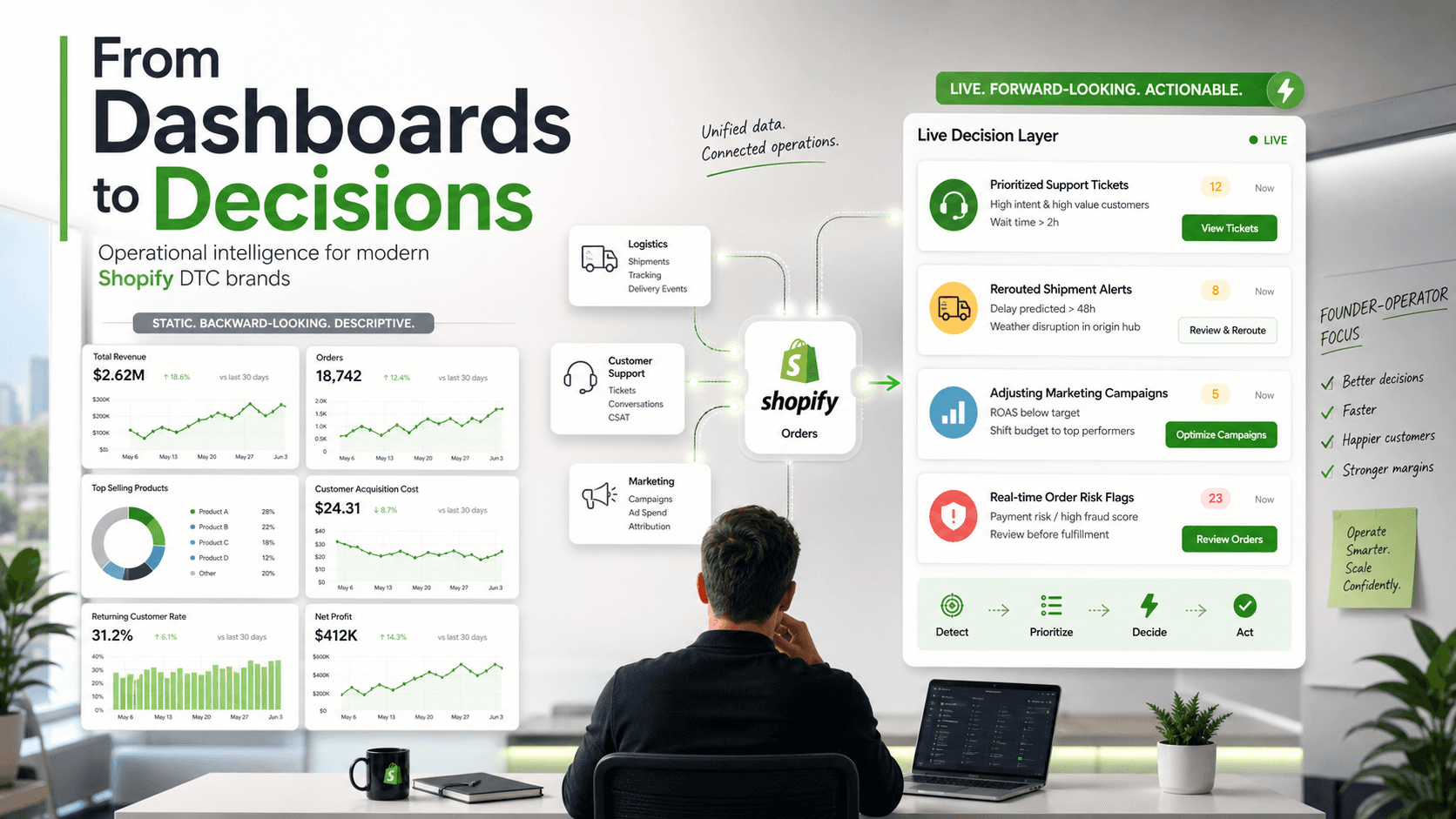
In the Shopify Growth Series, we covered a unified decision layer - a system that sits between Shopify, your support tools, your logistics partners, your CRM, and your marketing stack. It ingests events from all of them and decides what happens next.
Operational intelligence is the intelligence powering that decision layer.
What the Decision Layer Actually Does
Conceptually, the decision layer for a Shopify brand does four things:
Ingests events
- Shopify: order created, order updated, payment failed, refund issued.
- Logistics: shipment created, out for delivery, delay, failed attempt.
- Support: ticket created, sentiment low, SLA breach risk.
- Marketing: campaign launched, threshold spend reached, segment added/removed.
Evaluates rules and models
- Business rules: "If COD order value > ₹X and customer score < Y, require OTP confirmation."
- AI models: fraud risk scores, customer lifetime value predictions, churn risk, propensity to reorder.
Triggers actions
- Update Shopify order tags or notes.
- Re-route ticket priority or assign to a specific team.
- Trigger or pause a marketing flow.
- Fire a webhook to your logistics or ERP system.
- Hand control to an AI voice or chat agent for a particular flow.
Learns from outcomes
- Did the decision reduce RTO? Improve CSAT? Increase repeat purchase rate?
- Feed that back into models and rules to improve the decision layer over time.
In a world where AI is permeating ecommerce - from recommendations to pricing to support - real-time decisioning on operational data is the missing link that turns AI from tools into actual leverage.
Three Operational Intelligence Use Cases for Shopify DTC Brands
Use Case 1: Live Support and CX Prioritisation
Most Shopify brands measure support performance using BI-style metrics: average response time yesterday, ticket volume last week, CSAT trends. Useful, but all backward-looking.
Operational intelligence changes what happens while the queue is forming.
Example: The system sees a spike in "Where is my order?" tickets from a specific carrier in a specific region in the last 30 minutes. It also sees delayed scan events from the logistics partner's API for that region.
The decision layer does three things automatically:
- Tags those tickets with a high-priority label and moves them up the queue.
- Triggers a bulk proactive message to impacted customers explaining the delay.
- Temporarily adjusts the delivery time estimates on the site/checkout for that region.
This is operational intelligence: live operational data → immediate action → reduced frustration and fewer repeat contacts.
Use Case 2: Inventory and Fulfilment Risk Management
Traditional BI tells you which SKUs were out of stock last month and how that impacted revenue.
Operational intelligence monitors stock, demand, and logistics in real time and changes the experience accordingly.
Example: The system sees inventory falling below a critical threshold for a fast-moving SKU. It also sees a surge in traffic coming from an influencer campaign. The decision layer can:
- Reduce discounting on that SKU or remove it from aggressive promo slots.
- Switch "delivery in 2–3 days" to "delivery in 5–7 days" based on predicted logistics load.
- Automatically generate a reorder recommendation and send it to the ops team.
Again, the value is not the report. It is the system behaviour changing in the moment.
Use Case 3: Real-Time Marketing Guardrails
AI is making ecommerce marketing more automated - from creative generation to campaign optimisation. But in many brands, the marketing engine runs blind to operational health.
Operational intelligence connects the ad machine to the operations machine.
Example: The decision layer monitors carrier performance and NPS in real time. If it detects CSAT dropping or delivery delays in a key region, it can:
- Automatically scale down campaigns targeting that region.
- Shift spend to regions where operations are healthy.
- Trigger an internal alert for the CX and ops teams.
Instead of a weekly "we had a bad week in XYZ region" slide, the system quietly prevents that bad week from compounding.
Why Dashboards Alone Become an Operational Liability
At a certain scale, relying only on BI dashboards becomes not just insufficient, but actively risky.
Here is what typically happens in a scaling Shopify brand:
- Every function builds its own dashboard.
- No one owns the cross-functional connection between cause and effect.
- Decisions are made late, after damage has already been done.
- Teams become reactive - putting out fires that could have been prevented.
Operational intelligence does not replace BI. It sits beside it and ensures that insights translate into live, continuous changes in the way systems behave.
Think of it this way:
- BI is your "monthly report to the board."
- OI is your "real-time co-pilot" that quietly prevents many of the issues that would have filled that report.
The InovaBeing Moat: Operational Intelligence for Shopify DTC
At InovaBeing, we decided not to build "another Shopify dashboard."
We chose to build the decision layer and the agentic infrastructure that sits on top of it.
For Shopify DTC brands, our moat is simple to describe and hard to replicate:
We turn your fragmented operational data into a live operational intelligence layer that powers AI agents and automated decisions across support, logistics, and post-purchase - without forcing a platform migration.
How the InovaBeing Operational Intelligence Stack Works
For Shopify DTC brands between ₹1 crore and ₹50 crore in monthly revenue, the deployment looks like this:
Phase 1 - Real-Time Data Spine (Weeks 1–2)
- Connect Shopify, helpdesk, logistics APIs, and marketing platforms via webhooks.
- Normalise events into a unified schema (orders, shipments, tickets, campaigns).
Phase 2 - Operational Intelligence Rules & Models (Weeks 2–4)
- Define high-leverage rules (COD risk, VIP prioritisation, delay-based adjustments).
- Deploy AI models where needed (fraud risk, LTV, churn risk, demand signals).
Phase 3 - Decision Layer in Production (Weeks 4–8)
- Route support tickets based on live signals and customer context.
- Adjust messaging, promises, and flows in real time based on operational health.
- Drive AI agents (voice + chat) with accurate, live data from the decision layer.
Phase 4 - Continuous Optimisation (Week 8 onward)
- Track impact on RTO, CSAT, repeat purchase, and support cost per order.
- Refine rules and models based on performance.
In plain terms: we take what BI tools are only showing you after the fact, and we wire it into the systems that can act on it before the damage hits your P&L.
Operational Intelligence vs BI for Shopify - A Quick Summary Table
| Question | BI (Dashboards & Reports) | OI (InovaBeing Decision Layer) |
|---|---|---|
| What time frame does it operate in? | Yesterday, last week, last month | Now, last few minutes/hours |
| Where does it sit in the stack? | Analytics / reporting layer | Operational / execution layer |
| Who uses it day-to-day? | Founders, leadership, analysts | CX, ops, fulfilment, marketing operators |
| What does it produce? | Insights, charts, performance summaries | Actions, routing decisions, alerts, AI agent instructions |
| How does it change outcomes? | Indirectly, via human decisions later | Directly, by changing system behaviour in real time |
| Example in support | "Last week AHT was 9 mins" | "Today, VIP complaint bumped to top of queue, low-value spam deprioritised" |
| Example in fulfilment | "Last month RTO was 11% in Region X" | "Today, high-risk COD orders in Region X require OTP confirmation" |
| Example in marketing | "Last quarter ROAS in Region Y was 1.5x" | "This hour, campaigns in Region Y throttled because CSAT dropped there" |
Both matter. But they are not substitutes.
Conclusion: The Last Mile Between Data and Decisions
In 2026, most Shopify brands are not suffering from a lack of AI or a lack of data.
They are suffering from a lack of operational intelligence - the connective tissue that turns all that data and all those tools into real-time, compounding advantage.
BI answers:
"What happened, and how do we feel about it?"
Operational intelligence answers:
"What is happening, and what do we do right now?"
The brands that win the next five years in DTC will be the ones who move fastest on that second question. They will be the brands whose systems quietly make better decisions every hour of every day - on who to prioritise, what to promise, when to ship, where to spend, and how to respond - while everyone else is still opening another dashboard tab.
If you are a Shopify DTC founder who is tired of dashboard-watching and ready to build a decision layer instead, book a free Operational Intelligence Diagnostic with InovaBeing. We will take one live operational problem in your Shopify brand (support backlog, RTO spike, regional delays) and show you the live data streams already available in your stack, the concrete places where a decision layer could act in real time, and a 6–8 week plan to deploy operational intelligence without changing your existing tools.