
There is a specific quote every Indian D2C founder with 200 SKUs has stared at, and rejected, and then stared at again. It says ₹1 lakh to ₹2 lakh for a catalog shoot. Fifteen working days. And that's if nothing goes wrong.
You add a colour variant next month. Another ₹40,000. You refresh the packaging in September. Another ₹80,000. The Diwali campaign needs lifestyle. Another shoot. Every quote is reasonable in isolation and impossible in aggregate. So most brands do what most brands do - they shoot the top 30 SKUs professionally and let the rest sit with phone photos on a tabletop.
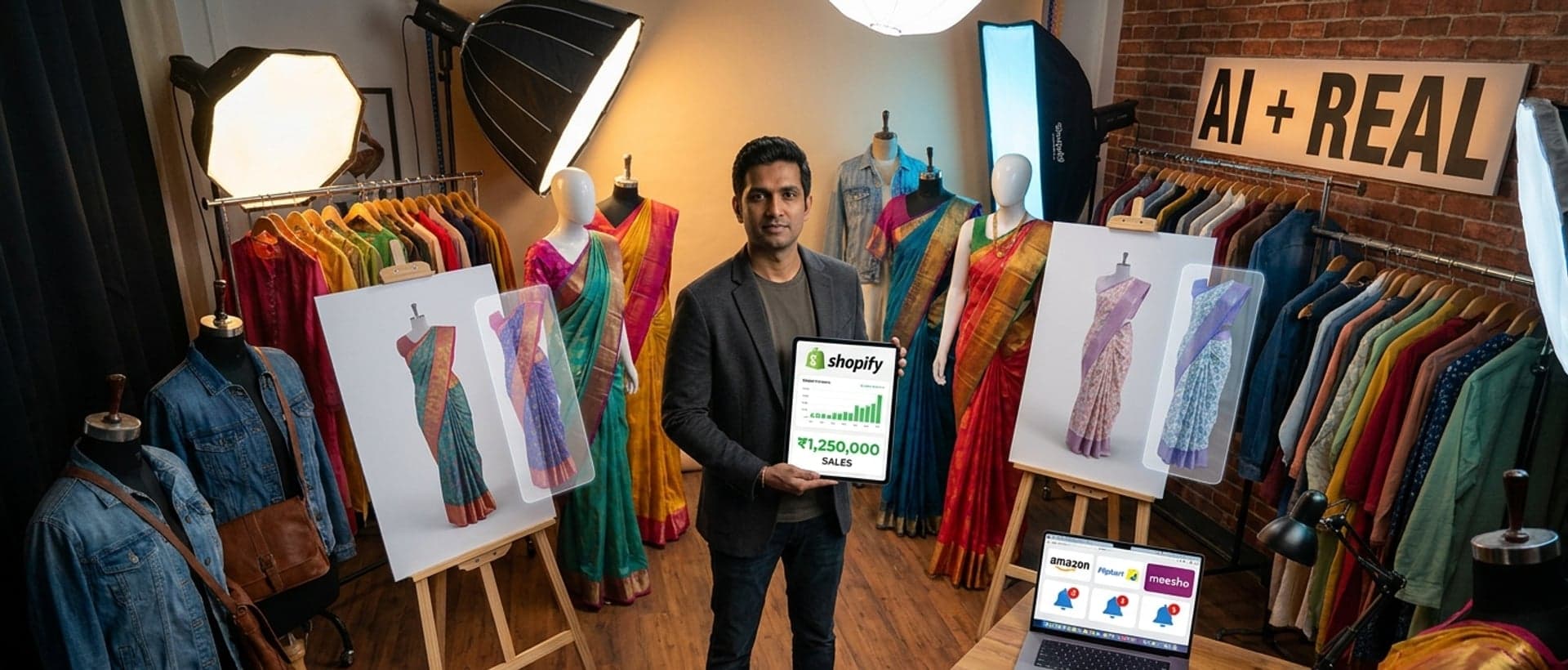
That is the specific gap the managed AI workflow closes. Not "AI replaces the studio." Not "here's a tool you can subscribe to." The honest workflow is a specific sequence: shoot the marketplace-compliant hero once, lock a reusable brand recipe, generate every variant and refresh against the recipe with human QA on every image before it ships. Real photograph where it must be real. AI where the studio math no longer works. One coherent catalog.
Why does traditional catalog photography break at 200-plus SKUs?
Quick Answer: Indian studio pricing lands at ₹250 to ₹1,000 per finished image, which puts a 200-SKU catalog at roughly ₹50,000 to ₹2 lakh per cycle. That would be workable if catalogs were static - but they aren't. Variants explode the SKU count (a shirt in 4 colours and 5 sizes is 20 SKUs), seasonal refreshes force re-shoots, and marketplace format changes require re-crops. The economics only balance for the 20 percent of the catalog that carries the brand. The other 80 percent is where studio pricing breaks.
The number that founders miss in the initial quote is the recurrence. A 200-SKU catalog shoot takes 15 to 25 working days end-to-end. During those weeks the catalog is frozen. Then variants arrive. Then packaging changes. Then Amazon changes its hero image spec and you need re-crops. Every one of these events triggers a phone call, a re-quote, and another calendar block.
Layer on the marketplace requirements. Amazon needs the primary hero at 2000x2000 pixels with a plain white background. Flipkart requires model-worn shots for apparel. Meesho has its own listing template. Every one of these needs a specific crop or a specific reshoot. Studio pricing charges per output, not per source. That charge stacks.
And variants. Anyone who has sold apparel knows the SKU math. A T-shirt in 4 colours, 5 sizes, is 20 SKUs. Nobody photographs 20 SKUs. Most brands photograph one and use a single image across all variants. That works until you check the conversion data - using a generic image across colour variants cuts conversion 18 to 35 percent. The work has to happen. It's a question of how.
Can you actually use AI-generated images on Amazon, Flipkart, or Meesho in 2026?
Quick Answer: Partially, and the policies are getting stricter. Amazon India requires the primary listing image to be a real photograph on plain white background - AI cannot be the hero. Flipkart requires model-worn shots on real models for apparel and rejects synthetic model imagery at QC. Meesho actively detects and prohibits AI-generated product imagery across all listings. Secondary lifestyle, PDP supporting, ad creative, and reel content are permitted across the board, with the accurate-representation rule.
This is the single most misunderstood piece of the AI catalog conversation. Founders read "AI images cost 90 percent less" and assume the whole catalog moves to AI. It does not. The marketplace hero image, for the products you sell on marketplaces, still needs to be a real photograph. The moderation teams at Amazon and Flipkart have been trained to flag AI. Meesho's detection is automated. Getting a listing suspended for policy violation is a real cost most founders factor at zero until it happens.
The workflow that actually works is a split. The primary listing image on marketplaces is a real photograph - shot once, marketplace-compliant, reused for the life of the SKU. Everything else - the PDP secondary shots on your own Shopify store, lifestyle imagery for reels and ads, category page hero variants, campaign creative, seasonal refreshes - is AI territory. That split is roughly 20 percent studio (primary + hero + macro + drape) and 80 percent AI (variants + lifestyle + ads + refresh).
For brands not selling on marketplaces at all, the split shifts further toward AI - closer to 10/90. For brands where marketplaces are the majority of revenue, the split stays around 30/70 studio-heavy. Your specific split depends on your channel mix, not on AI's technical capabilities.
What does an honest managed AI catalog workflow actually look like?
Quick Answer: Three stages. One - a hero photography day where the studio-mandatory shots happen (marketplace primary images, category heroes, jewellery macro, apparel drape). Two - a brand recipe lock: lighting direction, background palette, composition convention, colour temperature, prop language, model choice. Three - a generation-QA loop where every subsequent SKU, variant, or refresh renders against the recipe with human review before it ships. Recipe stays reusable for every future SKU. Human QA catches drift before it reaches production.
Stage one is compressed. A single studio day, in India, covers 30 to 80 SKUs depending on complexity. Marketplace hero images for the top 20 to 40 SKUs in a 200-catalog is one such day. The output is the source-of-truth photograph for each SKU - the reference every subsequent AI render matches.
Stage two is where most brands stall - and where the value actually lives. The recipe is the durable asset. It's a documented brief that captures: soft daylight lighting from the upper left; solid off-white background (Pantone 11-0602); tight center-crop composition with 15 percent negative space; no props on hero shots, seasonal props allowed on lifestyle; warm amber accent tone for skincare, cool teal for tech, neutral for apparel. The recipe takes 3 to 5 days to lock properly. It's reused for every future generation.
Stage three is the ongoing operation. New SKU arrives, gets photographed (if hero) or spec'd (if variant). The AI generates the image against the recipe. A human reviews it - checks the label rendered correctly, the shadow behaves, the packaging colour matches, the brand feels right. Approves or sends back for regen. Ships to Shopify, marketplace channels, ad platform in the correct format cuts. Elapsed time per image: hours, not days.
The whole thing is priced as a range against traditional studio - less than half typical studio rates for equivalent volume, delivered in days not weeks. The exact number depends on catalog complexity and recipe depth, not on the underlying generation technology.
What happens with variants, seasons, and marketplace format changes?
Quick Answer: These are exactly the workflows managed AI handles best. Variants: one source photograph plus recipe-locked variant renders for every colour and size, without re-shooting. Seasons: same catalog re-lit for Diwali, wedding, festive palette against the recipe. Marketplace format changes: Amazon updates hero spec, recipe re-renders the catalog to spec without a fresh project. All three cases would be full re-shoots in a studio pipeline. In a managed AI workflow they are day-scale operations.
Variant photography is the biggest single ROI unlock. A single apparel brand launching a T-shirt in 5 colours instead of one means 4 additional variant renders per style. Across a 30-style collection, that's 120 additional images. Studio pricing on that math is prohibitive. Recipe-locked AI generation handles it in a working day.
Seasonal refresh is the second unlock. Every August your catalog needs Diwali-adjacent staging. Every November it needs wedding-context imagery. Studio would reshoot. Managed AI re-lights the existing catalog against the seasonal recipe variant. Same source photograph, different staging.
Marketplace format compliance is the quiet third unlock. Amazon changed its hero image dimensions in Q1 2025. Flipkart introduced a new spec for footwear listings mid-2025. Meesho tightened image requirements for beauty in Q2 2026. Every one of these events triggered a re-crop panic for brands running studio-only. Managed AI absorbs these changes as recipe operations. Nobody at the brand has to know the new rule.
When is studio still the right answer inside a 200-plus catalog?
Quick Answer: For the marketplace primary hero images (mandatory), category page heroes that ads and social lead with, jewellery and macro work where the product IS the image, saree and lehenga drape physics that AI cannot render convincingly at inspection, and any product where a small visual error looks like a defect. That is roughly 15 to 20 percent of the catalog. Everything else - variants, lifestyle, backgrounds, seasonal, PDP supporting, reel content - is managed AI territory. The split isn't AI vs studio; it's which parts of the catalog use which.
Hero PDP images earn the studio treatment because they run for two years across every ad and marketplace listing. Amortised per-day cost is low. Failure cost is high.
Jewellery, macro, and premium packaging still favour studio. Shadow behaviour and reflective surfaces are where AI still fails inspection at the top 5 percent of visual fidelity. A ₹40,000 nose pin misrendered undersells the product. Studio sells it.
Saree drape, lehenga flare, live fabric physics still favour studio. Stitched garments on model shoots work well with AI; unstitched fabric drape still fails at inspection.
Everything else is where the workflow lives. The 80 percent of catalog work that a studio pipeline can't economically serve is precisely what managed AI is built for.
We build this workflow for D2C brands where the catalog is the operational spine of the business - clients in D2C skincare and in catalog-scale corporate gifting. In both cases the imagery workflow is one piece of a broader operational intelligence system - imagery is never a standalone problem when your catalog is your business.
What should you do next?
Skip the "AI vs studio" question. Answer the split question instead.
Make a two-column list of every SKU you sell. Column A - the products that will run as marketplace primary hero images, or category ads, or magazine spreads. Column B - everything else. Column A is usually 15 to 20 percent of the catalog. Column B is the rest.
For Column A, budget studio. For Column B, brief a managed AI service against your specific brand recipe, marketplace channel mix, and refresh cadence. The math surfaces immediately.
If you want a scoped quote against your specific SKU list, brand style, and channel mix, book an AI imagery audit and we'll come back with the split, the recipe brief, and the estimated managed spend for Column B against your current studio spend. No tool pitch. Just the workflow that fits your catalog.