
You noticed it. Your first AI-generated hero images felt exciting - fresh compositions, unexpected angles, a genuine sense of "we can create anything now." Three months later, you scroll your own catalog and everything looks... the same. Slightly warm lighting, slightly centred product, slightly moody background. Not bad. Not different from anyone else's AI-generated catalog either. Generic in a way you can feel but can't quite articulate.
Then you notice the same look on a competitor's site. Same warm lighting. Same centred product. Same moody background. Different logo, but the same visual grammar. You realise your AI-generated catalog and their AI-generated catalog could swap and no customer would notice.
That's the specific problem nobody in the AI tool marketplace is honest about. AI image tools converge to a shared visual mean over time - not because the models are getting worse, but because the workflow around them is doing nothing to prevent it. This post is what's actually going on, and the specific fix that separates managed AI photography from DIY.
Why do AI-generated images look fresh in month one and generic by month three?
Quick Answer: Two things happen simultaneously. First - in month one, you're exploring, using varied prompts because you don't know what works yet. By month three, you've settled into a small set of prompts that work reliably. Your prompt variance drops. Second - every AI image generation model has a strong pull toward its training-data mean style. Without deliberate counter-force, every image drifts closer to that mean over hundreds of generations. The interaction is that your narrowing prompt set makes the model's baseline style dominant, and the baseline style is what everyone else's outputs converge to as well.
The specific technical mechanism is that image generation models learn a probability distribution over image styles from their training data. Without strong prompt-level constraints AND workflow-level recipe constraints, the model samples toward the highest-probability region of that distribution - which is the visual style most represented in training data. That mean style is neutral, moderately warm, centre-composed, moderately detailed - because that's what the training data mostly is.
Every brand using the same underlying model without recipe-level constraints converges toward the same mean. Your brand and your competitor's brand look increasingly alike over time not because either of you got worse at prompts, but because you're both being pulled toward the same statistical centre.
The recognition often comes late because the shift is gradual. Month one images look different from month two which look slightly different from month three. Comparing month one to month three side by side reveals the drift dramatically. Comparing consecutive months hides it. Most brands don't do the month-one vs month-three comparison until they specifically look for it.
Is this a problem with the AI tool or the workflow around it?
Quick Answer: The workflow around it, almost entirely. Every major AI image generation model in 2026 - Midjourney, DALL-E via ChatGPT, Google Imagen, Ideogram, Flux, Stable Diffusion - has the same convergence property. Switching from one tool to another produces the same drift pattern within 60-90 days. What actually differs is the workflow discipline. Brands with a documented recipe layer applied consistently across every generation maintain brand distinctiveness over 12+ months. Brands without one drift, regardless of which tool they use.
The specific evidence for this is that ad agencies and enterprise brands using AI photography at scale rarely have this problem. Not because they use better tools, but because they treat AI image generation as a production pipeline with explicit brand-grammar controls - not as "we type prompts and see what comes out." The discipline is the difference.
For most Indian D2C brands trying AI photography DIY, the tool marketing doesn't emphasise the workflow layer because the workflow layer isn't a product they sell. Tool vendors sell tools. The workflow around the tool is where the brand consistency lives, and it's the responsibility of the buyer to build - which is why most DIY implementations fail at the 60-90 day mark.
What is a 'brand recipe' and why does it prevent the drift?
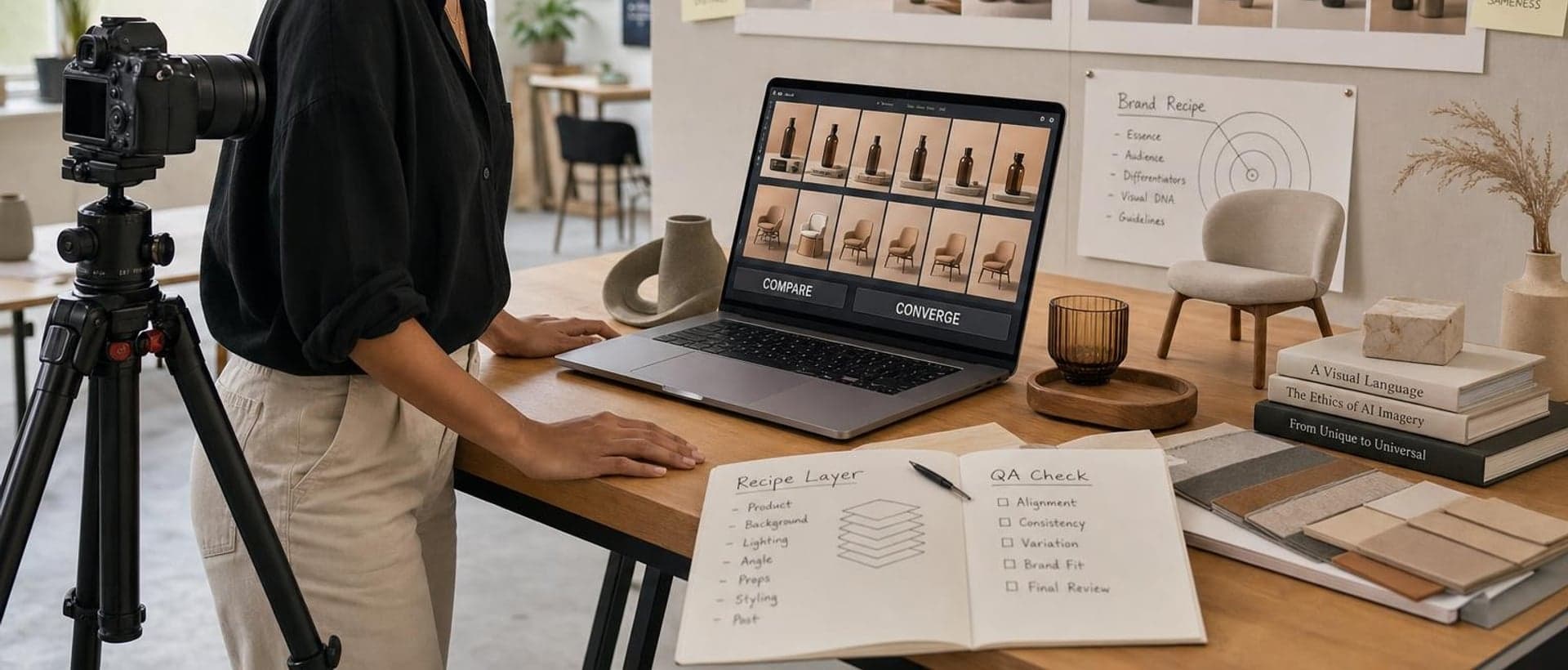
Quick Answer: A documented specification for the six style variables that determine visual identity - lighting (temperature, direction, quality), background (palette, material, complexity), framing (crop, subject placement, negative space), props (allowed categories, density), model style (if used), and colour rendering (brand palette, saturation, contrast). Each variable defined with concrete values rather than adjectives. Once locked, every subsequent generation inherits the recipe. This creates the counter-force that prevents drift toward the training-data mean. Without it, drift is inevitable.
The specific reason "concrete values" matters is that adjectives don't translate reliably. "Warm lighting" is a valid prompt but produces different results across generations because the model interprets "warm" within a distribution. "Colour temperature 3200-3800K, warm-tungsten cast, diffused single-source from upper-left at 60 degrees, minimal fill" produces predictable results because every parameter is specified.
The recipe is analogous to a photography studio's lighting setup document. Any competent photographer walking into that studio and reading the document could reproduce the shoot. Any AI generation reading the recipe as prompt context produces images consistent with the shoot. The recipe is the studio-quality specification made portable to AI workflow.
Building a recipe is a 3-5 day process. Day 1 - pull 20-30 reference images that represent the target brand grammar. Day 2 - analyse and extract specific patterns across all six variables. Day 3 - draft recipe with concrete values. Days 4-5 - test-generate, compare to references, tighten values. Once locked, the recipe is a durable brand asset reused indefinitely.
Why doesn't prompt engineering alone solve the drift?
Quick Answer: Because prompts are session-level and don't compose reliably across generations. Even a perfectly-written prompt run 30 minutes apart produces visibly different images due to the model's sampling variance. Scale that to 50 generations over 90 days and the variance dominates any consistency the prompts alone could provide. The recipe layer works because it operates at the workflow level - either via image-to-image generation with reference, or via structured parameter constraints - which is a stronger control than prompt-only.
The specific failure mode of prompt-only workflows is that founders spend increasing time writing longer, more detailed prompts hoping to fix drift. Prompts get to 200-400 words with elaborate style descriptions. The output is marginally more consistent but the effort scaling is unsustainable, and the drift still happens at the 60-90 day mark just slower.
The workaround that scales is not longer prompts - it's structured recipes plus image-reference workflows. A recipe locks the style parameters. An image reference (via image-to-image generation) locks the visual grammar. Together, they produce cross-generation consistency that prompts alone cannot achieve.
Does model quality (paying for the top-tier model) fix the drift?
Quick Answer: No. Model quality affects individual image characteristics - resolution, sharpness, detail rendering, prompt-following accuracy. Model quality does NOT affect brand consistency across a series. A cheaper model with a locked recipe produces more brand-consistent output than a top-tier model without one. Paying for Imagen 4 Ultra instead of Imagen 4 Standard improves per-image quality but doesn't prevent drift. The recipe layer is what prevents drift, not the model tier.
The specific tradeoff is that top-tier models have their own drift patterns because they were trained on the same broad visual distributions. The drift is toward a slightly better-rendered mean, not toward brand-distinctive output. If your ceiling is production-ready quality at brand-distinctive consistency, the recipe layer matters more than the model tier.
Where model quality DOES matter is text rendering (which we've felt directly this year), specific style capabilities (e.g., anime, technical diagrams), and specific detail categories (e.g., product texture, packaging accuracy). Choosing the right model for your category matters. Paying more for the same category rarely does.
How do you test whether your AI images are actually drifting?
Quick Answer: Three specific tests. First - the swap test. Show 5 of your recent AI images alongside 5 competitor images (or a random selection of AI-generated D2C content) to someone unfamiliar with any of the brands. Ask them to sort into two piles by "same brand." If they can't reliably do it, your brand grammar has drifted. Second - the month-over-month comparison. Line up your top 10 images from month one, month three, month six. Look at the aesthetic delta. Third - the reference alignment check. Compare your recent outputs to the reference images you initially set as your brand style. If the current outputs don't match, drift is confirmed.
Run these tests every 60 days. Most brands only run them when a specific incident prompts the question (a customer says "your feed looks like everyone else's now" or a marketing hire notices during onboarding). By then the drift is 6-9 months in and the recovery takes longer.
The specific brands that avoid this problem are the ones who treat "brand grammar audit" as a monthly ops item, not an occasional creative-team exercise. It's a discipline that compounds over years and reveals itself as a visible brand equity advantage.
What actually separates managed AI photography from DIY?
Quick Answer: Two workflow layers, both invisible from outside. First - a documented, versioned recipe that gets applied consistently across every generation and updated as the model improves. Second - a human QA loop that catches drift before it reaches production, plus monthly reference reviews that keep the recipe current. DIY workflows lack both. That's why DIY workflows drift and managed workflows compound.
The specific human-QA-loop mechanic is that every generated image goes through a check against the recipe reference before shipping. Images that drift outside acceptable variance get regenerated with tightened parameters. Over hundreds of generations, this creates a feedback loop that keeps the workflow tight. Without human QA, drift accumulates silently.
The monthly reference review updates the recipe as the model gets better - new capabilities, new failure modes, new best practices. This prevents the recipe from becoming outdated relative to what the current-generation model can actually produce. DIY workflows lack this update cadence and their recipes get stale, which contributes to the "boring at month three" experience.
For most Indian D2C brands where visual identity is genuinely core to the brand (beauty, apparel, lifestyle, home decor), the managed workflow is not a preference - it's the difference between "AI photography that helped for 3 months" and "AI photography that compounds into a brand equity advantage over 3 years." Both approaches exist. They produce very different long-term outcomes.
What should you do next?
Do the swap test tonight. Show 5 of your recent AI images alongside 5 from another brand's AI-generated content to someone who doesn't know either. Ask them to sort by "same brand." Note the result honestly. This one 5-minute test tells you whether you have a drift problem or not.
If the swap test fails, audit your workflow honestly. Have you documented your brand's specific style variables (lighting, background, framing, props, model style, colour rendering)? Or are you writing new prompts each time hoping consistency emerges? If it's the latter, you've been fighting the wrong battle.
Then decide the fix scope. If your visual identity is core to your brand and you're at 30+ AI images monthly, invest in the recipe layer - either DIY over 3-5 days with a dedicated workflow document, or via a managed service that builds the recipe and maintains the QA loop. If your visual identity is peripheral or you're generating fewer than 10 monthly images, prompt-level care might be enough.
If you want us to run the drift audit on your current AI images, document the recipe your brand should have, and set up the workflow to maintain it, book an AI imagery diagnostic. We come back with the drift honest assessment, the recipe brief specific to your brand, and either done-with-you or done-for-you options. Not a tool pitch. The workflow layer that actually prevents the drift.