
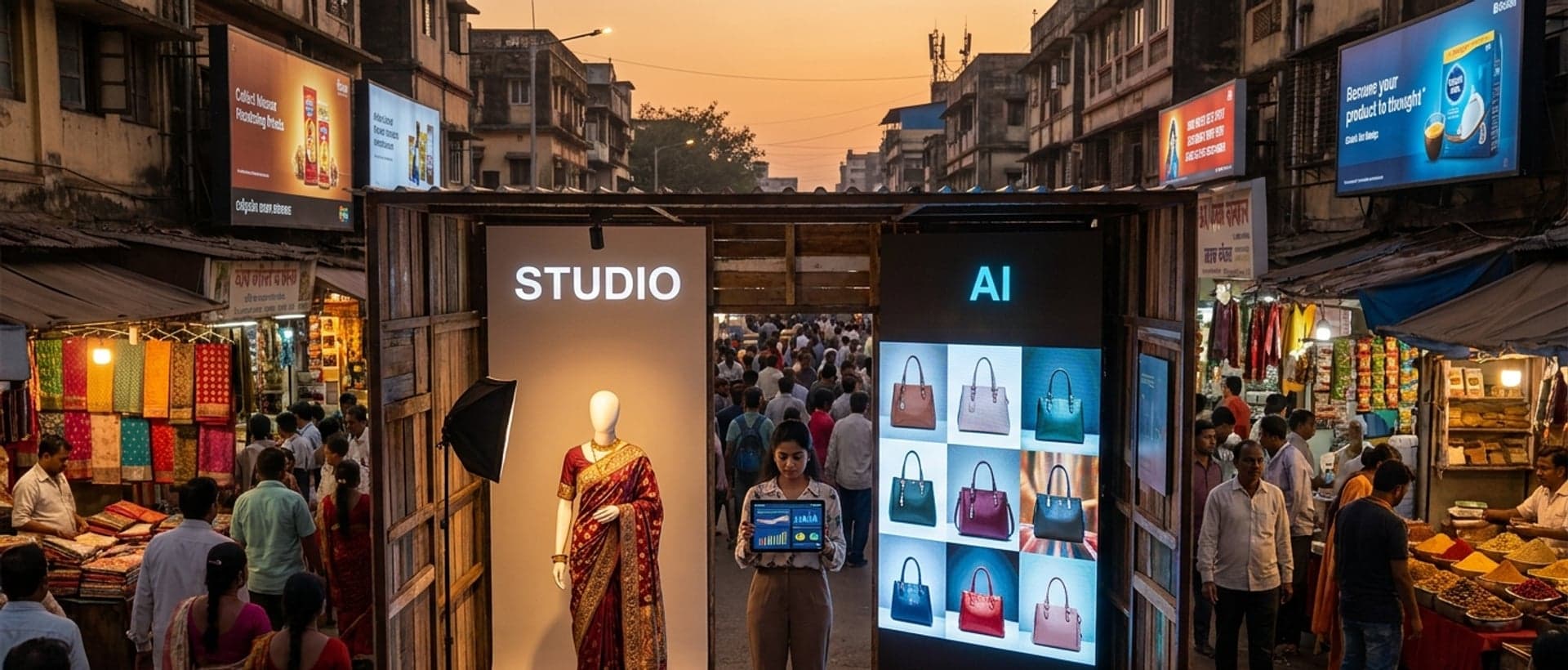
The AI-versus-studio debate for product photography is one of those questions that stopped being interesting once the numbers settled. For Indian D2C brands in 2026, professionally managed AI imagery costs a fraction of what a traditional studio catalog project runs, and delivers in days rather than weeks. That is not a debate any more. That is arithmetic.
The interesting question, the one every founder we work with is actually stuck on, is different. It is: which 20 percent of your catalog earns the studio treatment, which 80 percent belongs to AI, and how do you run the workflow at catalog scale without the visual quality drifting into obvious shortcuts?
Because the failure mode of doing AI photography badly is not "it looks a bit AI." It is that your brand starts looking assembled instead of considered. Fifty product images, each slightly off-brand from the others, quietly damages the trust equity you spent two years building. The tool is not the problem. The workflow is.
What does traditional product photography actually cost an Indian D2C brand?
Quick Answer: In 2026 India, professional product photography ranges from ₹150 to ₹1,500 per shot for high-volume catalog work, ₹1,500 to ₹8,000 per image for polished PDP work, and full studio day rates between ₹1.45 lakh and ₹3.6 lakh - before models, styling, or edit cycles. A 200-SKU catalog with 2 images per SKU realistically runs ₹2 to 6 lakh in image fees alone, plus 2 to 4 weeks of calendar time. Model or lifestyle shoots add ₹15,000 to ₹1 lakh per single professional shoot on top.
The numbers hold up across published rate cards from working Indian studios. CK Studio Mumbai publishes ₹150 to ₹1,500 per image as its typical range. National surveys from professional photography networks put per-image rates between ₹1,500 and ₹8,000 for polished work, with hourly rates of ₹5,000 to ₹12,500. Full-day studio hire lands between ₹1.45 lakh and ₹3.6 lakh depending on location, complexity, and post-production commitments.
The number that stings the most is not the per-image cost. It is the calendar time. A 50-SKU catalog realistically takes 2 to 4 weeks between briefing, shoot day, revision rounds, and delivery. For brands running seasonal drops, launch campaigns, or marketplace expansions, that timeline is the constraint - not the money.
Then there are the ongoing costs studio pricing does not surface until the invoice arrives. Reshoots for damaged product samples. Revisions when the brand direction shifts mid-shoot. New variant photography every time you add a colourway. Every one of these is a phone call and a re-quote.
What does professionally managed AI imagery actually replace?
Quick Answer: Managed AI imagery replaces the 80 percent of catalog work that is variant swaps, background changes, seasonal refreshes, marketplace-specification compliance, lifestyle B-roll for reels, and PDP supporting shots. Turnaround compresses from weeks to days for equivalent scope. Effective cost sits at less than half of a comparable studio catalog project - the exact number depends on brand style-guide complexity and review-approve cycles, not on the underlying generation technology.
The value framing that matters is not "AI is cheaper than studio." It is that AI is a different production model. Studio is a discrete project - brief, shoot, deliver. Managed AI is a continuous workflow - once your brand style guide is in the system, every subsequent SKU or variant fits the same visual language automatically.
For a D2C brand with an active catalog, that continuity is the actual product. When you launch a new colourway on Thursday and need it live on your Shopify PDP and three marketplaces by Monday, the studio path is not available. The managed AI path is a 24-hour turnaround with brand consistency baked in.
The specific work categories that map to managed AI:
Variant swaps. Same product, different colourways or fabrics. Studio work here is cost-prohibitive at catalog scale. AI handles it while maintaining brand cohesion.
Background changes. Same product across white background (marketplace), lifestyle setting (PDP), gift box context (festive), season-specific staging (Diwali, wedding). AI is faster and more consistent.
Seasonal refreshes. Existing catalog re-lit for a new campaign season without re-shooting product. Studio would demand a full re-shoot. AI handles it in a day.
Marketplace-specification compliance. Amazon changes its hero image rules quarterly. Flipkart and Meesho have overlapping-but-different specs. Managed workflow re-renders your catalog to spec without a studio project each time.
Lifestyle B-roll and reel content. Founder-recorded reels need matching lifestyle stills for the surrounding feed. Managed AI produces these at reel-cycle speeds.
PDP supporting shots. The 4 to 6 supporting images on a product page that aren't the hero. Volume work, low visual risk, straightforward for managed AI.
None of this eliminates the studio spend. It reallocates it to the shots where studio actually earns its cost.
When does the studio still win for Indian D2C?
Quick Answer: Traditional studio still wins on hero PDP images that will run for two years across every touchpoint, jewellery and macro work where the product IS the image, saree and lehenga drape physics that AI cannot render convincingly at inspection, PR and brand campaign shots destined for billboards or magazine spreads, and regulated categories where visual misrepresentation is a legal or trust liability. That is roughly 15 to 20 percent of a well-run catalog.
Hero PDP images earn the studio treatment because the failure cost is high and the amortised per-day cost across the product's lifetime is low. One studio day for hero images that run for two years costs less per day than one AI generation costs per hour, when you do the math properly.
Jewellery, watches, and macro work still favour studio. Shadow behaviour, refraction on gemstones, engraving detail - the top 5 percent of visual fidelity still fails on inspection with AI. A ₹40,000 nose pin on a bad AI render undersells the product. A studio shot sells it.
Saree drape, lehenga flare, sherwani cut. Live fabric physics on unstitched or complex-stitched garments still trips AI in 2026. Stitched garments on model shoots work well. Live drape does not.
PR, campaign, and brand launch shots. These end up on billboards, in magazines, on the back of retail packaging. Studio-plus-real-model is not an aesthetic choice - it is a risk management choice.
Regulated categories and anything where a small visual error looks like a defect. Medical devices, food packaging where the imagery is essentially the product claim. Legal accountability shifts the calculation.
Everything else - variant swaps, seasonal refreshes, lifestyle B-roll, backgrounds, marketplace secondary images, reel assets, PDP supporting shots - is managed AI territory. That is 80 percent of a real catalog. For some brands more.
What does a managed AI photography workflow actually look like?
Quick Answer: A properly managed workflow starts with a brand style-guide session - lighting direction, background palette, prop language, composition conventions - locked into a repeatable brief. From there, every SKU or variant goes through a generation-review-approve loop with 24-hour turnaround. The managed layer handles style consistency, marketplace-spec compliance, edit cycles, and rollback if quality drifts. The brand's job is to approve, not to prompt-engineer.
The workflow is where the value is. DIY tools generate images. Managed service delivers a catalog. The difference:
Brand style consistency. The first review of a new brand's images sets the tone that every subsequent image inherits. Without that, you get 200 images that each look fine and collectively look assembled.
Review-approve loops. Not every image is a keeper. Managed workflow includes revision rounds without extra cost, so the brand gets to say "warmer lighting, less prop" without a re-quote.
Marketplace-spec updates. When Amazon updates hero image rules, your managed catalog gets updated automatically. When Flipkart changes secondary image specs, same thing. Nobody at your team has to know the new rule.
Rollback and audit. Every generated image has a source brief. If a customer complaint surfaces a colour mismatch or misrepresentation, the audit trail exists.
Reshoot equivalence. If a product changes packaging, the workflow re-renders the affected images without a fresh studio project.
We build this workflow for clients running a growing D2C skincare catalog, and for catalog-scale corporate gifting photography. In both cases the customer discovery layer, the operational intelligence system, and the imagery workflow are all pieces of the same ops picture - imagery is not a standalone problem.
What should you do next?
Do not adopt a tool. Adopt a rule.
The rule is a two-column list of every SKU you sell, marked "hero" or "supporting." Hero SKUs get the studio treatment. Supporting SKUs get the managed AI treatment. Hero SKUs are usually 15 to 20 percent of what you carry - the ones that will run in ads for the next two years, the ones on category landing pages, the ones that define the brand aesthetically. Everything else is supporting.
Start with that list. Then get a scoped quote on the managed AI side for the supporting SKUs. Compare against your current studio spend on those same SKUs. The math usually surfaces immediately.
If you want us to run that comparison for you - your specific SKU list, your specific brand style, your specific catalog scale - book an AI imagery audit and we'll come back with the hero/supporting split, the estimated managed cost for supporting, and the exact studio brief for the 15-20 percent that stays. No tool pitch. Just the workflow that fits your catalog.