
Shopify brands do not usually have a support problem in isolation. They have a growth problem that shows up in support. As order volume rises, the same questions repeat across channels: where is my order, how do I return this item, what is the size guide, can I change my address, and when will this ship? AI customer service for ecommerce is now a mainstream strategy, but the winning approach is no longer a generic chatbot. It is intelligent agents that can triage, answer, and act across the support workflow.
For Shopify operators, this matters because support load is not just a cost center. It affects conversion, retention, and brand trust. Faster response times reduce friction before purchase, while reliable post-purchase support reduces refunds, repeat tickets, and customer churn. This is why the question is not only "how do we automate Shopify support?" It is how to reduce Shopify support load with intelligent agents in a way that improves both efficiency and customer experience.
Why Shopify support load keeps growing
Shopify support volume grows for predictable reasons. More traffic creates more questions. More SKUs create more product confusion. More shipping partners create more tracking issues. More promotions create more "did my discount apply?" tickets. And more marketplaces, apps, and fulfillment flows create more exceptions that customers do not understand.
A Shopify support team usually ends up handling the same repetitive issues over and over again. The most common support intents are order status, shipping updates, returns, product details, cancellations, and basic policy questions. These are ideal for intelligent agents because the intent patterns are predictable and the actions can often be standardized.
What intelligent agents do differently
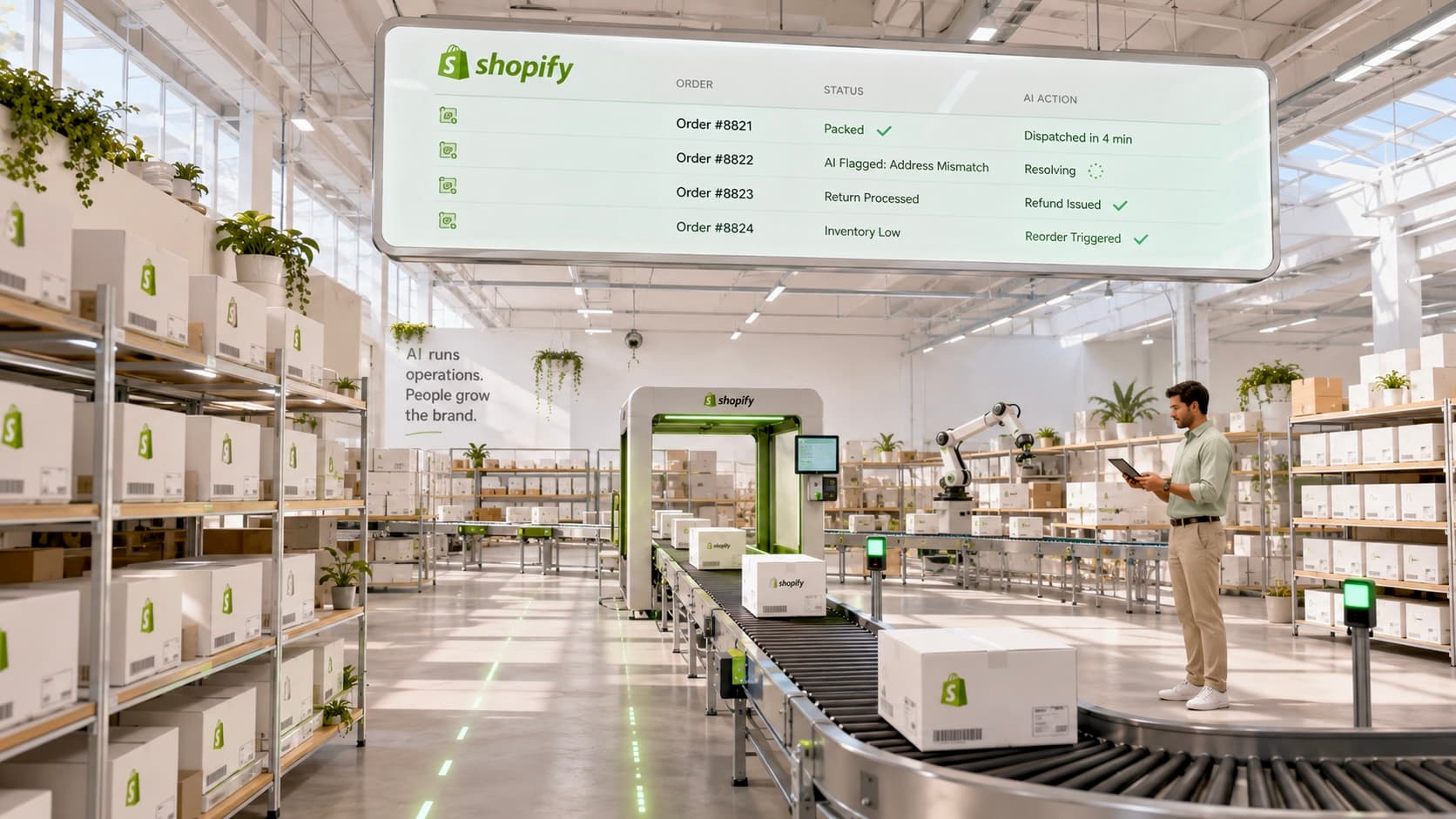
A traditional chatbot mostly answers questions. An intelligent agent can answer and then take action. In a Shopify context, that means checking order data, pulling tracking information, creating a return flow, routing a ticket, or escalating only when the issue falls outside policy.
That difference matters because support load is not only about response speed. It is also about whether the first response actually resolves the issue. When a customer asks "where is my order," an intelligent agent should not simply provide a generic reply. It should connect to the order system, fetch the live status, send the tracking link, and close the loop if possible.
The chatbot says: "I'll check on that for you." The intelligent agent says: "Your order #12847 was picked up by the courier at 2:14 PM yesterday and is currently at the Bangalore sorting facility. Estimated delivery is tomorrow between 11 AM and 2 PM. I've sent the live tracking link to your registered phone number."
One is a placeholder. The other is a resolution.
The best Shopify support workflows for intelligent agents
The best support workflows to automate are the ones with high volume, repeat structure, and clear policy rules. For Shopify stores, the top use cases are usually:
- Order status and tracking lookup - the single highest-volume support intent
- Shipping delay updates - proactively or in response to "where is my order" calls
- Return and exchange initiation - eligibility check + RMA generation + customer instructions
- Product availability and size guide questions - using catalog data as the knowledge base
- Address change requests before fulfillment - verify and update within the cutoff window
- Refund and cancellation status - pull from your payment processor and OMS
- Subscription or membership support - pause, resume, swap, cancel flows
- Basic store policy questions - shipping zones, exchange windows, payment methods
These workflows are easy to standardize and easy to measure. They are also the best first wins for brands that want to reduce support load without risking customer experience. Once these are running cleanly, more complex workflows can be added on top of the same agent foundation.
How support load reduction actually works
The most effective Shopify support systems follow a layered model:
1. Detect the intent
The agent identifies whether the customer is asking about shipping, returns, product details, cancellation, or something else. This is the triage layer - and getting it right is what separates a useful agent from a frustrating one.
2. Pull the right data
The agent connects to Shopify or the relevant support stack to fetch the live order, customer, or policy data needed to answer correctly. No live data = no real resolution.
3. Respond or act
If the question is routine, the agent answers directly. If the issue needs an action - create the return, send the tracking link, update the customer record, route the ticket - the agent takes the action and confirms the outcome to the customer.
4. Escalate only when needed
The agent passes edge cases to the support team with context already attached, so the human does not have to start from scratch. The human picks up knowing who is calling, what the issue is, what has already been tried, and what the next step should be.
This model reduces support load because it removes the most repetitive work from the queue while improving first-response quality. The team handles fewer tickets - and the tickets they do handle are the ones that genuinely need human judgment.
Why this is a growth lever, not just a support fix
Many Shopify teams think support automation is only about saving labor. That is too narrow.
Support quality affects checkout confidence, post-purchase satisfaction, refund rates, and repeat purchase behavior. When customers get fast answers, they are more likely to complete the order and less likely to abandon the purchase flow due to uncertainty. After the purchase, proactive tracking and issue handling reduce frustration and make the brand feel more reliable.
In that sense, intelligent agents reduce support load and improve ecommerce growth at the same time. You are not trading customer experience for cost savings - you are improving both. That is what makes this the strongest first AI deployment for most scaling Shopify brands.
Where InovaBeing fits
The strongest framing here is to position intelligent agents as part of a broader operational layer rather than a standalone chatbot project. Shopify brands do not just need "chat." They need agents that can answer, act, and coordinate across support and operations.
That positioning fits naturally with an AI Ops Architecture approach, because support is not isolated from the rest of the business. It touches orders, shipping, fulfillment, product data, and customer experience. The more connected the systems are, the more support load can be reduced without adding headcount - and the more those operational gains compound into retention and growth.
Pair intelligent support agents with AI voice receptionists on the inbound call channel, and you cover the two highest-volume customer touchpoints with a coordinated agent layer instead of stitched-together apps.
Closing point
Shopify brands that want to scale need more than faster response times. They need a support system that removes repetitive work from the queue, keeps customers informed, and connects support activity to the rest of the business.
That is why intelligent agents are the right next step. They reduce support load, improve customer trust, and create a cleaner operating model for growth.
If you are running a Shopify D2C brand and your support team is buried in the same tickets every week, intelligent agents are the operational upgrade that pays back the fastest. Book a discovery call - we will walk you through what an agent-first support layer looks like for your specific ticket volume and product complexity.