
The Call Nobody Answered Just Cost You a Customer
It is 9:17 PM on a Tuesday. A customer who placed an order three days ago has been checking their tracking link every few hours. The link has not updated. They are anxious. They pick up the phone and call your store.
Nobody answers.
They wait through a voicemail greeting. They do not leave a message. They open a competitor's site instead.
That call lasted 38 seconds and cost you a customer, a repeat purchase, and a potential referral.
This scenario plays out thousands of times every week across Shopify D2C brands that are growing their order volume faster than their support infrastructure can keep up with. According to a 2026 missed call revenue study, small and mid-sized businesses miss an estimated 25 to 60% of inbound calls, with performance declining sharply during peak demand periods and staffing gaps. The average annual impact of missed calls reaches $126,000 per year for SMBs - and higher-volume D2C brands feel proportionally more damage.
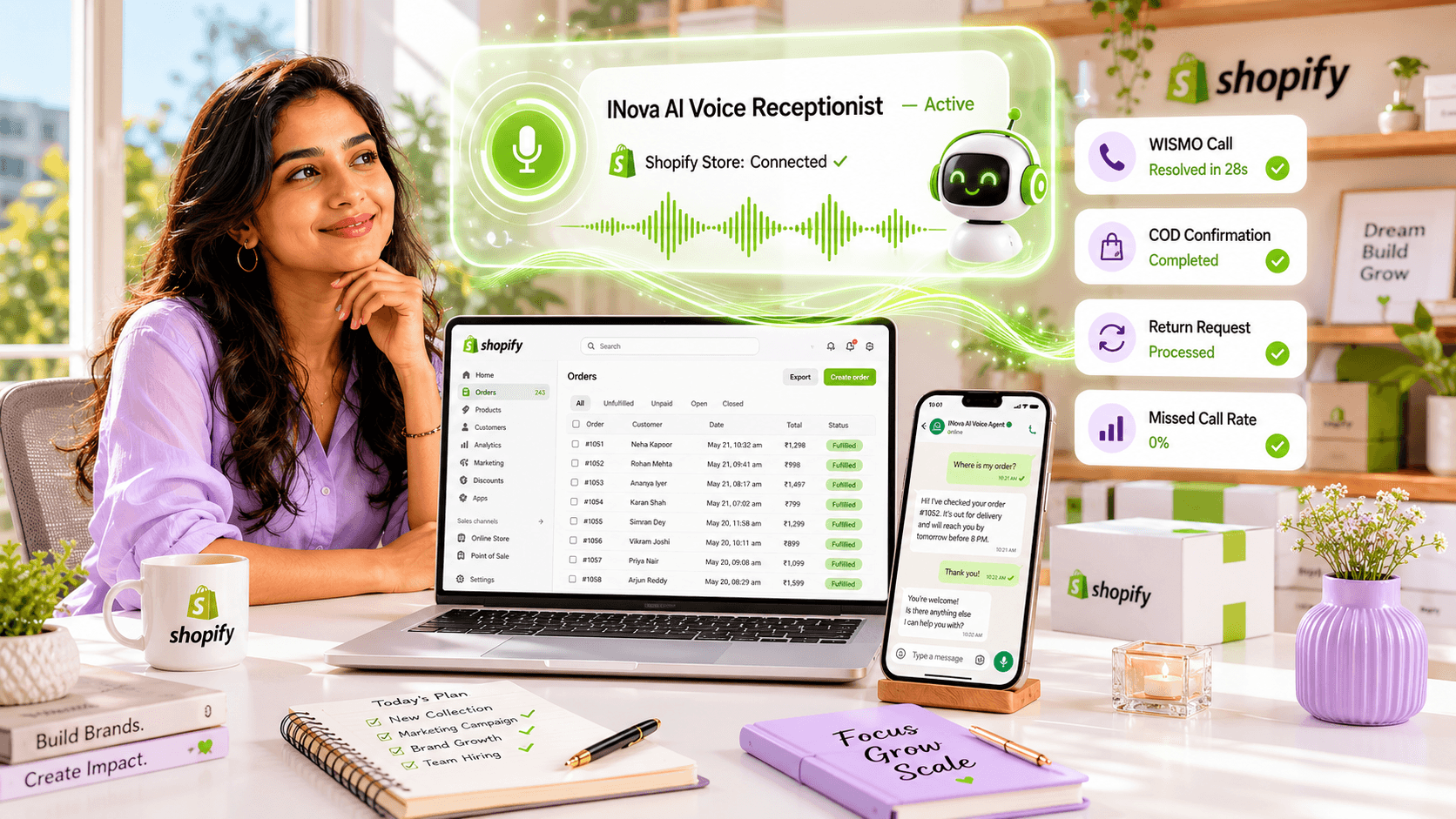
The solution is not hiring more support staff to answer phones around the clock. The solution is deploying an AI voice receptionist - a system that answers every call instantly, understands what the customer needs, connects to your Shopify data in real time, and resolves the majority of queries without a human ever getting involved.
This is Blog 2 of The Shopify Growth Series. In Blog 1, we covered how operations intelligence - not marketing performance - is the real growth engine behind every scaling Shopify brand. In this blog, we go deeper on the voice channel specifically: the most underserved, highest-cost, and highest-trust touchpoint in ecommerce customer service.
Part 1: Why Voice Is Still the Most Important Support Channel in Ecommerce
Customers Still Call. Especially When It Matters Most.
In an era of chat, email, and WhatsApp, it might seem like phone support is a declining channel. The data says otherwise - especially for ecommerce.
57% of service professionals believe automated voice assistants will become a top channel for customer communication, according to Salesforce research. More importantly, the calls that come in are the high-stakes ones: anxious customers with delivery problems, high-value orders gone wrong, return disputes, and time-sensitive queries that chat and email cannot resolve fast enough.
Voice is the channel customers turn to when the stakes are high and they need immediate resolution. Ignoring it - or staffing it inadequately - means failing customers at their most critical moment.
The Missed Call Problem Is Costing Shopify Brands Real Money
The 2026 PCN missed call revenue study found that SMBs miss 25 to 60% of inbound calls, with the problem worsening during peak trading periods - exactly when call volume is highest and your support team is already stretched.
Every missed call carries a direct revenue cost:
- The average missed call costs an ecommerce business $125 to $350 in immediate lost revenue.
- The annual impact reaches $50,000 to $200,000 or more depending on order volume and average order value.
- For a Shopify D2C brand doing ₹5 crore or more in annual GMV, even the lower end of that range represents a meaningful percentage of revenue walking out the door unanswered.
Phone Calls Recover Revenue That No Other Channel Can
Beyond inbound support, voice has unique commercial power:
- Phone calls achieve 70 to 85% connection rates for cart recovery - far higher than email or SMS.
- AI voice agents can make proactive outbound calls to customers who abandoned checkout, offering discount codes, answering hesitation questions, or simply reminding them their cart is waiting.
- For COD (Cash on Delivery) order confirmation, which remains a dominant payment method for Indian D2C brands, voice-based confirmation dramatically reduces return-to-origin (RTO) rates and failed deliveries.
The voice channel is not just a support cost. For D2C brands that deploy it properly with AI, it becomes a revenue recovery and conversion channel.
Part 2: The Size of the Voice AI Opportunity in 2026
The market data for voice AI in ecommerce reflects a technology that has crossed from experimental to essential:
- The global AI voice agent market is projected to grow from $2.4 billion in 2024 to $47.5 billion by 2034, at a CAGR of 34.8%.
- 80% of businesses have planned AI-driven voice solution integration for customer service in 2026.
- One in ten customer service interactions will be fully automated by voice AI by 2026.
- The AI customer service market overall is projected to reach $15.12 billion in 2026, with voice as one of the fastest-growing sub-segments.
- 76.4% of the market demand is for fully integrated voice AI platforms, showing a preference for comprehensive solutions over point products.
For Shopify D2C brands, the question is not whether voice AI will become mainstream - it already is. The question is whether your brand deploys it before or after your competitors do.
Part 3: What an AI Voice Receptionist Actually Does for a Shopify Store
An AI voice receptionist for a Shopify store is not an IVR menu. It is not "press 1 for orders, press 2 for returns." It is a conversational AI agent that answers calls the way a trained, knowledgeable human support rep would - except it is available 24/7, handles unlimited simultaneous calls, never has a bad day, and responds in under 3 seconds.
Here is exactly what a properly integrated AI voice receptionist does:
1. Answers Every Call Instantly, Around the Clock
No hold queues. No voicemail. No "we are currently closed." Every inbound call - whether it comes in at 2 PM on a weekday or 11 PM on a Sunday during a sale event - is answered immediately by the AI voice agent.
AI voice agents can handle 1,000+ simultaneous calls, versus one call per human agent at a time. During peak events - flash sales, Black Friday, product launches - this becomes the difference between every customer being served and hundreds of calls going to voicemail.
2. Handles WISMO Calls End-to-End Without a Human
Order tracking calls are the single largest category of inbound phone support for Shopify D2C brands - accounting for 20 to 40% of all support contacts and climbing to 50%+ during peak seasons.
An AI voice receptionist integrated with your Shopify store handles these calls completely:
- Greets the caller and asks for their order number or registered phone number.
- Authenticates the customer against your Shopify customer records.
- Pulls real-time order status and tracking data from your connected logistics provider.
- Reads out the current delivery status, estimated delivery date, and any delay information.
- Closes the call with the customer satisfied - in under 60 seconds.
What was a 5-minute human interaction becomes a 30-second automated resolution. Multiply that across hundreds of calls per week and the labour saving becomes immediately significant.
3. Processes Returns and Exchanges Over the Phone
The AI voice receptionist handles return and exchange requests by:
- Verifying the customer's order and return eligibility against your Shopify order data and return policy.
- Collecting the reason for return and preferred resolution (refund, exchange, store credit).
- Generating a return authorization and sending instructions via SMS or email immediately after the call.
- Logging the return request into your OMS or fulfilment system so your team can act without manual data entry.
4. Answers Product, Policy, and Pre-Purchase Questions
Using your product catalog, FAQ content, shipping policy, and size guides as its knowledge base, the AI voice receptionist answers questions that would otherwise require a human to look up and relay:
- "Do you ship to Pune?"
- "What is your exchange policy for gifted items?"
- "Can I change the color on an order I just placed?"
- "What is the difference between your standard and premium version?"
Every one of these calls is resolved without a human agent. For D2C brands with a wide product catalog or complex policies, this is a significant volume deflector.
5. Routes Complex Calls Intelligently to the Right Human
When a call genuinely requires a human - a complaint, a sensitive return dispute, a payment issue - the AI voice receptionist does not just transfer blindly. It:
- Collects context and summarises the issue during the call.
- Routes to the right team member with the full conversation summary already prepared.
- Ensures the human agent picks up knowing who is calling, what the issue is, and what has already been tried - reducing handle time and improving resolution quality.
6. Handles Outbound Calls for Revenue Recovery
Beyond inbound support, an AI voice receptionist runs proactive outbound campaigns:
- COD confirmation calls: Calls customers who placed COD orders to confirm delivery address and intent, reducing RTO rates by 30 to 50% for Indian D2C brands.
- Abandoned cart recovery: Calls high-intent customers who added to cart but did not complete checkout, offering assistance or a time-limited incentive.
- Post-purchase follow-up: Calls customers after delivery to confirm satisfaction, flag delivery issues proactively, and invite reviews.
- Win-back campaigns: Re-engages lapsed customers from your Shopify customer database with a personalized voice touchpoint.
Part 4: The India-Specific Opportunity - WhatsApp, COD and Vernacular Voice
For D2C brands operating in India, the voice AI opportunity has additional dimensions that make it even more commercially relevant than global benchmarks suggest.
COD Still Dominates and Creates a Specific Voice AI Use Case
Despite the rapid growth of UPI and digital payments, COD remains a significant share of orders for many Indian D2C brands - particularly for first-time buyers, lower-tier cities, and higher-ticket items. COD orders carry a higher risk of failed delivery and return-to-origin (RTO), which directly erodes margins.
AI voice agents that make automated COD confirmation calls - verifying the customer's intent, confirming delivery address, and addressing any hesitation - are one of the highest-ROI deployments for Indian D2C brands. A 30% reduction in RTO on COD orders can meaningfully improve net margins at scale.
WhatsApp Voice Is the Channel Indian Customers Actually Use
For Indian D2C customers, WhatsApp is not just a messaging app - it is the primary customer service channel. WhatsApp Business has over 200 million monthly active users in India, and customers increasingly expect to be able to call or message a brand directly through WhatsApp rather than hunting for a phone number or email address.
AI voice agents that integrate with WhatsApp Business allow D2C brands to handle voice and chat support through the channel their customers are already using - without requiring a separate phone line or a dedicated WhatsApp support team.
Vernacular Language Support Matters at Scale
Production voice AI in India in 2026 is now running in Hindi, English, Hinglish, Tamil, Telugu, Kannada, Marathi, Bengali, Gujarati, and Punjabi for D2C, fintech, and logistics use cases. For D2C brands selling to customers across India, voice agents that can respond in the customer's preferred language are not a luxury - they are a retention tool.
Part 5: The Real Performance Data - What AI Voice Agents Deliver in 2026
The performance benchmarks for AI voice agents in ecommerce customer service in 2026 are no longer hypothetical:
- Voice AI reduces average call handling time by 35%, improving service speed and agent productivity.
- Voice AI implementation increases customer satisfaction by 30%, enhancing the overall support experience.
- AI voice systems cut customer service queue times by up to 50%, reducing wait frustration and call abandonment.
- AI voice agents deflect 45% of routine support calls, minimising the need for human intervention.
- AI voice agents achieve 92% accuracy in first-level query resolution, ensuring reliable automation across standard query types.
- 70% of mid-sized businesses report a 40%+ jump in CSAT within 3 months of adopting AI customer service tools.
- A typical WISMO call resolved by an AI voice agent integrated with Shopify takes under 30 seconds - compared to 3 to 5 minutes for a human agent.
On the cost side:
- AI-powered customer service reduces operational costs by 20 to 30% across standard deployments.
- Voice AI reduces operational costs by up to 70% in high-volume deployments.
- For a D2C brand handling 500,000 calls per month at ₹100 per call, AI containment of just 25% of those calls eliminates 125,000 human-handled calls per month - a saving of ₹1.25 crore per month at scale.
Part 6: The Gap Between IVR and Agentic Voice - Why Most Deployments Fail
Not all voice automation is equal. Most D2C brands that have tried phone automation before found it frustrating to manage and rejected by customers - because they were using IVR (Interactive Voice Response) systems, not agentic AI voice.
| Traditional IVR | AI Voice Receptionist | |
|---|---|---|
| Interaction model | Press 1, press 2, press 3 | Natural conversation |
| Query handling | Pre-programmed menus only | Open-ended questions handled |
| Shopify integration | None or manual | Real-time live data lookup |
| First-call resolution | 20–35% | 60–92% |
| Customer experience | Frustrating, robotic | Natural, responsive |
| Language support | Single language | Multi-language, vernacular |
| Outbound capability | None | COD confirmation, recovery calls |
| Scalability | Fixed line capacity | Unlimited simultaneous calls |
| Learning over time | No | Yes - improves with every call |
The failure mode most D2C founders have experienced - customers pressing 0 immediately to reach a human, abandoning calls, or leaving negative reviews - is the IVR failure mode. Agentic AI voice is architecturally different: it listens, understands intent, accesses live Shopify data, and responds conversationally.
Closing Thought: Voice Is Where the Customer Trust Is Won or Lost
Every Shopify D2C brand has the same fundamental problem at scale: order volume grows faster than the team can respond to customers. Email and chat absorb some of that load. But the calls - the ones from anxious, high-intent, high-LTV customers who picked up the phone because they cared enough to - those are the ones that decide whether the customer comes back.
An AI voice receptionist is not a cost-cutting measure. It is a customer-keeping measure. The brands that deploy it first will compound the retention advantage every quarter; the brands that delay will keep losing customers they could have kept for the price of a properly architected voice agent.
Voice is where customer trust is won or lost. For Shopify D2C brands operating at scale, that channel is too important to leave to voicemail.
If you are scaling a Shopify D2C brand and watching your support load outpace your team, an AI voice receptionist is the operational change that pays back the fastest. Book a discovery call - we will walk you through what a Shopify-integrated voice agent looks like for your specific call volume, return rate, and COD profile.