There is a stage in the growth of a DTC brand where the phone line stops being a small support channel and starts becoming an operational signal.
At first, calls feel manageable. A few order questions. A few delivery follow-ups. One or two missed calls during lunch. A support agent returning calls when time permits.
Then growth happens.
Orders go up. Campaign spikes get sharper. Customers expect faster answers. Call volume becomes less predictable. Support agents spend more of their day answering the same basic questions. Missed calls become normal. After-hours calls quietly go unanswered. And suddenly the founder is dealing with a question that sounds tactical but is actually strategic:
Is it time to add a voice agent?
This is where many brands make one of two mistakes.
The first mistake is waiting too long. They keep throwing human time at repetitive voice volume until support cost rises, missed calls increase, and customer experience starts slipping.
The second mistake is adding voice AI too early or for the wrong reasons. They deploy it because it sounds modern, not because the workflow is ready. Then the agent handles the wrong conversations, creates frustration, and gets blamed for problems that were really about bad qualification and bad design.
The right answer sits in the middle.
Not every DTC brand needs a voice agent yet. But some brands absolutely do - and by the time they realise it, they have already spent months absorbing avoidable support cost, losing inbound revenue from missed calls, and letting routine support work eat into human capacity.
This blog is built to help founders self-qualify. Not with hype. With a simple framework based on four things that actually matter: call volume, complexity of conversations, missed call patterns, and support cost versus service quality.
If your brand ticks enough of the right boxes, a voice agent pilot is not an experiment anymore. It is the next obvious operational step.
What an Ecommerce Voice Agent Is Actually Good At
Before deciding whether your brand should add one, it is important to define the job properly.
An AI voice agent for ecommerce is not just an upgraded IVR and it is not supposed to replace your whole support team. The strongest use cases today are structured, repetitive, operationally time-sensitive conversations that benefit from immediate response and live system lookups.
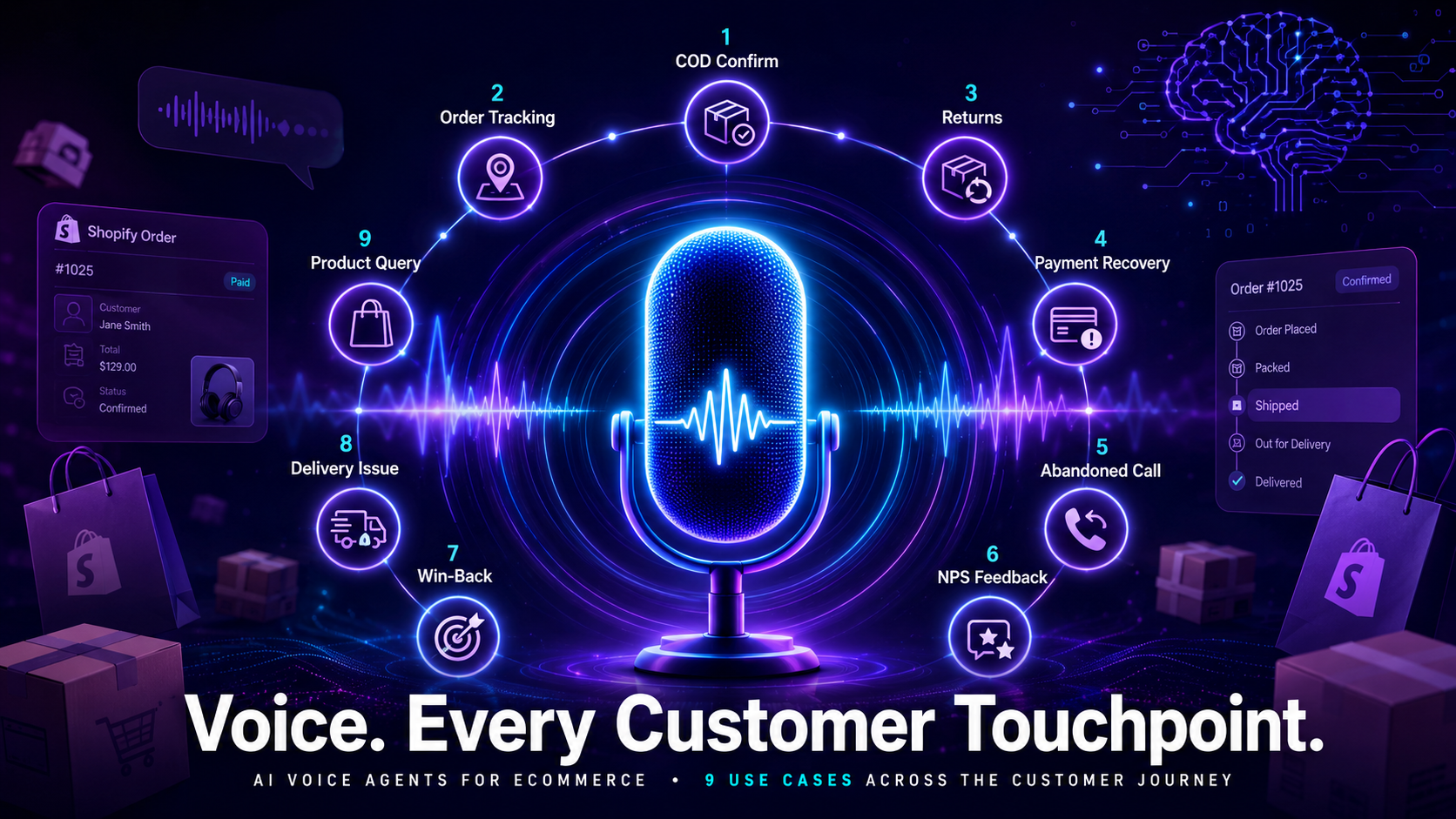
For DTC brands, those use cases usually include:
- Order status checks
- Delivery updates
- Return or refund initiation
- COD confirmation calls
- Basic policy questions
- Store timings or service availability
- Callback scheduling
- Call overflow during campaign spikes
These are the kinds of interactions where customers want a fast, accurate answer more than they want a long, high-empathy human conversation.
A voice agent is best for calls where the intent is easy to identify, the logic is repeatable, the answer depends on live data from Shopify, logistics, or policies, and speed matters more than open-ended advisory conversation.
That is why the first decision is not "Do we want AI?" It is: Do we have enough voice interactions of the right kind to justify it?
The Founder Qualification Question
Founders usually ask the wrong first question. They ask which platform, what accent, how realistic, can it do multiple languages. Those questions matter later.
The first question should be much simpler:
Is our support operation now paying a real price for not having a voice layer?
That price usually shows up in four places:
- Missed calls
- Repetitive call load
- Poor after-hours coverage
- Rising support cost with flat service quality
Once those pressures start appearing together, the decision becomes much easier.
Signal 1: You Now Have Meaningful Inbound Call Volume
A voice agent becomes much more useful once inbound call volume is no longer occasional noise and starts becoming an operational stream.
The exact threshold differs by brand, but the pattern is consistent: when calls arrive often enough that missing them, delaying them, or manually returning them becomes normal, you are likely in voice-agent territory.
This usually shows up as:
- Agents are interrupted repeatedly by routine calls during the day
- Call spikes happen around order dispatch, delivery delays, weekends, or campaigns
- Team members start switching between chat, email, and phone constantly
- Call handling becomes reactive instead of designed
A brand does not need a call centre with hundreds of seats before voice automation becomes valuable. What matters is whether call volume is now large enough to create operational friction.
If your support team is regularly saying things like "we will call them back later" or "we could not pick up all the calls during that sale window," the problem is already visible.
Signal 2: A Large Share of Calls Are Repetitive and Structured
This is the strongest indicator of all.
Voice agents work best when the brand is receiving a high percentage of calls that follow a structured input-output pattern. In ecommerce, these are usually not difficult conversations. They are repetitive ones:
- "Where is my order?"
- "Has my return been approved?"
- "When will my package arrive?"
- "Can I change the delivery address?"
- "Is COD available?"
- "Can someone call me back?"
These calls are expensive for a human team to keep answering because the work is low-complexity, high-frequency, and interruption-heavy.
They also create the perfect case for voice automation because the agent can authenticate the caller, look up live order data, provide the answer instantly, and escalate only when the request crosses a policy or exception boundary.
If a founder listens to ten recent inbound calls and notices that six or seven of them could have been resolved from live Shopify and logistics data, that is a strong fit signal.
Signal 3: Missed Calls Are Quietly Becoming Revenue and CX Loss
Missed calls are often underestimated because they do not show up as cleanly as abandoned carts or ad spend.
But they carry real cost.
If inbound calls have commercial intent, support urgency, or post-purchase anxiety behind them, a missed call is not a neutral event. It is a broken moment in the customer journey.
For ecommerce brands, missed-call pain usually looks like:
- Customers calling twice or three times for the same issue
- Lost conversion from pre-purchase intent calls
- Escalated frustration because support was unreachable during a delivery issue
- Support teams spending extra time on callbacks instead of first-touch resolution
- Founders hearing "no one answered the phone" too often in complaint summaries
Recurring missed-call patterns are a concrete operational reason to evaluate voice AI.
Signal 4: Your Support Cost Is Growing Faster Than Your Support Quality
This is the moment when the voice-agent conversation moves from "interesting" to "financially necessary."
If the support team keeps expanding effort - more people, more manual callbacks, more shift juggling, more after-hours patchwork - but customers are not feeling a corresponding improvement in speed or consistency, the model is starting to break.
Voice AI is often framed purely as a cost story, but that is too narrow. Its real value is leverage.
It allows human agents to stop spending prime attention on calls that are operationally necessary but cognitively light. It protects response quality during spikes. It keeps basic service live after hours. And it creates more room for humans to focus on the calls that actually require empathy, discretion, and recovery skill.
The Volume and Complexity Matrix
| Situation | Voice agent fit | Why |
|---|---|---|
| Low call volume, low complexity | Not urgent yet | Human team can usually absorb this without major operational strain |
| Low call volume, high complexity | Not a fit yet | Calls are too nuanced, and volume is too low to justify automation |
| Medium call volume, low-to-medium complexity | Strong pilot fit | Repetitive calls start consuming real time and can be automated safely |
| High call volume, low-to-medium complexity | Immediate fit | High repeatable call load creates clear ROI and CX upside |
| High call volume, high complexity | Hybrid fit | Use voice AI for triage, routing, and first response, then hand off to humans |
The core founder takeaway: voice agents are best when call volume is meaningful and complexity is manageable.
If volume is tiny, wait. If complexity is too high, use AI to assist or triage rather than fully resolve. If volume is large and repetitive, the business case becomes obvious.
The 7-Point Founder Checklist
If your DTC brand ticks 4 or more of these boxes, you are likely ready for a voice agent pilot.
- Your team misses calls regularly during peak hours, weekends, or after business hours.
- A large share of calls are repetitive, such as order status, delivery updates, return status, COD confirmation, or policy questions.
- Customers need live answers, not just email follow-up, because the issue is time-sensitive or operationally anxious.
- Your support team spends too much time on callbacks instead of first-touch resolution.
- Your support cost is rising but customers are not experiencing proportionally better response quality.
- You want 24/7 coverage or overflow handling but do not want to expand human staffing linearly.
- Your workflows can connect to live systems like Shopify, logistics APIs, order status, and return status so the agent can give real answers, not generic scripts.
- Tick only one or two → you are probably early.
- Tick four → the pilot conversation is reasonable.
- Tick six or seven → you are likely already paying the cost of not having a voice layer.
Three Signs You Are Not Ready Yet
Just as important: not every brand should deploy voice AI now.
1. Your call volume is still too low
If phone support is still occasional and easy to absorb, voice automation will not create much leverage yet.
2. Most calls are emotionally complex or exception-heavy
If the majority of calls are angry escalations, nuanced product consultations, or complex resolution cases, a voice agent should not be the front-line resolver.
3. Your underlying systems are too disconnected
If the agent cannot access reliable order, shipment, or return data, it will sound polished but act blind. That is usually worse than having no voice agent at all.
Where Voice Agents Work Best in DTC
The strongest DTC voice-agent deployments are not generic. They are designed around specific operational jobs.
1. Order Status and Delivery Calls - the most obvious use case. Customers want a fast answer, the data exists in the system, and the logic is highly repeatable.
2. Return and Refund Status - voice agents can guide customers through the status of a return, collect structured information, and hand off only when the case becomes policy-sensitive.
3. COD Confirmation and Verification Calls - for brands where COD creates operational overhead, voice agents help confirm intent, reduce fake or low-intent orders, and tighten the workflow before dispatch.
4. Overflow and After-Hours Support - campaign spikes, weekend traffic, and late-evening post-purchase anxiety create exactly the kind of support gaps where a voice agent can add value by staying available when the human team cannot scale instantly.
5. Multilingual First Response - for brands serving customers across regions, voice AI can provide a first-touch experience in multiple languages and route complex cases to the right team once the intent is clear.
Where Humans Should Still Own the Conversation
A strong voice strategy does not pretend AI should take everything. Human agents should still own:
- High-emotion complaint recovery
- VIP retention situations
- Complex refund disputes
- Fraud investigations that need judgment
- Edge cases that sit outside structured policy
- Brand-sensitive conversations where empathy itself is the product
The most effective model is not human versus AI. It is a system where voice AI handles the repeatable front layer and humans step in where judgment and trust matter most. That is why the design of handoff paths is as important as the design of automation.
What the Best Founders Do Before Piloting a Voice Agent
The founders who get strong results from voice AI usually do three things before deployment.
1. They classify call intents
They listen to real calls and group them into buckets - WISMO, return status, delivery issues, COD confirmation, product questions, escalations, miscellaneous. This immediately shows what percentage of the phone queue is structured enough for automation.
2. They map the live data sources
A voice agent is only as good as the systems it can read. If it needs to answer order and delivery questions, it must connect to Shopify and logistics data. If it needs to help with returns, it must connect to returns and policy logic.
3. They define the handoff boundary
The single most important design question is: what should the voice agent resolve, and what should it escalate immediately? This boundary is what protects customer experience.
What a Founder-Ready Pilot Looks Like
A good pilot should be narrow, measurable, and connected to clear operational pain.
For most DTC brands, that means starting with 1 to 3 use cases such as order status and delivery calls, return status calls, COD confirmation, or overflow support during peak hours.
A founder should be able to answer three questions at the end of the pilot:
- Did missed calls reduce?
- Did human team time get freed up?
- Did customers get faster answers without more frustration?
That is how you keep the pilot practical and commercial.
Conclusion: A Simple Founder Decision Rule
If your brand ticks 4 or more of the readiness signals, and at least half of inbound calls are repetitive and system-readable, then a voice agent pilot is likely justified.
If your brand ticks 6 or more, the question is probably no longer "Should we try this?" The question is "How much cost and customer friction are we already absorbing by waiting?"
A voice agent is not something a DTC brand adds because AI is trending. It is something a brand adds when phone support has become operationally meaningful, repetitive enough to automate, expensive enough to justify change, and important enough that missed calls are no longer harmless.
When the answer to "Is our business now paying a clear operational price for not having it?" becomes yes, the pilot decision gets much easier.
And when it is designed correctly, a voice agent does not replace the team. It protects the team from being buried in repeatable work.
Ready to check if your brand is a fit? In one working session, InovaBeing will help identify whether your current call volume justifies a pilot, which call intents are safe to automate first, where human handoff is essential, and what a 2–4 week pilot could look like for your Shopify DTC operation. Book a Voice Agent Fit Audit.