
The Era of Cheap Growth Is Over. What Replaces It?
Let us start with the numbers that define the DTC landscape in 2026.
- CAC has risen structurally by 25–40% depending on channel - and this is not cyclical. It is the new baseline.
- Median DTC revenue growth has slowed to ~3% (year-to-date 2025, per the DTC Index). The double-digit growth decade is over.
- Mid-market DTC brands ($10M–$50M) are now in a dead zone where fixed costs rise faster than revenue, compressing median EBITDA margins to roughly 7–8%.
Figures from Yotpo's 2026 DTC benchmark round-up, which draws on Deloitte and the DTC Index.
The brands still growing are not doing it with bigger ad budgets. The growth-at-all-costs model is broken. The brands winning in 2026 are doing something fundamentally different.
They are building operational intelligence - and turning it into a moat that compounds every quarter, is invisible to competitors, and becomes harder to replicate the longer it runs.
This blog is about what that moat actually is, how it is built, why it applies equally to single-brand DTC operators and multi-vendor marketplace builders, and what it looks like when deployed on Shopify.
What Is a Growth Moat - and Why Operations Is the Last Uncrowded One
Warren Buffett's concept of an economic moat - a durable competitive advantage that protects a business from competition - has always applied to business models, not just to products.
In DTC ecommerce, the moats that used to work are eroding fast:
Product differentiation - easier than ever to copy, faster than ever to manufacture, and no longer sufficient on its own when your product appears next to 40 similar items in a Google Shopping result.
Brand - still powerful, but takes years and significant capital to build. Not available to most early-stage DTC operators as a near-term lever.
Paid acquisition - was a moat when CAC was low and Meta targeting was precise. Now that CAC has risen 25–40% and signal loss from iOS privacy changes has degraded targeting accuracy, this moat is gone for most brands.
Price - a race to the bottom. Never a sustainable moat.
What remains? Operations.
Specifically: the intelligence layer a brand builds on top of its operations over time - the proprietary data on customer behaviour, fulfilment performance, demand patterns, return reasons, support interactions, and post-purchase engagement that accumulates every day the business runs.
This data, when properly captured, connected, and acted upon through AI, becomes an operational intelligence moat. It is not a feature a competitor can copy. It is not an ad spend advantage that evaporates. It is a compounding structural advantage that gets deeper every month.
And in 2026, most DTC brands and multi-vendor operators are sitting on this data - and doing almost nothing with it.
The 5 Dimensions of Operational Intelligence
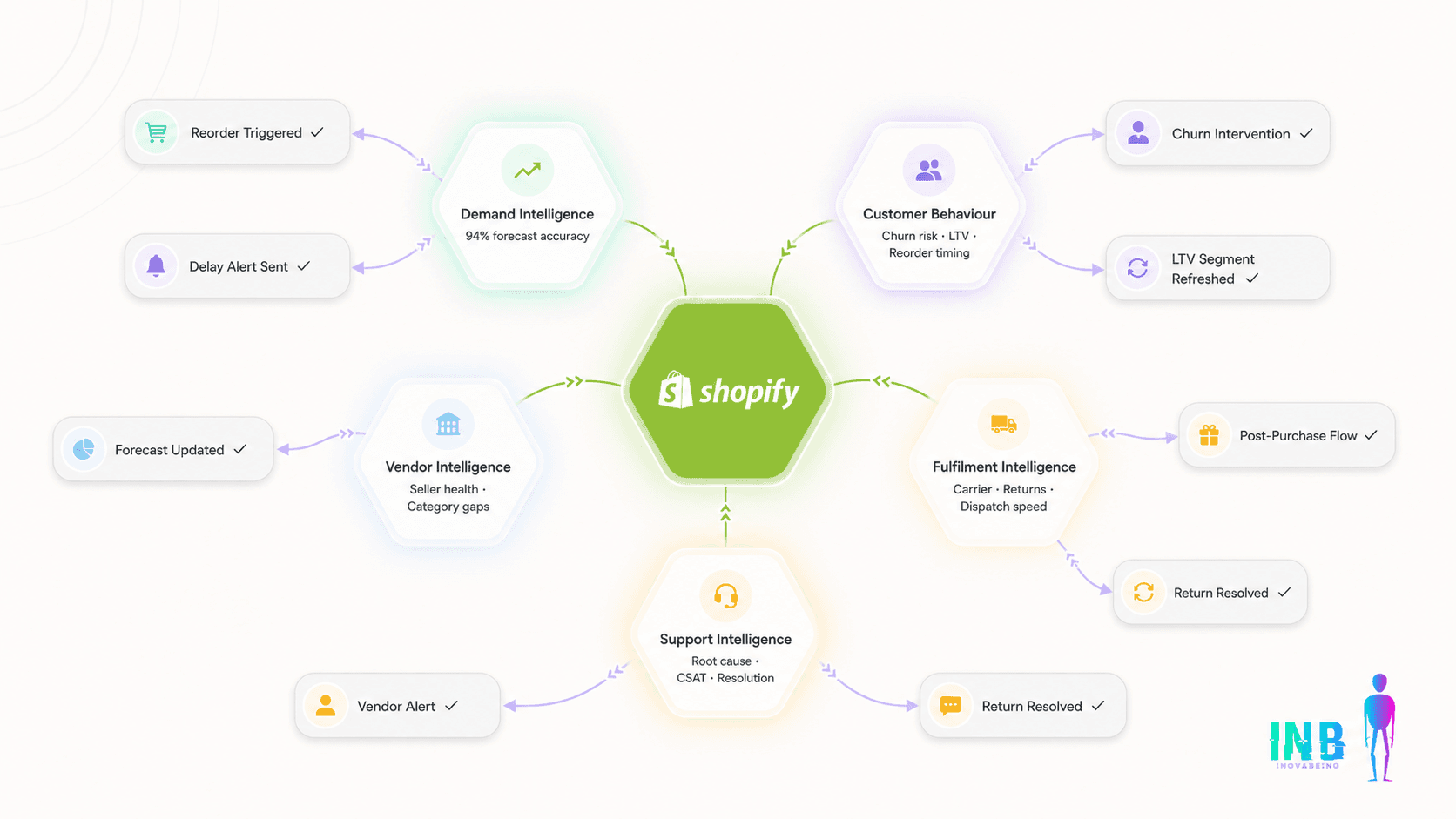
Operational intelligence is not a single system or a single tool. It is the sum of five interconnected intelligence layers that, when unified, create the moat.
1. Demand Intelligence
The ability to accurately forecast what your customers will want, when they will want it, and in what volume - before they ask.
Most DTC brands manage inventory reactively. They stock based on last season's sales, reorder when something runs out, and lose revenue on both ends - stockouts that turn away ready buyers, and overstock that ties up working capital.
AI-powered demand forecasting changes this structurally. McKinsey's research ties AI in planning and distribution to 20–30% lower inventory levels and 5–20% lower logistics costs (McKinsey research, summarised here).
For multi-vendor platforms, demand intelligence is even more powerful - it tells you which vendor categories are growing, which SKUs are about to spike, and where to prioritise seller recruitment before the demand materialises publicly.
2. Fulfilment Intelligence
The operational data generated by every order - dispatch time, carrier performance, delivery rate, damage rate, return rate by SKU, return reason by category - is one of the richest datasets a DTC brand generates.
Most brands collect this data in siloed systems. The carrier data lives in one tool. The return data lives in Shopify. The support ticket data lives in a helpdesk. None of it talks to each other.
Fulfilment intelligence connects these streams into a unified operational picture. It answers questions that no individual tool can answer alone:
- Which SKUs generate the highest return rates - and what is the most common return reason?
- Which carrier-region combinations have the worst delivery performance - and which customers are in those zones?
- What is the correlation between dispatch speed and repeat purchase rate?
- Which fulfilment failures are generating the most WISMO support tickets - and what is the revenue cost of each?
When a brand can answer these questions in real time, every operational decision improves. Carrier selection, warehouse routing, packaging decisions, and return policies all get sharper - and the cumulative effect on unit economics is significant.
3. Customer Behaviour Intelligence
The pattern of how individual customers interact with your brand - what they browse, what they buy, what they return, how they respond to post-purchase communication, when they typically reorder, and what triggers their churn - is the raw material of the highest-value moat.
Brands that build this intelligence layer convert it into:
- Personalised reorder prompts timed to actual consumption patterns (not arbitrary 30-day timers)
- Cross-sell recommendations based on purchase history rather than bestseller lists
- Churn prediction - identifying customers who are about to disengage before they actually leave, and triggering a retention intervention
- LTV segmentation - knowing which customers are in the top 20% of lifetime value, and treating them accordingly
The compounding effect: every interaction a customer has with your brand adds a data point. Over time, the model becomes more accurate. The personalisation becomes sharper. The retention rate improves. And the gap between your operational intelligence and a new entrant's grows wider every month.
4. Vendor and Seller Intelligence (Multi-Vendor Specific)
For multi-vendor marketplace operators - brands running a Shopify-based marketplace with multiple sellers, or DTC brands expanding into a multi-brand model - operational intelligence takes on an additional dimension.
Vendor intelligence answers:
- Which sellers are driving the highest customer satisfaction scores - and which are generating disproportionate support volume?
- Which vendor categories have the highest return rates - and is the return pattern a product quality issue or a listing accuracy issue?
- Which sellers are about to churn from the platform - based on declining order volume, rising dispute rates, or reduced listing activity?
- Where is there a supply gap - categories where customer demand exists but no current vendor is meeting it?
Sellers on two or more marketplaces generate on average 17.5x the GMV of single-channel sellers (Mirakl 2026 Seller Report). Multi-vendor operators who can demonstrate operational intelligence - showing sellers data that helps them grow their own business - build a retention moat with their seller base that is as valuable as the customer retention moat on the other side.
5. Support and Resolution Intelligence
Every customer support interaction is a data signal. The volume, category, resolution time, and customer satisfaction outcome of every support ticket, call, and chat contains operational intelligence that most brands never extract.
Support intelligence answers:
- What are the top 5 reasons customers contact support - and which of those are operationally preventable?
- Which product categories generate the most post-purchase confusion - signalling a content or packaging gap?
- What is the correlation between first-response time and repeat purchase rate?
- Which support agents (or AI agents) are driving the highest post-interaction CSAT scores - and what are they doing differently?
Brands that build support intelligence convert it into proactive operational improvements - eliminating the root causes of support volume rather than just managing the queue. Over time, support costs fall, CSAT rises, and the operational data becomes a product improvement engine.
Why This Is a Moat - Not Just an Efficiency Play
The word "moat" matters here. An efficiency play saves you money. A moat creates structural competitive distance that compounds over time.
Operational intelligence is a moat for three specific reasons:
Reason 1: It Is Proprietary by Definition
Your operational data - your specific customer behaviour patterns, your fulfilment performance data, your return reason breakdowns, your vendor performance history - belongs exclusively to you. No competitor can access it. No new entrant can replicate it without running your business for the same period of time.
Every month your operational intelligence system runs, the data becomes richer, the models become more accurate, and the gap between your decision quality and a competitor's decision quality grows wider.
Reason 2: It Creates Network Effects Within Your Own Business
As demand intelligence informs inventory decisions, fulfilment costs fall. As fulfilment intelligence reduces return rates, support volume falls. As support intelligence eliminates preventable contact reasons, response times improve. As customer behaviour intelligence sharpens personalisation, retention rates rise. As retention rates rise, LTV improves, and the LTV:CAC ratio moves in your favour - giving you more margin to reinvest in operational intelligence.
Each layer feeds the others. The system gets better faster as it scales.
Reason 3: It Creates a Customer Experience That Is Structurally Impossible to Replicate Quickly
A competitor can copy your product. They can copy your pricing. They can copy your website design. They cannot copy five years of operational data about your customers' behaviour, preferences, and patterns.
The customer who receives a reorder prompt at exactly day 28 for a 30-day supply product - because your AI knows their consumption pattern from 6 previous orders - is experiencing something no new competitor can offer them on day one.
That experience is not a feature. It is the output of operational intelligence that was years in the making.
The Multi-Vendor Dimension
Everything above applies to single-brand DTC operators. For multi-vendor marketplace operators, the opportunity is amplified.
Marketplaces accounted for about 67% of global online sales in 2024, up from 40% in 2014 (Mirakl). And retailer-run marketplaces are growing fast: those on Mirakl grew 34.3% in 2024, roughly four times faster than ecommerce overall (Mirakl 2025 Index).
For a Shopify-based multi-vendor operator, operational intelligence creates a two-sided moat:
Customer side: Better demand forecasting → better in-stock rates → better delivery performance → higher customer satisfaction → higher repeat purchase rate → stronger brand reputation.
Seller side: Richer performance data fed back to vendors → sellers who grow faster on your platform than on competing platforms → higher seller retention → better category coverage → more customer choice → higher customer satisfaction.
The marketplace operator who can show a seller "your return rate in category X is 12% above the platform average, driven by size guide inaccuracy - here is the data and here is how to fix it" is providing a service no spreadsheet export can match. That seller stays. They invest more in your platform. They recruit other sellers.
This is the two-sided operational intelligence flywheel - and part of why well-run marketplaces keep outgrowing ecommerce overall.
What Operational Intelligence Looks Like in Practice
At InovaBeing, we build the operational intelligence layer for Shopify DTC brands and multi-vendor operators - connecting the data streams that currently exist in silos, running AI across the unified dataset, and deploying the intelligence through automated workflows that act on it in real time.
Layer 1: Unified Data Pipeline
We connect your Shopify store data, logistics/carrier API, support helpdesk, WhatsApp/SMS communication platform, and (for multi-vendor operators) your vendor management system into a single unified data pipeline.
For the first time, you can see the relationship between a fulfilment delay on a specific carrier route and the support volume, return rate, and repeat purchase rate for customers in that delivery zone. These connections - invisible when the data lives in silos - become the source of every operational improvement that follows.
Layer 2: AI Intelligence Models
Across the unified pipeline, we deploy AI models for each intelligence dimension:
- Demand forecasting model - trained on your sales history, seasonal patterns, marketing calendar, and external demand signals. Accuracy is measured against your own history before it is allowed to drive decisions.
- Customer behaviour model - segments customers by purchase pattern, LTV trajectory, churn risk, and reorder probability. Updates in real time with every new interaction.
- Fulfilment performance model - identifies carrier-region combinations with elevated delay or damage risk. Flags proactively before customer impact.
- Support intelligence model - categorises every support interaction, identifies root-cause operational failures, and tracks resolution quality over time.
- Vendor performance model (multi-vendor) - scores every seller on delivery performance, return rate, listing accuracy, and customer satisfaction. Identifies at-risk vendors and growth opportunities.
Layer 3: Automated Action Workflows
Intelligence is only a moat if it is acted upon. We deploy automated AI workflows that take action on the intelligence in real time:
- Inventory reorder triggered automatically when stock falls below the AI-calculated threshold
- Proactive delay alert sent to customer before they notice, with revised ETA and goodwill gesture
- Churn-risk customer receives a retention intervention triggered by the behaviour model
- Vendor performance alert sent to at-risk seller with specific data and recommended corrective action
- Post-purchase sequence personalised in real time based on customer cohort, product category, and order value
Layer 4: Intelligence Dashboard
Every intelligence layer surfaces in a real-time operations dashboard - giving the founder or operations lead a single view of demand health, fulfilment performance, customer retention metrics, support trends, and vendor performance.
This is not a reporting tool. It is a decision engine. Every metric is connected to an action. Every alert is connected to a workflow. The dashboard does not show you what happened - it shows you what is happening and what should happen next.
The Compounding Math: An Illustrative 12-Month Model
Illustrative planning ranges, not client results or guarantees. Actual impact depends on your data, volumes and execution.
| Intelligence Layer | 12-Month Impact | Mechanism |
|---|---|---|
| Demand forecasting | 30–40% improvement in inventory turns | Reduced stockouts + reduced overstock |
| Fulfilment intelligence | 15–25% reduction in return rate | Root-cause SKU and carrier fixes |
| Customer behaviour model | Repeat purchase rate +10–15 percentage points | Personalised timing and relevance |
| Support intelligence | 20–30% reduction in support volume | Root-cause elimination vs. queue management |
| Vendor performance model | 15–25% improvement in seller retention | Data-driven vendor coaching and early intervention |
For a hypothetical Shopify DTC brand doing ₹5 crore monthly revenue, this illustrative model puts the combined 12-month impact at:
- ₹60–90 lakhs in recovered revenue from improved repeat purchase rates and reduced stockouts
- ₹15–25 lakhs in reduced operational costs from lower support volume, fewer returns, and automated workflows
- LTV:CAC ratio improvement from below 3:1 toward 5:1 - the threshold that signals a sustainably profitable DTC business in 2026
Treat these as a way to size the opportunity, not a promise. The mechanism is the point: five intelligence layers running on unified data, each one improving the others, every month.
Conclusion: The Moat Is Not Built in a Day - But It Starts on Day One
The brands that will dominate DTC and multi-vendor commerce in 2026 and beyond are not building bigger ad budgets. They are building deeper operational intelligence.
Every day a brand runs without connecting its data streams is a day of operational intelligence that is lost forever. The demand patterns from this quarter, the fulfilment performance data from this carrier route, the support signals from this product category - all of it is moat-building material that evaporates if it is not captured and connected.
The good news: you do not need to build the entire moat at once. You need to start the system. The intelligence compounds from day one. The gap between your brand and a competitor who starts six months later begins accumulating the moment your unified data pipeline goes live.
The moat is not built in a day. But it starts on day one - and every day after that, it gets harder for anyone else to catch up.
Ready to start building your operational intelligence moat on Shopify? Book a Technology Diagnostic with INovaBeing.