
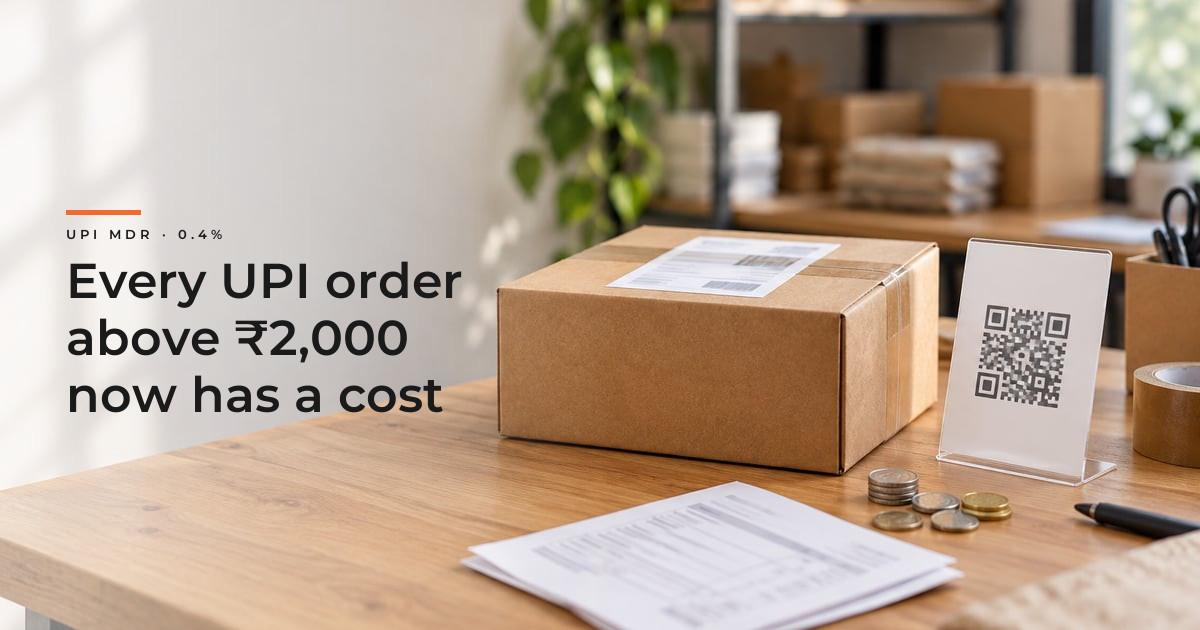
For years, the cheapest way for an Indian customer to pay you has also been the cheapest way for you to be paid. That is about to change for any order above ₹2,000.
NPCI has set a merchant discount rate of 0.4% on UPI payments above ₹2,000, capped at ₹300 per payment. It was due on 15 October 2026. Two days before that, NPCI deferred it until after Diwali, kept the fee structure unchanged, and said the new date would be notified separately. Diwali falls on Sunday, 8 November, so the new date could be announced any day now.
Most of the coverage so far has been about what it means for Paytm and the payment companies. This is about what it means for the brand on the other side of the payment.
What exactly has NPCI set?
The source is NPCI's own FAQ of 15 September 2026. The structure:
| Payment amount | Fee paid by the merchant |
|---|---|
| ₹2,000 or less | Nothing |
| Above ₹2,000 | 0.4% of the full amount |
| ₹3,000 | ₹12 (NPCI's own example) |
| ₹50,000 | ₹200 |
| ₹75,000 and above | ₹300 cap |
Three details matter for an online store.
The fee is on the full amount. A ₹2,001 order pays 0.4% on ₹2,001, not on the ₹1 above the threshold. NPCI's ₹3,000 example works out to ₹12, which is 0.4% of the whole payment.
You cannot pass it on. NPCI's FAQ is direct: merchants cannot pass MDR charges to customers when accepting payments through UPI, and customers pay only the posted price. A "UPI convenience fee" line at checkout is not an option.
Customers still pay nothing. UPI apps are also barred from charging customers a platform fee for UPI payments.
Who is exempt?
- Small merchants under P2PM, receiving up to ₹1 lakh a month through UPI QR directly into their own account. A merchant above ₹1 lakh a month for three consecutive months moves into the standard category.
- UPI AutoPay mandates, the recurring payments behind subscriptions, carry no prescribed MDR. This matters if you run a subscription or replenishment model.
- Flat-fee categories, such as railways, telecom, insurance, fuel and utilities, pay ₹5 per payment above ₹2,000.
- Credit on UPI, such as RuPay credit cards linked to UPI, follows separate credit product rules.
An online D2C brand taking payments through a gateway is a standard merchant. The 0.4% applies.
What does it cost a typical D2C brand?
Per order, the numbers are small:
| Order value | UPI fee |
|---|---|
| ₹1,499 | ₹0 |
| ₹2,499 | ₹10 |
| ₹4,999 | ₹20 |
| ₹9,999 | ₹40 |
Per month, it depends entirely on your order mix. Take a hypothetical brand with 3,000 orders a month, 60% of them paid by UPI, and 40% of those UPI orders above ₹2,000 at an average of ₹3,200. That is 720 orders paying about ₹12.80 each, roughly ₹9,200 a month that was not in the plan last quarter.
That is not a crisis. It is a line in your unit economics that did not exist before, and it lands hardest on brands whose average order sits just above ₹2,000, where the fee arrives with no change in what the customer sees.
For comparison, NPCI's FAQ puts standard credit card MDRs at 1.5% to 2.5% and debit card MDRs at up to 0.90%. UPI remains the cheapest digital way to be paid. The point is not to steer customers away from it. It is to stop treating it as free.
What should an online store do before it starts?
1. Measure your exposure. Pull the last three months of orders and find three numbers: the share paid by UPI, the share of those above ₹2,000, and their average value. That gives you the monthly cost in one line of arithmetic.
2. Ask your payment gateway three questions in writing. How will the fee appear: deducted from each settlement or invoiced monthly? Will GST be charged on it? And will their own gateway charges on UPI change at the same time? The MDR goes to the acquiring side, and your gateway is how it will reach you.
3. Update your contribution margin per order. Add the fee as a separate cost line for UPI orders above ₹2,000, next to the gateway charge and shipping. If you model margin by product or bundle, the ones priced just above ₹2,000 are where it shows.
4. Do not add a surcharge. NPCI's FAQ rules it out for UPI. If you want to change behaviour, change prices or offers openly, not the checkout total.
5. Reconcile settlements against orders. A new deduction on some payments and not others is exactly the kind of change that makes the bank, the gateway and the order system disagree. I wrote about why e-commerce numbers stop matching; a fee that applies only above a threshold is one more reason.
Should you price around ₹2,000?
Be careful. A ₹2,049 bundle repriced to ₹1,999 saves ₹8 in fees and loses ₹50 in revenue. For most brands, price based on fees alone is a bad trade.
Where it can make sense is in how you build bundles and free-shipping thresholds. If your free-shipping threshold is ₹1,999, customers who add one more item to reach it will mostly stay under the fee line. If it is ₹2,499, every order that qualifies also pays the fee. That is worth knowing when you next change the threshold, not a reason to change it this week.
The status, honestly
The fee was due on 15 October. NPCI's UPI and Services Steering Committee deferred it until after Diwali on 13 October, after opposition from traders and with a legal challenge pending. The Supreme Court has sought responses from the Centre, RBI and NPCI, and declined to stay the framework. Some state bodies and trader associations have asked for it to be withdrawn.
It could still change. But every payment company is preparing for it, and Paytm said in late October that the 0.4% fee will lift its payments processing margin. Plan as though it will start, and treat any reversal as a bonus.
Where we help
The work here is not the fee itself. It is making sure your systems can see it: per-order payment costs, settlements matched to orders, and margins that include every deduction. At INovaBeing we build that kind of reconciliation under AI & Automation, with automated matching and a human check on the exceptions.
If you are rethinking checkout and payment options at the same time, that is part of how we build Ecommerce Websites.
What I take from this
UPI being free to accept was a policy choice, and it has now been partly reversed. ₹12 on a ₹3,000 order will not decide whether a brand survives. What it does is test whether a brand knows its costs per order, or only its total revenue.
The brands that will notice this first are the ones that already reconcile payments to orders every week. For the rest, it will show up as a gap in the numbers a few months from now, with nobody quite sure why.