
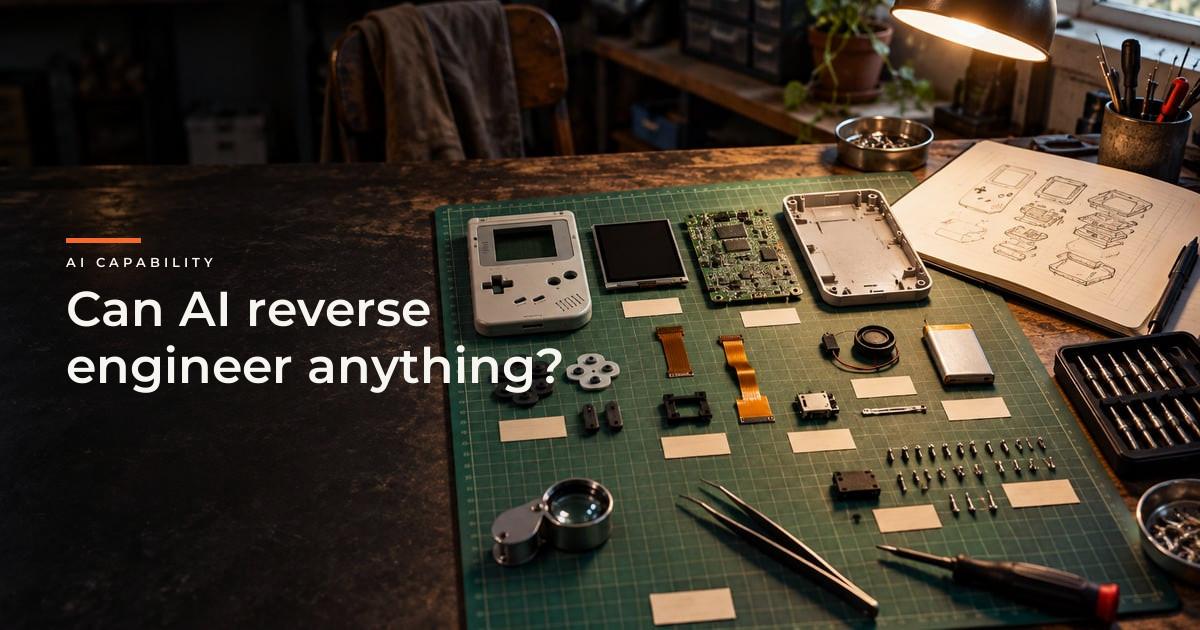
You see a feature in someone else's application. It does something genuinely clever, and you would like to understand how.
Traditionally that is a specialist's job. Someone who reads disassembly, knows what a decompiler is lying about, and has the patience to spend a fortnight on it.
Now a project called REA, short for Reverse Engineer Anything, proposes that you ask your coding agent instead.
The name is doing a lot of work, and my instinct with names like that is suspicion. So I went through the repository, the documentation, the showcases and the reconstruction code underneath them.
The short version: the capability is real, the project is serious, and the honest answer to "can it reverse engineer anything" is no, in a way that turns out to be more interesting than yes.
What it actually is
REA is an MIT-licensed MCP server and CLI, written in TypeScript, published on npm as rea-agents. It connects an AI coding agent to reverse engineering tools that already existed.
That last point is the one most of the commentary misses. REA does not decompile anything itself. It is an orchestration layer. Deep native analysis runs through Hopper, Ghidra or IDA, which you supply and license yourself. The repository is explicit that it grants no tool licence or key.
The loop, per the project's own description, is: your agent calls REA through MCP, REA inspects the target with the appropriate tool, and it returns findings with their evidence. The agent then asks follow-up questions, explains the behaviour, or writes and tests an implementation.
Supported targets are genuinely broad. Native binaries, JavaScript and Electron applications, .NET assemblies, Android APKs, websites, firmware, packet captures, SQLite databases, WASM, Go and Rust binaries, Unity IL2CPP metadata. Static JavaScript and .NET inspection need no native engine at all.
Two details worth holding onto. Static inspection reads files without running them, while runtime capture actually executes the target with your user permissions. And although analysis runs locally, the findings go to your agent, whose model provider has its own data policy. For a competitor's binary that is a curiosity. For your client's proprietary code it is a procurement question.
Worth knowing before you try it: the barrier is lower than it looks for web work and higher than it looks for binaries. Static JavaScript and .NET analysis need only Node.js and an agent that speaks MCP, which includes Claude Code, Codex, Cursor and Gemini CLI. Anything touching native code needs Hopper, Ghidra or IDA installed and licensed, and the commercial ones are not cheap. The agent is the cheap part of this setup now, which is itself a change worth noticing.
Is it a real project? As of 23 October 2026 the GitHub API reports 365,458 stars, 91,606 forks, 304 contributors, 1,829 closed issues, and releases every few days. The open issues read like a maintained codebase: specific, technical, reproducible. This is not a README with a logo.
The evidence, and what it actually shows
The repository lists three showcases. The most substantial is DX-Ball, a Windows game from the 1990s.
The README presents it modestly: follow a sound call into its position-to-pan helper, turn incomplete pseudocode into C, and the result passes 3,205 original x86 cases while reproducing all 63 compiled function bytes.
Sixty-three bytes. One function. Impressive but small.
Then I opened the reconstruction repository, and it has gone much further than the showcase suggests. As of 22 October 2026 it reports all 270 authored functions and 84,968 authored code bytes exact, with the source building into a working Windows game using the original Visual C++ 4.0 compiler. It documents passing checks for gameplay, the level editor, rankings persistence and a fifty-board fixture under Wine.
That is a 1990s commercial game reconstructed to byte-exact source. I did not expect that, and it is the strongest evidence in the whole project.
It is also published with its own unfinished list: the full fifty-board campaign, every power-up in live play, focus recovery under Wine, and physical audio and MIDI output all remain unverified. The second showcase, a reconstruction of the PC-98 game TH04, states plainly that complete game and original timing acceptance remain unfinished.
I respect that these caveats are published rather than buried. But there is one more thing you should know before treating any of it as validation.
The showcases are not independent. Both reconstruction repositories belong to a GitHub account with 592 commits to REA itself. These are demonstrations by people who build the tool, on targets they chose. That does not make the results false, and the DX-Ball artefacts are checkable. It does mean nobody outside the project has published an evaluation of comparable depth, and the commentary treating these as benchmarks is wrong to.
Where the claims stop
| Claim | What is actually supported | The limitation |
|---|---|---|
| Reconstruct individual functions from a binary | Strongly supported. Byte-exact output verified against the original compiler | Requires a licensed decompiler and an expert directing the work |
| Rebuild a complete self-contained program | Demonstrated once, on a 1990s game, over months | The target had no server, no network protocol, no modern obfuscation |
| Understand JavaScript and observable web behaviour | Well supported. Modules, imports, IPC and network observations | Shows you the client. The client is not the product |
| Recover hidden backend logic | Not supported | Server-side code is not present in anything you can inspect |
| Reproduce a modern enterprise platform | Not supported, and not claimed by the project | Value sits in data, integrations and operations, not the binary |
| Produce production-ready code autonomously | Not supported | Every published result involved skilled humans steering throughout |
The verdict I would give: the technology is legitimate and the headline is not. "Reverse engineer anything" is a name, not a capability statement, and the project's own documentation is considerably more careful than its title.
The deeper point is a distinction that gets lost constantly. Reproducing what software does is not the same as understanding what it is. DX-Ball could be reconstructed byte-for-byte because everything it does lives in one executable. Almost nothing you compete with today works that way.
What this means commercially
Strip away the cloning fantasy and several genuinely useful applications remain. All of them assume you have the right to inspect the thing you are inspecting.
Legacy modernization. This is the strongest case. A business running an undocumented order system built by someone who left years ago has a real archaeology problem, and the knowledge is only in the binary. AI-assisted investigation can recover workflow logic and business rules well enough to plan a migration. If you are weighing that kind of rebuild, the economics are in what a custom OMS actually costs.
Integration discovery. Poorly documented integrations are everywhere, and observable behaviour against artefacts you are authorised to analyse is often faster than waiting for a vendor's answer. This is close to the diagnostic work in when app sprawl becomes an integration problem.
Build versus buy. The most practical use I can see. When a platform pitches ten capabilities, investigation can help separate what is native, what is configuration, what needs custom work and what is genuinely proprietary. That changes a negotiation, and it sharpens the per-category reasoning in build vs buy in ecommerce tech.
Copying a competitor's feature. Technically plausible for frontend behaviour, legally fraught, and usually commercially pointless. The feature was rarely the moat.
On which point: does this threaten SaaS? Less than the headlines suggest. If a platform's advantage is a UI pattern, it was always borrowable and AI makes that faster. But accumulated data, integration surface, switching costs, reliability under load, compliance posture and domain expertise are not in the client bundle. Recreating an interface is not replacing a production system, and anyone who has run one knows the interface was the easy part.
What I actually take from this
The interesting shift is not that software can be copied. It is that unfamiliar systems can be understood at a cost that used to be prohibitive.
Most engineering teams carry at least one system nobody fully comprehends. A service whose author left. An integration that works for reasons no one can articulate. That opacity has always been expensive, and the expense was tolerated because investigating it required a specialist nobody could justify hiring.
If that cost falls far enough, the calculation changes. Not because you will clone a competitor, but because you can finally document your own estate, test it properly, and modernise it without a rewrite born of ignorance.
REA is an early, rough, genuinely impressive version of that. The name oversells it and the repository undersells itself, which is an unusual combination. Watch what gets reconstructed next, and by whom. If the next significant result comes from someone with no commits to the project, that will tell you more than the star count ever will.