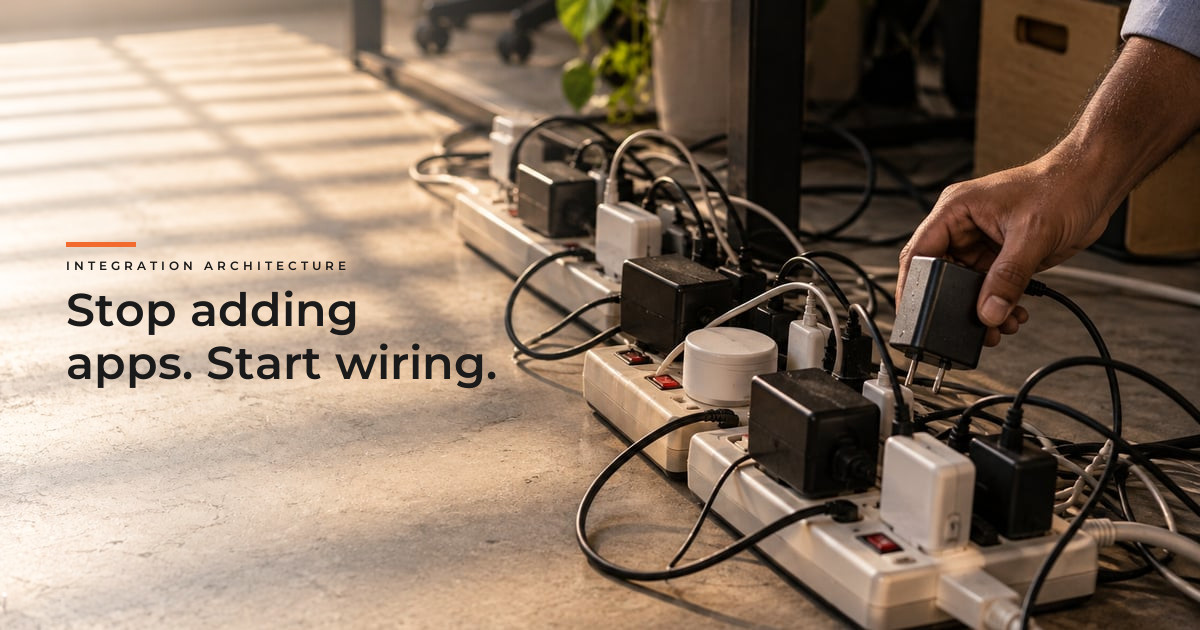
The install button is the problem. Four minutes, a free trial, no procurement conversation, and the thing that was annoying this morning is handled by lunch. Repeat that across two years of growth and nobody ever made a bad decision, yet you end up with twenty apps, several of which write to the same order.
That is the trap worth naming: app sprawl is not caused by carelessness. It is caused by a series of individually correct choices, each made without visibility into the others.
What the data says about the shape of it
Published 2026 ecosystem data puts the average Shopify store at roughly six to eight apps, with a median around six. Spend is heavily skewed - the large majority of stores spend little or nothing, while a small fraction spend over $100 a month. The average paid app sits somewhere around $30 to $60 a month depending on how it is measured.
So the typical brand is not bankrupting itself on subscriptions. That is the wrong worry.
The real cost shows up in two other places. Performance is one: stores running sixteen or more apps average a PageSpeed score about fifteen points below leaner stores, which is a conversion tax paid on every session. Data integrity is the other, and it is the expensive one.
The thing apps cannot do
Every app is written on the assumption that it is the only thing touching its field.
The loyalty app assumes it owns customer tags. The subscription app assumes it owns the order it created. The inventory sync assumes its number is the number. The returns portal assumes it can set order status. Individually, each assumption is reasonable. Together, they are a race condition with a monthly invoice.
You see it as symptoms rather than as architecture:
- Stock that is right in Shopify and wrong in the warehouse system, reliably, every week
- A refund that fires twice because two apps both watched the same cancellation
- Customer tags that revert overnight because a nightly sync has a different opinion
- An order stuck between "fulfilled" in one place and "processing" in another
- A tag or metafield that one person on the team knows not to touch, for reasons nobody has written down
None of those is an app being bad. Each is two apps being right at the same time, about the same record, in a different order than yesterday.
Seven signs you have crossed the line
Count the ones that are true today. This is deliberately about evidence, not instinct.
Two or more apps write to the same field. Order tags, inventory levels, customer attributes, fulfilment status. The moment two writers exist with no agreed precedence, you have an integration problem wearing an app costume.
Someone manually reconciles systems on a schedule. A weekly spreadsheet that compares the marketplace against Shopify against the 3PL is not an admin task. It is a human performing the integration that does not exist.
Your team has rules nobody can explain. "Do not edit that order before 6pm." "Always cancel in the app, never in Shopify." Folklore is the residue of undocumented coupling.
An app outage stops operations. If a connector going down means orders stop flowing rather than queueing, you have a dependency with no failure handling.
You cannot answer which system is authoritative for stock. If three people give three answers, that is your root cause, and no further app will fix it.
Fixes require a specific person. When the only person who can untangle a mismatch is one operations lead, the architecture lives in their head and leaves when they do.
Adding a channel means adding apps everywhere. If opening a new marketplace means four new installs and a fresh reconciliation sheet, the cost of growth is scaling faster than the growth.
Three or fewer, and apps are still the right call - keep going, revisit in two quarters. Four to five, and you are in the band where the next incident is more expensive than the fix. Six or more, and you are paying for architecture already, in people and in errors, without having bought any.
What replaces them, and what it costs
The replacement is not "a custom build". It is a layer that owns the contract between systems: which system is authoritative for each field, how data is transformed on the way across, what happens when a call fails, and which failures retry versus escalate to a person.
That layer can be an integration platform or a purpose-built service. Published 2026 ranges for iPaaS-based Shopify and ERP integration put implementation at roughly $10,000 to $40,000 with platform fees of $500 to $3,000 a month for two to four connected systems. Industry guidance adds twenty to forty percent for the parts buyers underestimate - data migration, QA, security setup, ongoing API maintenance - and puts annual upkeep at fifteen to twenty-five percent of implementation cost. Indian delivery economics typically land lower for comparable scope.
Set that against the apps it retires, the reconciliation hours it removes, and the incidents it prevents, and the comparison becomes arithmetic rather than philosophy.
The decision of what sits in that layer - orchestration, events, or resource management - is a separate question, and getting it wrong is expensive in its own way. We separate those in Shopify Flow vs OMS vs ERP, and the signals that you need an orchestration layer at all are in when a Shopify brand actually needs an OMS.
The cost nobody puts in the spreadsheet
When brands compare apps against an integration layer, they compare subscriptions. That comparison always favours apps, and it is the wrong one.
The line items that actually move are these. Reconciliation labour: if one person spends four hours a week matching systems, that is roughly half a working month a year, performed by someone you hired for judgment rather than for copy-paste. Error cost: an oversell is a cancellation, and a cancellation on a marketplace is a seller metric, not just a refund. Decision latency: when nobody trusts the stock number, every decision that depends on it slows down, and the slowdown is invisible because it never appears as an incident.
Then there is the cost of the ceiling. A brand that cannot add a channel without adding four apps and a spreadsheet will delay adding the channel. That delay rarely gets attributed to the app stack, but it belongs there.
None of this argues for buying architecture early. It argues for comparing the right numbers when you do compare. Subscriptions against subscriptions makes apps look permanently cheaper. Subscriptions plus labour plus errors plus the growth you postponed is the comparison that matches reality.
How to migrate without a big bang
The failure mode here is replacing everything at once and discovering, in production, which app was quietly load-bearing.
A safer sequence, which takes weeks rather than quarters:
Map the writers before anything else. For each of order status, inventory, customer attributes and fulfilment, list every app and person that writes to it. This document is usually the first time anyone has seen the real picture, and it frequently resolves two incidents on its own.
Declare one authority per field. Not per system - per field. Inventory may be authoritative in the warehouse system while order state is authoritative in Shopify. Write it down and make it boring.
Move the conflicts first, not the easy ones. The apps worth replacing are the ones fighting over the same record. The standalone review widget is not costing you anything.
Run both paths in parallel and compare. For two to four weeks, let the new layer compute what it would have done and diff it against the apps. Discrepancies found here are cheap; the same discrepancies found after cutover are refunds.
Remove the retired apps deliberately. Uninstalling is where orphaned webhooks and stale metafields surface. Treat it as a task, not as cleanup.
The honest counter-argument
Plenty of brands should not do this.
If you sell on one channel, ship from one location, and nothing manual happens between order and dispatch, apps are a genuinely excellent deal and an integration layer is a solution looking for a problem. The complexity that justifies architecture comes from channels, locations, vendors and exceptions - not from revenue. A brand doing good numbers with a simple operation can stay on apps for years and be right to.
The test is the incident count, not the invoice. If no one has hand-fixed a record that two systems disagreed about in the last month, keep installing apps and spend your attention elsewhere.
If that happens most weeks, and the fix depends on one person being awake, you are already paying for integration work. The only open question is whether it stays invisible or becomes something you own.
If you want the writer map built against your actual stack - which apps overlap, which field has no authority, and the smallest change that stops the weekly reconciliation - book an operations architecture review. We come back with the map, the three apps worth replacing first, and the ones we would leave exactly where they are.