
The Number That Should Keep Every Shopify Founder Up at Night
85.23%.
That is the percentage of your customers who will never buy from you again.
Not because your product failed them. Not because a competitor offered something better. But because somewhere between the "Order Confirmed" email and the package arriving at their door - the experience broke down. The tracking link went silent. The delivery was late. The return was a friction nightmare. The follow-up was a generic, templated email that felt like it came from a robot built in 2009.
And they quietly left. No complaint. No feedback. Just gone.
Meanwhile, you spent an average of $29 to acquire that customer - and saw nothing in return.
This is the silent revenue leak inside most Shopify D2C brands. Not the ad spend. Not the product. The order operations.
In 2026, the brands pulling away from the pack are not the ones with the biggest marketing budgets. They are the ones that have engineered their post-purchase operations to be so frictionless, so responsive, and so intelligent that customers have no reason to go anywhere else.
The Retention Economics Every D2C Operator Must Understand
Before we get into operations, the numbers need to be on the table. Because once you see them, the urgency becomes self-evident.
The cost gap between acquisition and retention is not a rounding error. It is a business model difference.
- A 5% increase in customer retention can boost profits by 25% to 95%
- Repeat customers convert at 60–70% - compared to 1–2% for new customers
- Repeat customers spend 25% more per order than first-time buyers
- Customers who have a strong post-purchase experience spend 140% more over time than those with poor experiences
- 65% of total company revenue comes from repeat buyers
- Loyalty program members make 67% more purchases than non-participants
Read that last one again. Sixty-seven percent more purchases. Not from better ads. Not from a new product line. From operational excellence and the trust it builds.
And on the other side of the ledger:
- 84% of consumers will not return after just one poor delivery experience
- 98% of ecommerce consumers say their delivery experience directly affects brand loyalty
- 53% of consumers have abandoned a purchase entirely because of slow delivery times
The pattern is clear. Order operations are not a backend logistics problem. They are a front-line revenue and retention problem.
What "Order Operations" Actually Means - and Why Most Brands Get It Wrong
Most Shopify founders think of order operations as the unglamorous back-office work: warehouse picks, carrier handoffs, tracking updates, return processing. The necessary but boring infrastructure that sits behind the exciting parts of the business.
That framing is the root of the problem.
Your customer does not experience your product page. They experience your fulfilment.
The product page is a promise. The fulfilment is the delivery of that promise. Every touchpoint from the moment an order is placed to the moment the product is in the customer's hands - and every interaction that follows - is a retention event.
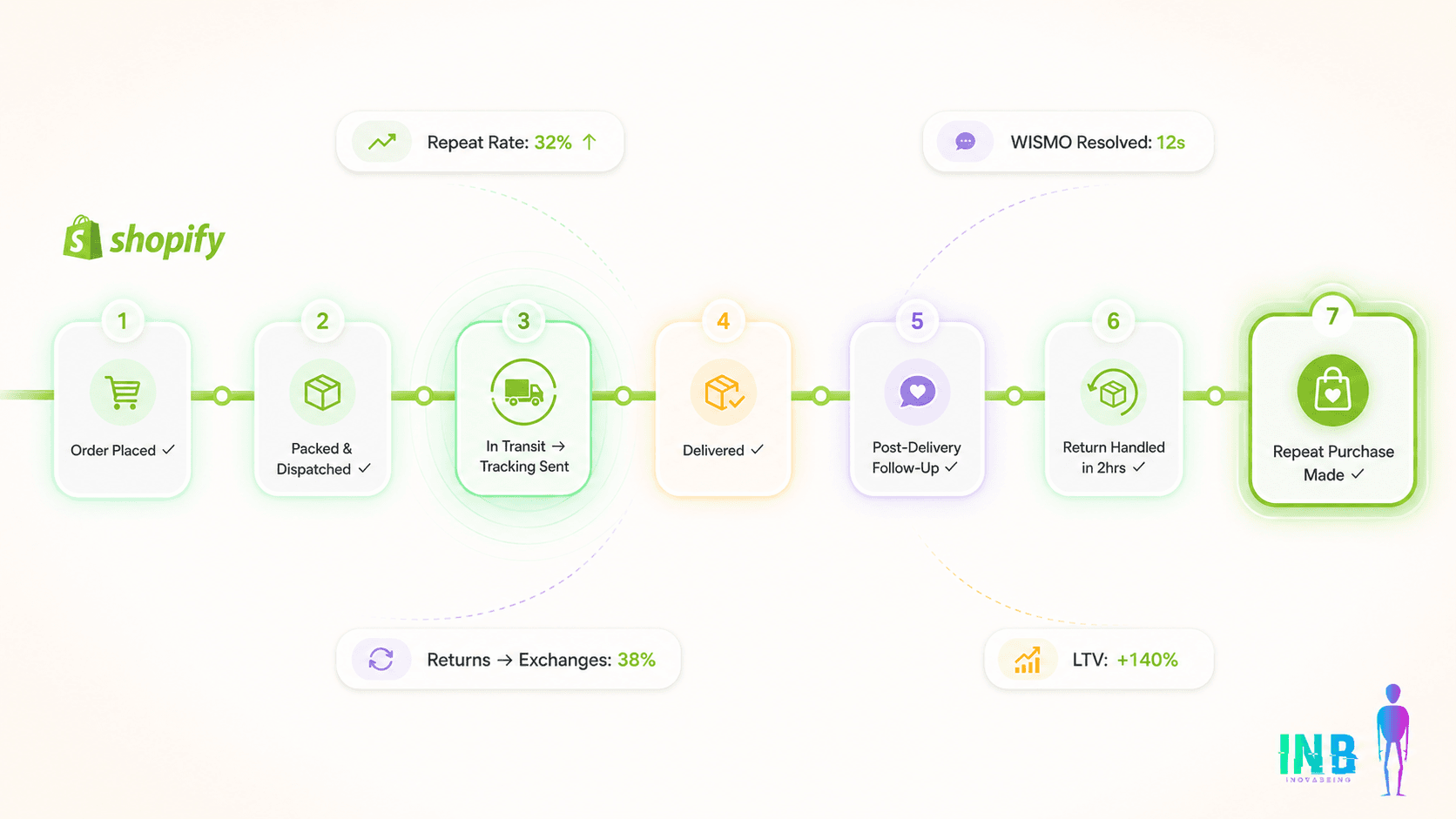
Here is what order operations actually covers, framed through the customer's lens:
| Operations Step | Customer Experience | Retention Impact |
|---|---|---|
| Order confirmation | Instant, personalised confirmation | Sets trust baseline |
| Inventory accuracy | Product actually in stock | Prevents first-strike disappointment |
| Packing and dispatch speed | Dispatched same day or next day | Signals reliability |
| Proactive tracking updates | Customer knows where order is without asking | Eliminates anxiety |
| WISMO (Where Is My Order) handling | Fast, accurate answer | Major churn prevention point |
| Delivery accuracy | Right product, right condition, right address | Core satisfaction driver |
| Post-delivery follow-up | Timely, relevant, not generic | Triggers the repeat purchase window |
| Returns processing | Fast, frictionless, no friction | Highest-stakes loyalty moment |
Most Shopify brands do the first two columns reasonably well. They almost universally fail at the third.
The 4 Order Operation Failures That Destroy Repeat Purchases
1. The WISMO Silence Problem
A customer places an order. Two days pass. The tracking link shows "In Transit" and has not updated in 36 hours. They send a WhatsApp message. No reply for 4 hours. They email support. Auto-reply says "We'll get back to you in 48 hours."
By hour 6, they have opened Amazon.
WISMO queries - "Where Is My Order?" - account for up to 35% of all inbound customer support volume for ecommerce brands. Every unanswered WISMO query is not just a support cost. It is a retention risk.
The customer who asks where their order is and gets a fast, accurate, empathetic answer? They come back. The one who waits? Statistically, they do not.
2. The Generic Post-Purchase Email Problem
"Thank you for your order. Your tracking number is [TRACKING]."
That email is not a customer experience. It is an automated receipt. Yet most Shopify brands send exactly this - one generic template, same for every customer, every product, every order value.
The post-purchase window - the 48 to 72 hours after delivery - is the highest-intent moment in the customer lifecycle. The product is new in their hands. Satisfaction is at its peak. This is the single best moment to deepen the relationship, cross-sell intelligently, collect a review, or initiate a loyalty touchpoint.
Most brands waste it with a tracking number.
3. The Returns Black Hole
Returns are not a cost to be minimised by making them difficult. They are a loyalty test.
A customer who has a smooth, fast, no-questions-asked return experience has a higher probability of repurchasing than a customer who never returned anything. The act of handling a return well - quickly, fairly, with good communication - proves your brand's integrity when it costs you money to do so.
A customer who fights through a painful return process? They post about it. Their network hears about it. And they never come back.
4. The Inventory Misinformation Problem
A customer orders a product shown as "In Stock." Three days later, they get an email: "We're sorry, this item is temporarily out of stock. Your order may be delayed by 7–10 business days."
This single failure event kills the relationship before it starts. The customer never got to experience your product. They experienced your broken inventory system.
How Shopify Brands Are Fixing This With AI-Powered Order Operations
The shift happening across high-performing Shopify D2C brands in 2026 is not a fulfilment infrastructure overhaul. It is an intelligence layer placed on top of existing operations - one that makes every order-related touchpoint faster, more accurate, and more personal.
Here is what that looks like in practice.
AI-Powered WISMO Resolution
Instead of a customer waiting hours for a support agent to manually look up a carrier API, an AI agent connected to your Shopify store and your logistics provider can:
- Pull real-time order status the moment a customer asks
- Proactively send a WhatsApp or SMS update when an order is delayed - before the customer notices
- Resolve 80–90% of WISMO queries without any human involvement
- Escalate only the genuinely complex cases (lost packages, wrong items) to a human agent with full context already loaded
The result: WISMO resolution time drops from hours to seconds. Customer anxiety is eliminated before it becomes customer churn.
Intelligent Post-Purchase Sequencing
An AI layer on your Shopify store can segment post-purchase communication by:
- Order value - high-value orders get a personalised thank-you, lower-value orders get an optimised cross-sell
- Product category - beauty product buyers get a usage guide; apparel buyers get a styling tip; consumables buyers get a reorder reminder at the predicted consumption rate
- Customer cohort - first-time buyers get a trust-building sequence; repeat buyers get loyalty acknowledgement and early access offers
- Delivery confirmation trigger - the post-delivery sequence fires automatically on confirmed delivery, not on a fixed 3-day timer
This is not complex to implement on Shopify. It requires the right AI workflow connected to your customer data. The brands doing this are seeing repeat purchase rates climb from the industry average of 30% toward the top-performer benchmark of 62%.
Returns Intelligence
An AI-powered returns flow can:
- Initiate a return instantly via chat or voice, without the customer filling out a form
- Identify the reason for return (wrong size, damaged product, changed mind) and route accordingly - exchange, refund, or store credit with the right incentive
- Flag repeat returners for review without penalising legitimate customers
- Process refunds in hours, not days
- Send a proactive "How can we make it right?" message before the customer has to ask
Brands that implement intelligent returns management report 25–40% of returns converting to exchanges rather than refunds - preserving the revenue and, more importantly, preserving the customer relationship.
Real-Time Inventory Accuracy
AI-connected inventory management synced to your Shopify store can:
- Remove out-of-stock items from the storefront in real time, not on a batch update schedule
- Trigger reorder workflows automatically when inventory drops below threshold
- Alert the operations team to address mismatches before they become customer-facing failures
- Notify waitlisted customers the moment an item is back in stock - capturing demand that would otherwise be lost
The Retention Math: What Fixing Order Operations Actually Delivers
Let us make this concrete with a realistic Shopify D2C scenario.
Store Profile:
- 500 orders per month
- Average order value: ₹2,500
- Current repeat purchase rate: 20% (below industry average)
- Monthly revenue: ₹12,50,000
After AI-Powered Order Operations (Conservative Estimates):
- Repeat purchase rate improves from 20% to 32% (industry average for optimised operations)
- That is 160 repeat customers per month instead of 100
- 60 additional repeat customers × ₹2,500 AOV = ₹1,50,000 in additional monthly revenue
- Return-to-exchange conversion of 25% saves an estimated 30% of return revenue
- WISMO resolution drops to under 1 minute, reducing churn from the most common anxiety trigger
Annual impact: ₹18,00,000+ in incremental revenue from the same customer base.
No new ad spend. No new product launches. Just operations that work the way customers expect them to.
The 2026 D2C Retention Playbook
Based on current ecommerce data and InovaBeing's work with D2C operators, here is the retention playbook the top-performing Shopify brands are running in 2026:
Week 0 (Order Placed): Instant confirmation with estimated delivery window. Personalised based on product category. No generic templates.
Day 1–2 (In Transit): Proactive tracking update via WhatsApp/SMS. No customer needs to ask. AI monitors carrier API and sends update if status changes.
Day 3 (Delivered): Delivery confirmation message within 2 hours of confirmed delivery. Not a scheduled email - an event-triggered AI message. Includes a simple satisfaction check-in (one tap, not a survey form).
Day 4–5 (Post-Delivery Window): Product tip, usage guide, or complementary product recommendation - specific to what they bought. This is the cross-sell moment, delivered with value, not just a promotional push.
Day 7 (Review Request): A single, well-timed review request. Not two days after delivery before they have even used the product. Seven days in, when the product experience is real.
Day 14–21 (Loyalty Trigger): For first-time buyers: a loyalty or referral invite. For repeat buyers: an early-access offer or VIP acknowledgement. This is the retention anchor.
Day 30–45 (Reorder Trigger): For consumable products: a reorder prompt timed to predicted consumption. For fashion/lifestyle: a new arrival alert based on purchase history.
This is not a complex marketing automation stack. This is structured, intelligent order operations - and every touchpoint above can be managed through an AI layer connected to Shopify.
Why Indian D2C Brands Have a Specific Retention Opportunity Right Now
Indian ecommerce is in a retention-critical inflection point in 2026.
Customer acquisition costs on Meta and Google are rising every quarter. The D2C brands that grew on cheap paid traffic in 2021–2023 are now facing unit economics that no longer work at scale. The only sustainable path forward is higher lifetime value from the existing customer base.
Meanwhile, Indian consumers' expectations have been set by Amazon, Flipkart, and Myntra - same-day or next-day delivery, instant WISMO, no-questions-asked returns. The brand that can match those operational standards while offering the product differentiation of a D2C brand - that brand wins the decade.
The barrier for most Indian Shopify D2C brands is not will. It is operational capacity. A 10-person team cannot manually manage post-purchase communications, WISMO queries, returns, and reorder prompts at scale.
That is exactly the gap AI-powered order operations fills. Not by replacing your team. By handling the repetitive, high-volume, time-sensitive operational tasks - so your team focuses on the decisions that require human judgment.
How InovaBeing Helps Shopify D2C Brands Build This
At InovaBeing, we build the AI operations layer that sits on top of your existing Shopify store and turns your order operations into a retention engine.
What we deploy:
- AI Order Operations Agent - Handles WISMO queries via WhatsApp, chat, and voice. Connected directly to Shopify and your logistics provider. Resolves 80%+ of queries without human involvement. Available 24/7.
- Post-Purchase Intelligence Workflows - Personalised, event-triggered communication sequences built on your Shopify customer data. Not email blasts - intelligent, segmented touchpoints that arrive at exactly the right moment.
- Returns Management AI - Conversational returns initiation, intelligent routing (exchange vs. refund vs. store credit), fast processing, and retention-focused follow-up.
- Inventory Sync Intelligence - Real-time inventory accuracy connected to Shopify, with automatic alerts and waitlist management.
This is not a 6-month enterprise implementation. We deploy a working AI order operations layer for Shopify D2C brands in 3–4 weeks.
Conclusion: Retention Is an Operations Problem, Not a Marketing Problem
The most common response to a falling repeat purchase rate is to spend more on email marketing, loyalty apps, or retargeting ads.
That is treating the symptom. The root cause is that your post-purchase operations are silently breaking the customer relationship - one missed WISMO query, one generic confirmation email, one painful return at a time.
The brands that compound revenue without compounding ad spend in 2026 are the ones that treat order operations as a retention engine - not as backend infrastructure. They are building the AI layer that turns every order touchpoint into a trust-building moment, every WISMO query into an instant resolution, every return into a loyalty test they pass.
That is the playbook. The numbers prove it works. The technology exists to deploy it in weeks, not quarters.
The only question is whether you build it before your competitors do.
Ready to fix the silent revenue leak inside your Shopify D2C brand? Book a Technology Diagnostic with INovaBeing - we will map your current order operations, identify the specific retention leaks, and show you the AI deployment that would close them.