Every Shopify partner in your DMs is quoting you a 24-hour launch. Every custom dev agency is quoting you six months. Both are describing the same event from opposite ends of a scale where neither number is the truth you need.
The honest answer is a three-part timeline that most founders never see broken down cleanly. Your platform is live in about 7 days. Your first paid sale from a stranger takes about 30 days. Your store starts feeling like a real operation around day 90. Confusing these three is why so many first-time founders launch fast, run out of runway, and blame the wrong thing.
If you are trying to figure out what "launching an ecommerce store" actually means in 2026 India, the numbers you need are the ones that separate platform-live from first-sale from working-store. This post walks through all three, in the order they matter.
What's actually happening in those 7 days to platform-live?
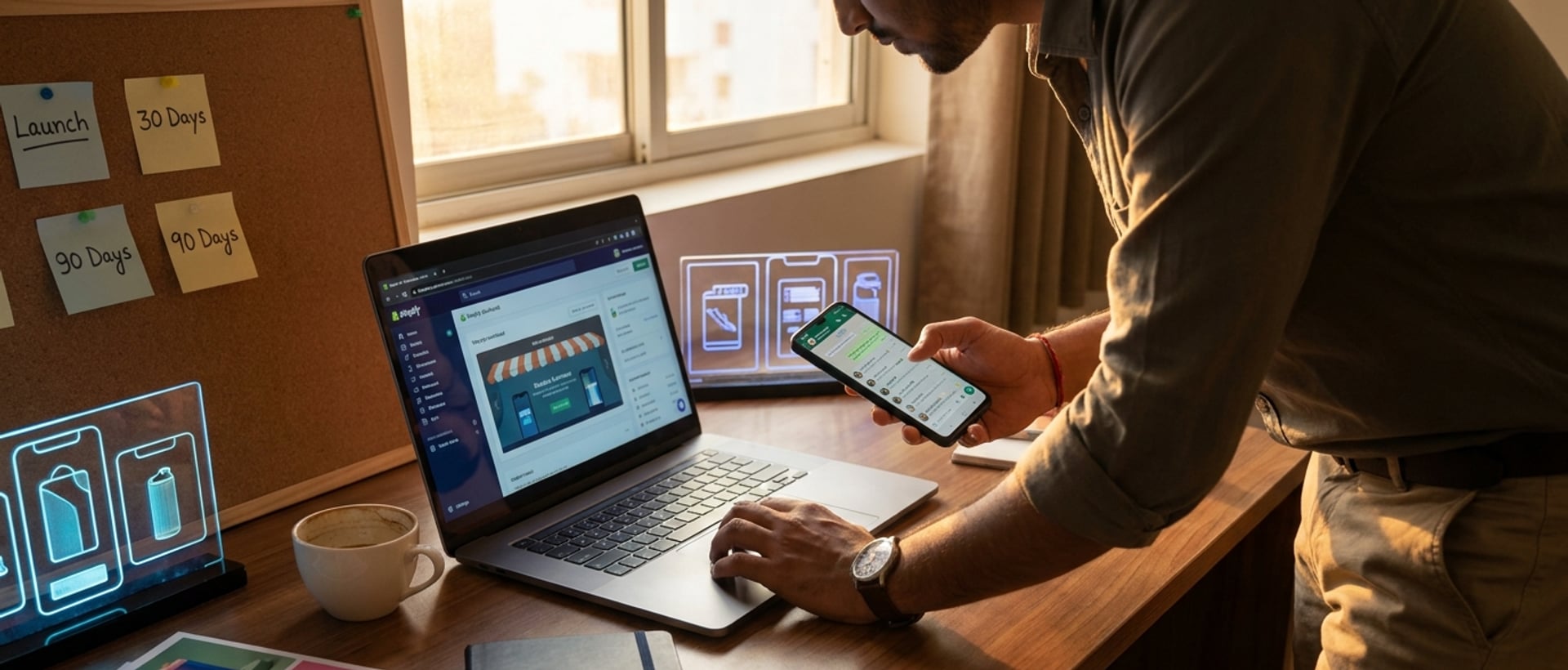
Quick Answer: A basic Shopify store with Razorpay for payments, Shiprocket for shipping, a premium theme, and 10-15 loaded SKUs can genuinely go live in 5-7 working days. The pieces are small and mostly parallel: domain registration (1 day), Shopify subscription and theme purchase (same day), Razorpay merchant onboarding (2-3 days), Shiprocket account (1-2 days), product upload and page copy (3-4 days). This is the timeline the agencies quote and it is real.
According to the Shopify India setup guides, the platform side is genuinely fast in 2026. Shopify Basic runs ₹1,994 per month. A premium theme costs ₹15,000-25,000 one-time. Razorpay onboarding for a proprietorship with GSTIN and current account takes 48-72 hours in most cases. Shiprocket account activation is faster, usually same-day. Everything technical is ready inside a week.
What is happening during those 7 days is set-up, not launch. Set-up means the URL resolves, the theme is installed, products are visible, checkout completes with a test order, WhatsApp Business Catalog is linked, GST is configured. The store is functionally alive. Whether anyone finds it or buys from it is a completely different question that the 7-day timeline never answers.
This is where the founder-vs-agency vocabulary gap creates trouble. The agency says "your store will be live in 7 days" and delivers exactly that. The founder heard "your store will be selling in 7 days" and gets angry when day 8 is quiet. Both are being honest inside their own definition. Neither is describing the same thing.
Why does the content stack take longer than the platform stack?
Quick Answer: Content - meaning product photography, video, descriptions, category imagery, and campaign creative - is the actual bottleneck on launch. A traditional studio catalog for 30 SKUs takes 10-15 working days plus another 5 days for post-production. That is longer than every technical setup step combined. Content readiness is why "the store is ready" and "the store is sellable" are two different sentences.
Most launch delays that founders blame on the developer are actually content delays. The theme is installed on day 3, waiting for hero images. The product pages exist on day 5, waiting for the studio shoot. The category page is functional on day 7, waiting for lifestyle imagery. The developer is done. The photographer is not.
The math is uncomfortable. Studio pricing in India ranges ₹250 to ₹1,000 per finished image, so a 30-SKU catalog runs ₹15,000-60,000 and takes 10-15 working days. Add variants and packaging and the number climbs. Add a lifestyle or model shoot for the launch campaign and you add another week. The technical launch is done in 7 days and you are still shooting product photos three weeks later.
The 2026 workaround is a hybrid workflow - the marketplace-mandatory hero shots on one studio day, then a locked brand recipe that generates the variants and lifestyle imagery inside a week. We wrote about that split in the 200-SKU catalog workflow, which specifically addresses how to compress the content timeline without losing marketplace compliance. The relevant point for launch: content is where speed goes to die, and it is fixable if you plan for it separately from platform work.
What is the honest 30-day path from platform-live to first sale?
Quick Answer: From platform-live (day 7) to first stranger sale (day 30), the work is content completion, small ad tests, and demand validation. First sales in weeks 2 and 3 are usually friends, family, and one-off outreach. First honest sale from a paid channel or organic discovery is week 4 for most Indian D2C brands. Anything faster is either a lucky campaign or a founder counting friends as customers.
Week 2 - the store is live but empty of trust signals. Product photography is finalising, category pages are getting real imagery, the About page finally reads like a brand. The founder is loading the last 20 percent of the catalog. WhatsApp Business Catalog is syncing. Instagram bio has the store link. First orders come from the announcement to your existing network.
Week 3 - the first paid ad campaigns run. Meta ads for a new store need a warm-up period; the pixel needs event data before conversion campaigns work properly. A ₹15,000-25,000 test budget across Meta and Google Search Ads produces the first data on which product resonates. Content creators reach out. Reels start posting. The site is technically the same as week 1, but the engine around it is spinning up.
Week 4 - the first cold sale usually lands. Not from the ads yet (those are still learning), but from an unexpected organic path - a WhatsApp forward, an Instagram reel that went further than expected, a curious Shopify customer clicking through. This is the moment most founders emotionally register as "the launch," even though it's four weeks after the store went live.
According to Indian D2C launch benchmarks, most brands see their first 20 cold sales between day 30 and day 45 post-launch. Below that pace, either the product-message-market fit is off, or the discovery layer isn't running yet. Above it, either the founder already had audience equity from prior work, or the launch coincided with a lucky viral moment.
What is the 90-day path from first sale to a real working store?
Quick Answer: Between day 30 and day 90, the store transitions from "occasional orders" to "operational rhythm" - and every operational muscle that failed to build in this window becomes an expensive problem later. Returns policy gets tested for the first time. RTO percentage becomes visible. WhatsApp support volume finds a pattern. Repeat rate data starts existing. Ad economics start being real, not aspirational.
The 90-day mark is where a lot of Indian D2C stores quietly stall. The founder is proud that they launched fast. Orders are coming in - not many, not few. But the operational stack is under-built. Returns are being handled ad-hoc via WhatsApp. RTO complaints are drowning support. Shopify order status contradicts what the courier scan says. The founder is doing the operational work themselves and burning out. This is a normal 90-day state.
The brands that make it past this stall built the operational layer between day 60 and day 90 instead of after day 90. Automated returns flow. WhatsApp support routing. RTO-reason tagging so the pattern becomes visible. Repeat rate cohort tracking. Post-purchase notification stack across the six delivery milestones. The store starts running instead of the founder running the store.
This is why fast launches are so risky. A store that went live in 7 days with zero operational preparation is still going to hit day 90 with the same volume of operational work as a store built over 90 days with operations baked in. The compression saved calendar days, not work. The work reappears somewhere. Usually in the founder's inbox.
If your ambition is to be a real operator by month four - which is the point of launching in the first place - the honest budget is 7 days for the platform, 30 days for the first sale, 90 days for the store to actually work. Compressing the calendar too aggressively front-loads speed at the cost of the operational muscle you'll need in month five.
What can you actually get done in 7 days if you MUST launch fast?
Quick Answer: A sub-7-day launch is possible with a specific constraint - 10-15 SKUs, one studio-shot hero image per product (or existing high-quality photography), a Shopify premium theme with minimal customisation, Razorpay + Shiprocket + WhatsApp Business Catalog, and a founder willing to answer support DMs personally for the first month. Cut anything from this list and either the launch delays or the store looks unfinished.
The two-day sequence that founders miss is Day 1-2 documentation before Day 3-7 build.
Day 1 - domain registration, Shopify plan selection, Razorpay merchant application submitted with all documents ready (PAN, GSTIN, cancelled cheque, current account statement). Theme purchased. Basic brand assets consolidated - logo files, brand colours, tone of voice notes.
Day 2 - product photography either shot (single day, 15 SKUs, one hero angle each) or curated from existing high-quality sources. Product descriptions drafted in a single-founder sprint. Category structure defined. Shipping policy, returns policy, privacy policy drafted from Shopify's Indian templates and lawyer-reviewed if you have one on retainer.
Days 3-5 - theme installed, products uploaded with photography and descriptions, category pages built, cart and checkout tested with real Razorpay flow using a small test transaction, GST configured per the Shopify India setup, WhatsApp Business Catalog synced.
Days 6-7 - Shiprocket account activated with warehouse address, courier selections made, first shipping label test-generated, meta descriptions and SEO basics added, Instagram and Google Analytics linked, one Meta ad campaign draft prepared to launch on Day 8.
This works. It also produces a store that is technically alive and starving for content depth. The founder will spend weeks 2-4 filling in what a 30-day launch would have delivered on Day 8. Choose the compression consciously. The Shopify India 2026 setup guides confirm the 7-day path is genuine for the technical layer, but they don't warn you about the content and operations gap that follows.
For most brands, the honest tradeoff is to run platform work and content work in parallel from Day 1 - so that Day 7 delivers a technically live store AND enough content depth to actually sell. The workflow we describe in our AI photography managed service post is how brands compress the content timeline without sacrificing marketplace-compliant hero images.
What should you do next?
Skip the launch date debate for one hour. Instead, write down three separate dates: when does the platform need to be technically alive, when do you need your first stranger sale, and when do you need operational rhythm. Those are usually 7 days, 30 days, and 90 days respectively - and building the calendar around all three keeps the compression honest.
Then look at your content readiness. If you have 30 SKUs and no photography plan, your bottleneck is not the platform. Book the studio day now, or scope a managed AI catalog service. Everything else on the launch stack is downstream of finished imagery.
Then decide the operational bet. Are you comfortable running support, returns, and RTO handling manually for the first three months? If yes, run lean. If no, budget for a WhatsApp automation layer, a returns tool, and a courier integration from Day 1. Most first-time Indian D2C founders under-build here and pay for it around month four.
The realistic decision framework is honest about calendar reality. Launching in 7 days is genuine. Selling in 7 days is a fantasy. Working store in 7 days is impossible. Sequence the three timelines and the launch stops feeling like a fire drill.
If you want a scoped audit of your specific launch plan against your product complexity, channel mix, and content readiness, book a launch diagnostic - we'll come back with the honest 7-30-90 day plan for your brand. Not a sales pitch. Just the sequence that works.