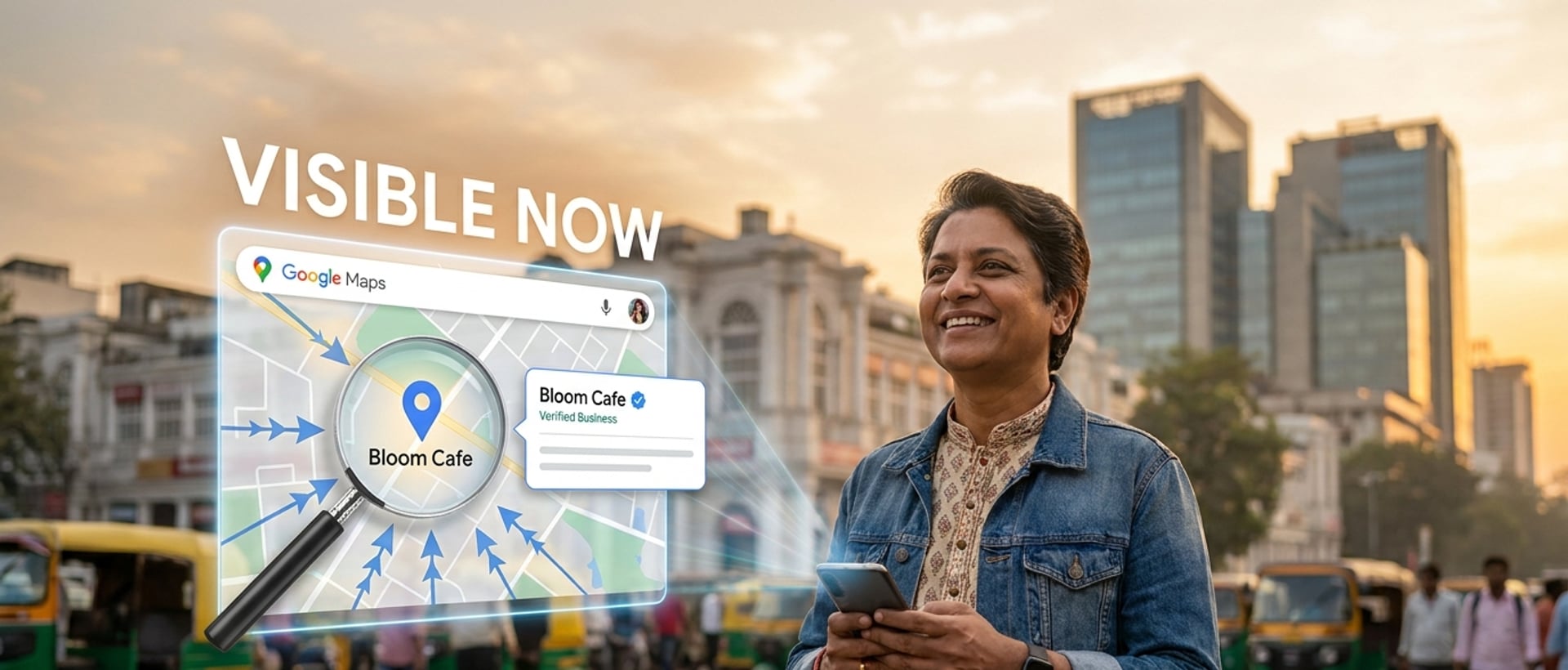
You Google your own business name from your phone. Nothing shows up. You Google what you sell in your city. Your competitors show up on the map, in the sidebar, and in the ads. You show up nowhere. You've had a website for two years. You paid a designer to build it. You bought a domain. You wrote About Us copy. And you are functionally invisible to the people looking for exactly what you sell.
Every SEO agency you've talked to will tell you the fix is a 6-month engagement with keyword research, content, and backlinks. That's not the fix for this specific problem. The reason you don't show up is not SEO. It's foundational discoverability - a Google Business Profile that was never claimed, citations that never got built, and name-address-phone data that Google can't verify.
The fix is 7 days of specific work that costs almost nothing and doesn't require an agency. Do this first. Then think about SEO. Reverse the order and you'll spend six months on an SEO retainer wondering why the traffic isn't coming.
Why isn't my business showing up when people Google it?
Quick Answer: Three overlapping reasons cover 90 percent of cases. First - you don't have a verified Google Business Profile (GBP), so Google has no verified entity for your business and won't show you on Maps or in the local sidebar. Second - your name, address, and phone number aren't consistent across the web (Justdial says one thing, your website says another, your Facebook page a third), so Google's trust score for the entity is low. Third - you have zero citations on Indian directory sites (Sulekha, IndiaMart, Yelp), which are the trust-building layer that supports GBP visibility.
The specific failure mode is that most Indian small businesses set up a website and stop there. The website exists. It even gets indexed by Google eventually. But indexing is not visibility. Indexing means "Google knows this page exists." Visibility means "Google shows this page to users searching for what you sell." The gap between the two is bridged by foundational discoverability signals that most SMBs never build.
For local-service businesses (salon, restaurant, clinic, workshop, retail store), the biggest single gap is unclaimed or unverified GBP. Google won't show you on Maps until it has verified you exist. It also won't include you in the local 3-pack (the top three business listings that show above organic results for location-based searches). Both of these are massive traffic sources for local SMBs, and both are gated by GBP verification.
For online-only businesses (ecommerce, SaaS, service platforms), the biggest gap is citation inconsistency plus zero third-party mentions. Google reads consistent mentions of your business name and website URL across the web as trust signals. A brand that appears only on its own website has zero trust signals. A brand mentioned on 20-40 directory sites has real ones.
What does 'Google Business Profile' actually do for you?
Quick Answer: GBP is the single highest-leverage local visibility asset for any Indian SMB. A verified GBP gets you into Google Maps results, the local 3-pack sidebar for category searches in your city, the knowledge panel that shows when someone searches your business name, and the Google Maps discovery layer (users browsing map without a specific search). Every one of these is a discovery surface most SMBs miss entirely without a verified GBP. Setup and verification is free.
The knowledge panel is the specific piece most SMB owners have envied without knowing what it's called. When you Google an established business, the right sidebar shows a card with the business name, address, hours, phone, reviews, and photos. That card is powered by GBP. A verified GBP populates it. An unclaimed business gets no card, or worse, gets an incorrect auto-generated card that customers see and act on.
The local 3-pack is the second big lift. When someone Googles "salon near me" or "electronics repair Bangalore," Google shows a small map with three business results at the top. Getting into that 3-pack drives 40-60 percent of the clicks for that query. The 3-pack ranks by proximity, category fit, and GBP completeness/activity. An unverified business can't be in it at all.
The Maps discovery layer is subtle but real. Users browsing Google Maps in their city looking at "restaurants" or "gyms" see the businesses that have complete GBP entries. Businesses without GBP are invisible to this browsing behaviour entirely.
Setting up GBP is genuinely free and takes 30-60 minutes. Verification takes 5-14 days for postcard, 24-72 hours for video (most common now in India). The lift after verification is usually visible within 2-4 weeks - you start showing up for name searches, category searches in your city, and Maps discovery. This is the single largest ROI action most Indian SMBs never take.
What are the exact 7 days of the fix?
Quick Answer: Day 1 - claim and start GBP verification. Day 2 - fix name/address/phone consistency on your website, GBP, and all social profiles. Days 3-4 - build 15-20 citations on Indian directory sites (Justdial, Sulekha, IndiaMart, Yelp, TrueLocal, GetIt, JustDial). Day 5 - add complete GBP details (hours, categories, services, photos, description). Day 6 - publish 3-4 GBP posts about your services or offerings. Day 7 - verify everything works (search your own name, your category in your city, check GBP insights). Total time: 15-20 hours across the week. Total spend: under ₹5,000.
Day 1 is the highest-priority action. Go to business.google.com, search for your business name and address. If Google auto-suggests your business, click "claim." If it doesn't, click "add your business" and enter the details. Pick verification method - video is fastest if offered. Postcard is 5-14 days. Just start the process; verification runs in the background while you continue with the rest.
Day 2 is name-address-phone consistency. Open a spreadsheet. Column 1: every place your business name appears (website, GBP, Facebook, Instagram, LinkedIn, JustDial if already listed, email signature). Column 2: the exact name, address, and phone as listed there. Fix any inconsistency to match your GBP - same spelling, same address format, same phone format. This is boring, tedious, and delivers real ranking lift because it fixes the trust-signal fragmentation Google was penalising you for.
Days 3-4 are citation building. Sign up on the top 15 Indian directory sites - Justdial, Sulekha, IndiaMart, Yelp India, TrueLocal India, GetIt, JD Business, Yellow Pages India, TradeIndia, Grotal, Askme India, WhoisIn, IndiaGet, Locanto, and OLX Business (yes, still relevant for SMBs). Some are free, some charge ₹500-2,000 one-time. Total spend for the full 15: ₹8,000-15,000. All use the same NAP data from Day 2.
Day 5 is GBP completeness. Add every business category that applies (up to 10). Add your services with descriptions. Upload 20-30 real photos - storefront, team, work-in-progress, before/after, products. Set hours precisely. Write the business description (750 characters, keyword-relevant but human-voiced). Every completeness signal you add lifts your GBP score.
Day 6 is GBP posts. Publish 3-4 posts using the GBP posting feature. Each post can highlight a service, offer, event, or update. This signals to Google that the profile is actively maintained (a ranking factor). Keep publishing 1-2 posts per week going forward - not a growth channel, but a maintenance signal.
Day 7 is verification. Google your business name, your service + city, your competitor's category + city. Check where you appear now versus where you appeared before Day 1. Check GBP Insights for how many searches you're already showing up in. Note the baseline. Come back in 30 days and check again - most of the lift shows up in weeks 2-4 as Google indexes the citations and verifies the GBP data.
Why does 'consistency' actually matter so much for Google?
Quick Answer: Google is trying to answer the question 'is this a real, trustworthy business entity or a spam listing?' The specific signal it uses is whether name, address, and phone number appear consistently across many verified sources. A business named 'Bloom Cafe' on the website, 'Bloom Cafe & Bakery' on GBP, 'Bloom Cafe Bengaluru' on Justdial, and 'Bloom's' on Facebook looks like 4 different entities to Google's entity resolution system. Consolidating to one exact name across all 4 lifts trust score dramatically.
The address format matters as much as the name. '123, MG Road' versus '123 MG Rd' versus '#123 MG Road, near XYZ landmark' all read as potentially different addresses to entity resolution. Pick one format (matching your GBP), enforce it everywhere, don't creative-write variants. Same for phone - pick one format (+91-XXXXX-XXXXX or +91 XXXXX XXXXX or (0XX) XXXX XXXX) and use it consistently.
The specific ranking impact of NAP consistency is under-quantified but consistently observed. Businesses that fix NAP inconsistency typically see 20-40 percent GBP visibility lift within 6-8 weeks with no other change. This is the single highest-ROI 4-hour task in the entire 7-day playbook.
What happens after Day 7 - do I need SEO now?
Quick Answer: Yes, but a specific kind of SEO, and only after the foundation is solid. The 7-day fix gets you discoverable for name searches, local category searches, and Maps browsing. That's foundational visibility. SEO investment thereafter should focus on category-authority content (answer-first pages targeting your top 10 category queries), on-site technical SEO (schema, page speed, mobile), and third-party mentions (guest posts, PR, participation on category communities). Not backlink-buying, not keyword-density obsession.
The natural sequence for a small Indian D2C or service brand is: Weeks 1 - foundational visibility (this post). Weeks 2-12 - answer-first content on your top 10 category queries. Months 4-12 - E-E-A-T layer building (Reddit, Quora, comparison articles, review presence). Skipping Week 1 and jumping to Week 4 is why most SEO retainers under-deliver - the foundation was never built.
The AI Overview shift compounds this. Being cited by AI Overviews requires foundational entity recognition first, then content authority second. Brands without verified GBP and consistent NAP data are functionally invisible to AI Overview citation - the AI can't verify them as a trusted entity. The 7-day fix is also AI Overview readiness. The two aren't separate projects.
For most Indian SMBs, the honest sequence is: fix visibility first (this post), then run AEO/SEO content (see our SEO vs AEO breakdown), then invest in the E-E-A-T layer over 12+ months. The compounding advantage is real, but the sequence matters.
What should you do next?
Do the Day 1 action right now - open business.google.com and start your GBP claim. Everything else on this list is downstream of that single action. If your GBP is already verified, skip to Day 2 - open the spreadsheet and audit your NAP consistency across every place your business is listed.
Then commit the 7 days. Not vaguely 'over the next month.' Specifically this week or next week, calendar-blocked, 2-3 hours per day. The playbook only works when done in the compressed timeline, because the verification, citations, and consistency updates create a cluster signal that Google's crawl picks up over the following 2-4 weeks.
Then wait for the lift. Between weeks 2-8, your Google visibility for name searches and local category searches will start climbing. Track it via GBP Insights (search count, direction requests, phone clicks) and Google Search Console (impressions for your brand name and category keywords). The lift is measurable within 30 days for most brands.
If you want us to run the 7-day fix for your specific business - claim + verify GBP, audit NAP consistency, build the citations, and set up the GBP posting cadence - book a discoverability audit. We come back with your current visibility baseline, the specific gaps in your foundation, and either a done-with-you playbook or done-for-you setup. Not an SEO engagement. Foundational visibility.