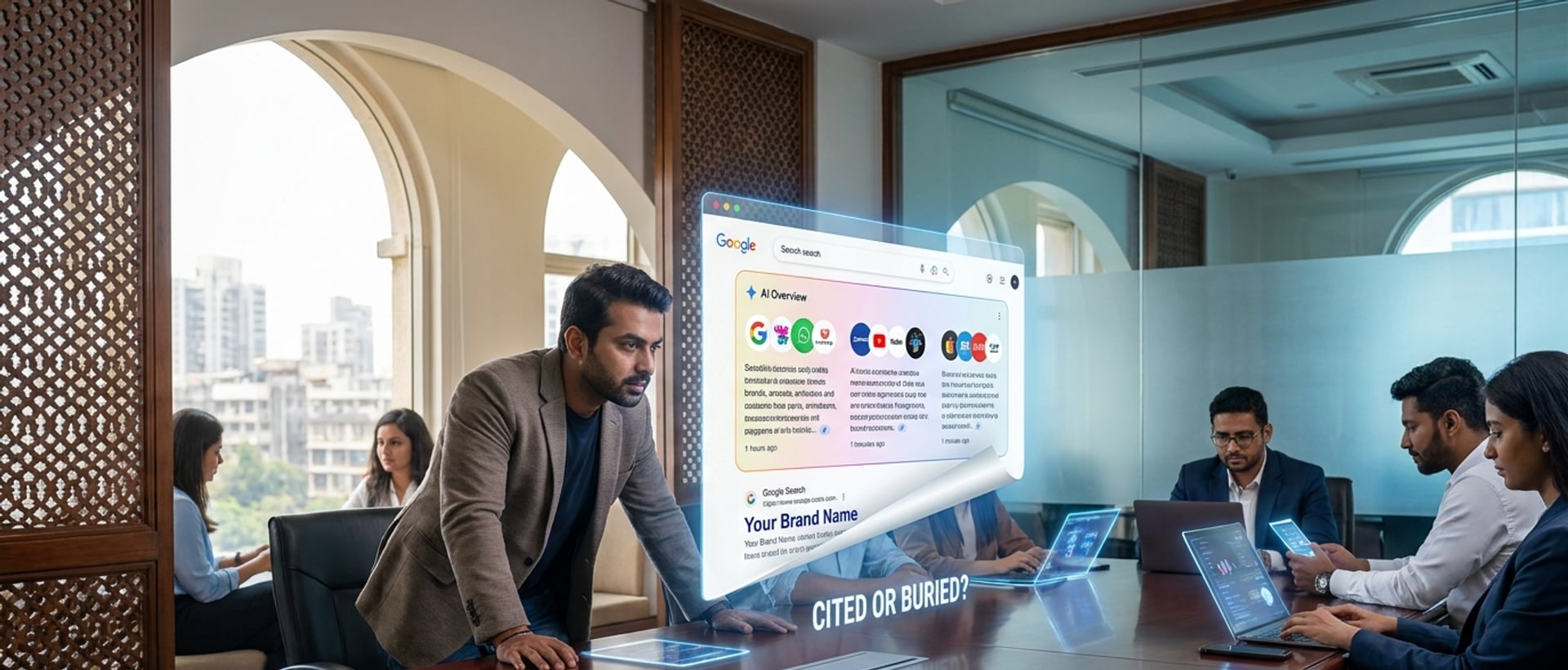
You spent three years building a page that ranks number one for your money keyword. Today, someone searches that keyword and Google shows an AI Overview above your listing. The AI Overview cites two brands. Neither of them is you. The customer reads the AI answer, taps one of the cited brand names, and never sees your listing at all.
That is the specific 2026 problem for a lot of Indian D2C brands. Ranking number one on Google no longer guarantees the click, because the click doesn't happen. The AI answer is now the click. And the difference between being cited inside that answer versus being buried below it is the difference between owning the discovery moment and losing it entirely.
This isn't about SEO being dead. Classic SEO still works for a lot of queries where AI Overviews don't render. But for the growing share of commercial-intent queries where they do render, the game has shifted from "rank the page" to "be cited by the AI." Different rules, different signals, different content shape. Here's the honest playbook.
What's actually happening on the SERP in 2026 - the click-through math?
Quick Answer: Google AI Overviews now render on approximately 48 percent of searches, and for those queries, click-through on the top-ranking organic result fell about 58 percent per Ahrefs's late-2025 study. For any commercial-intent query where the AI Overview cites 2-3 sources, being cited is worth 5x more in conversion terms than being ranked #1 below it. Brands not adapting are watching their organic-click revenue drop 30-50 percent on their historically-strongest queries.
The mechanical shift is that the AI Overview panel dominates the top of the SERP visually, pushes the first organic result below the fold on mobile, and provides a complete answer without requiring the click. For informational queries (how, what, why), the user often doesn't click at all - they got what they needed from the overview.
According to ecommerce AI Overview data, Google AI Overviews appeared on over 10 percent of shopping queries by early 2026 - a five-fold increase in four months. This is not slow adoption. This is exponential growth for the specific query type that most D2C brands depend on.
The upside for brands that adapt is real. Being cited inside the AI Overview signals authority - Google's AI vetted your page before quoting it. Users clicking a cited source convert approximately 5x higher than users clicking a standard organic result, because the citation itself is a trust signal. The net-revenue math often improves even as raw click volume drops - fewer clicks, but each click converts far better.
What signals actually get you cited in an AI Overview?
Quick Answer: Three overlapping signals dominate citation eligibility. First - answer-first content structure (question as H2, direct 40-60 word answer immediately below, supporting detail after). Second - complete structured data (FAQPage schema on content pages, Product schema with price + availability + ratings on product pages). Third - E-E-A-T signals (author expertise, brand identity consistency, third-party mentions the AI can cross-check). Content missing any of the three under-performs on citation frequency.
The answer-first structure requirement is the highest-leverage rewrite for most brands. According to AI citation research, 44.2 percent of all LLM citations come from the first 30 percent of a page's text. If your answer is buried in paragraph 12, the AI won't extract it, no matter how good the paragraph is. Move the answer to the top. Every section. Every page.
The structured-data requirement is the technical foundation. FAQPage schema on content pages, Product schema on product pages, Organization schema site-wide, Article schema on blog posts. According to structured-data impact studies, pages with proper schema are 36 percent more likely to appear in AI summaries than pages without. This is a 2-4 hour developer job per template that returns compounding value.
The E-E-A-T requirement is the slowest to build and the hardest to fake. AI models cross-check the brand across the web - are you named on Reddit threads discussing the category, are you mentioned in comparison articles, does Wikipedia recognise your brand entity, are your product reviews consistent across platforms. This third-party validation layer is what separates a citation-worthy brand from a search-optimised website.
Why does the same page structure win BOTH classic SEO and AI Overview citation?
Quick Answer: Because both reward the same content quality signal - direct answers to real questions. Classic SEO rewards it through featured snippets and PAA-panel eligibility. AI Overviews reward it through extraction eligibility. A page structured as "question H2 + 40-60 word direct answer + supporting detail" gets eligible for featured snippets, PAA, AI Overviews, ChatGPT citations, and Perplexity citations simultaneously. This is the rare case where optimising for one channel actively helps every other channel.
The specific mechanical convergence is around the "Answer Capsule" pattern - a short, self-contained, quotable answer that stands alone if extracted from context. Google's classic search extractors use this for featured snippets. ChatGPT, Perplexity, and Google AI Overview extractors use this for citation. The content shape is identical; the surface differs.
The uncomfortable implication is that a lot of existing SEO content is not answer-capsule structured. It's essay-structured - opinion at the top, evidence in the middle, conclusion at the bottom. This is fine for readers but bad for extraction. The rewrite from essay-shape to answer-capsule-shape is what unlocks multi-channel eligibility.
This is exactly the pattern this very blog is written in. Every H2 is a question a real founder would ask. Every H2 is followed immediately by a bolded 40-60 word Quick Answer. Supporting detail comes after. The AI extractor sees a clean answer capsule and can cite it directly. A human reader sees a scannable structure that answers their question in the first paragraph.
What content types get cited MOST in AI Overviews, and which get cited least?
Quick Answer: Most cited - comparison content ("X vs Y"), pricing breakdowns, how-tos with specific numeric steps, and category-authority answer pages ("what is the best X for Y"). Least cited - generic "ultimate guide" essays, thin product pages without complete schema, brand-story marketing pages, and any content over 3,000 words without clear internal structure. Query fan-out means the AI is looking for the crispest answer to a specific sub-query, not comprehensive coverage.
Comparison content wins disproportionately because comparison queries are one of the highest AI Overview trigger patterns. "X vs Y for use-case Z" queries almost always render an AI Overview with 2-4 cited comparison sources. Brands that produce genuine, opinionated comparison content (not the AI-generated fluff most affiliate sites publish) get cited repeatedly.
Pricing breakdowns win because pricing is one of the most researched pre-purchase queries and traditional websites hide pricing behind gates. AI extractors reward pages that name a number and explain the range. Our Shopify vs custom breakdown works partly because it names actual rupee ranges instead of "contact us" boilerplate.
How-tos with specific numeric steps win because the format matches the extraction pattern perfectly - each step is an answer capsule. "How to launch an ecommerce store in India" - 7 days, 30 days, 90 days breakdown works well for citation because each phase has a number.
Category-authority answer pages win because AI Overviews are answering a question and the most authoritative answer to that specific question tends to win. Being the "recognised go-to answer" for a narrow category question beats being one of many voices on a broader topic.
What is Shopping Graph data, and why does it matter for D2C brands?
Quick Answer: Shopping Graph is Google's product-catalog knowledge layer that powers AI Mode shopping answers, Google Shopping tabs, and product mentions inside AI Overviews. Feeding it properly requires complete Product schema on every PDP, a Google Merchant Center feed, and consistent product data across your site and external mentions. Brands with complete Shopping Graph presence show up as product recommendations inside AI answers. Brands without it don't.
According to Google AI ecommerce optimization guides, showing up in Google AI Mode for shopping queries requires a dual track - content citations (through answer-capsule structure and E-E-A-T) AND product data (through Shopping Graph completeness). Sites that optimise only one path miss the other, and the two paths cite different query types.
Setting up Shopping Graph properly is a 6-12 hour engineering job for most Shopify sites. Google Merchant Center feed, product schema JSON-LD on every PDP with price + availability + ratings + brand + GTIN + condition, and consistency between the feed and the site. Once done, it maintains itself as long as product data stays clean.
The specific query patterns that reward Shopping Graph completeness are "best X for Y" transactional queries where the AI wants to recommend specific products. Not being in the Shopping Graph means not being in the recommendation pool at all - a zero, not a low ranking. This is often the highest-value AI Overview shift for D2C brands to prioritise.
What should you do next?
Baseline your citation footprint first. Open ChatGPT, Perplexity, and Google AI Mode. Ask the ten questions a ready-to-buy customer in your category would ask. Note which brands get named in each answer. If you're not being named in even one answer across the three engines, you have a citation-zero problem. If you're being named in some but not others, you have a channel-consistency problem. Different problems, different fixes.
Then pick the top 10 pages to restructure. Not the whole site. The top 10 by traffic plus the top 10 targeting your highest-intent commercial queries. Rewrite them to answer-first structure - question H2s, 40-60 word direct answers immediately below, supporting detail after. Add FAQ schema to every one.
Then commit to the E-E-A-T layer over 6-12 months. Genuine participation on Reddit threads and Quora questions in your category. Guest content on category-authority publications. Consistent brand mentions across review platforms. This layer compounds slowly and cannot be shortcut without faking it - AI companies actively tune against manufactured consensus.
If you want an audit of your specific AI Overview citation footprint and a 90-day plan to fix it, book an AEO audit - we come back with your current citation baseline across all three engines, the top 10 pages to restructure, the schema gaps to close, and the specific content sequence for your category.