You have 300 product pages on your Shopify store. Each one has a title tag, a meta description, a decent product photo, and a description someone wrote 18 months ago. None of them rank particularly well. Traffic goes to your homepage and your top category pages; the PDPs are mostly empty of organic sessions. The SEO agency that's been on retainer for six months has been pitching keyword research and backlink outreach. Neither is moving the needle.
That agency isn't scamming you. They're just working on the wrong layer for the actual problem. Product page SEO in 2026 is less about keyword research and backlinks and more about schema completeness, mobile page speed, review integration, and answering the specific queries buyers actually type. Get those four right and PDPs start ranking. Get them wrong and no amount of keyword work will help.
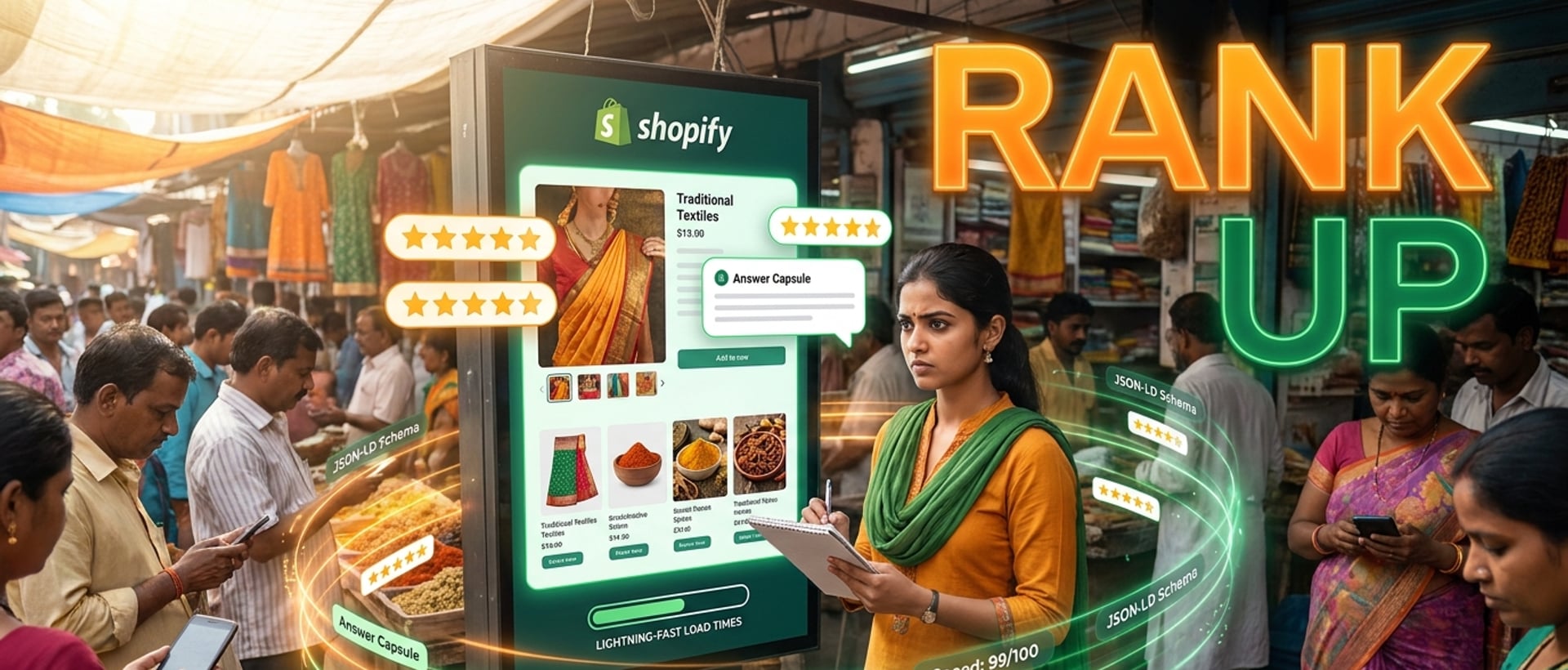
This post is the honest 2026 playbook for what actually moves PDP rankings for Indian D2C brands. Skip the generic SEO listicles. Fix the four layers that compound.
What actually determines whether a product page ranks in 2026?
Quick Answer: Four factors dominate PDP ranking for Indian D2C in 2026 - complete Product schema (unlocks rich snippets, AI Overview eligibility, Google Shopping graph inclusion), mobile page speed (Core Web Vitals + user behaviour signal), review count and quality (Moz 2026 data shows 23 percent ranking lift for products with 50+ reviews), and answer-capsule description structure (scannable answers to specific buyer questions, not narrative paragraphs). All four together compound; missing any one caps the ceiling.
Keyword optimisation still matters but at a lower weight than most SEO retainers price it. The 2020-era formula (keyword-dense title + keyword-dense H1 + keyword-dense description + backlinks) delivers diminishing returns as Google's algorithm shifts toward entity understanding and answer quality. Modern PDP ranking is more about matching buyer intent than matching keyword strings.
According to product page SEO benchmarks, keyword strategy, structured data, and product description completeness are the three highest-impact factors for e-commerce product page rankings. Notice keyword is one of three, not the whole. Structured data (schema) and completeness are equally weighted, and completeness includes reviews, variant coverage, and answer-quality of descriptions.
The specific pattern for Indian D2C is that mobile page speed dominates because 78 percent of traffic is mobile - a slow PDP that ranks technically well still bleeds sessions because users bounce before engagement metrics register. This is why the mobile speed fix often unlocks the ranking potential of otherwise-well-optimised PDPs.
What Product schema should every PDP have in 2026?
Quick Answer: Full Product schema JSON-LD block with - name, image, description, brand (as Brand entity), sku, gtin (if available), offers (with price, priceCurrency, availability, priceValidUntil, url), aggregateRating (with ratingValue, reviewCount when reviews exist), review (individual review objects for top reviews), and additionalProperty (for material, care, dimensions, features). Product variant relationships via Schema.org ProductGroup type for size/colour variants. Missing schema is missing eligibility for rich snippets, AI citations, and Shopping graph inclusion.
According to structured-data research, pages with proper FAQ, Product, and Organization schema are 36 percent more likely to appear in AI summaries than pages without. For Indian D2C, this AI-visibility lift matters more than the traditional rich-snippet lift because AI Overviews now render on over 10 percent of shopping queries and are growing 5x per year.
In 2026, Google expanded support for product variant structured data using the Schema.org ProductGroup type. A single parent product can now declare its variants (sizes, colours, materials) as structured data, which is important for apparel and jewellery brands where variant discovery drives conversion. Correctly implementing ProductGroup instead of duplicating full Product schema per variant improves crawl efficiency and reduces duplicate-content signals.
The implementation is typically a 6-12 hour engineering job for a Shopify site (theme template edit + Liquid variables + JSON-LD block generation). Cost with a competent Shopify developer - ₹15,000-40,000 one-time. Ongoing maintenance near zero. Payback in ranking and rich-snippet lift is typically visible within 45-60 days.
Why does mobile page speed matter so much specifically for Indian PDP ranking?
Quick Answer: Two compounding reasons. First - Core Web Vitals is a Google ranking signal, and mobile speed dominates that measurement. A PDP failing Core Web Vitals thresholds (LCP under 2.5s, CLS under 0.1, INP under 200ms) is deprioritised versus competitor PDPs that pass. Second - user behaviour signals (bounce rate, session depth, return visits) are also ranking inputs, and slow mobile PDPs blow up all three. In Indian mobile context on 4G with mid-range Android, the difference between 2.5s and 4.5s PDP load is roughly 20-25 percent conversion delta AND 15-25 percent ranking delta.
The specific mobile-first indexing shift Google completed in 2023 means the mobile version of your PDP is the version that gets indexed and ranked. Desktop performance doesn't matter for ranking (though it still matters for the small share of desktop buyers). Optimising desktop while ignoring mobile is a common Indian D2C SEO mistake.
The measurable Core Web Vitals targets to hit - Largest Contentful Paint under 2.5 seconds, Cumulative Layout Shift under 0.1, Interaction to Next Paint under 200 milliseconds. Test with Lighthouse on Chrome for Android on throttled 4G (not fibre, not desktop, not iPhone). The specific score is a proxy for how Google's crawler will experience the page.
Common mobile speed leaks on Shopify PDPs - unoptimised hero images (fix with WebP conversion and responsive srcset), too many third-party scripts (audit and remove unused pixels/chatbots/A-B testing tools), Liquid template inefficiency (deferred loading for below-fold blocks), and unused theme features (many Shopify themes ship with slideshows and testimonial widgets that aren't needed on PDPs but still load).
How does review integration actually work for PDP SEO?
Quick Answer: Two mechanisms. First - review count is a direct ranking factor (Moz 2026 shows products with 50+ reviews rank 23 percent higher than under-10-review products). Second - review content is crawled and used for query matching - buyer questions in review text get indexed and match long-tail queries. Third - review schema unlocks rich snippet star ratings in SERPs, which lifts CTR 15-30 percent on the same ranking position. Reviews compound - they help ranking, matching, and click-through simultaneously.
The practical fastest-path to 50+ reviews per SKU is WhatsApp-based review requests to existing customers 7 days post-delivery. WhatsApp response rates for review requests in India are 25-40 percent, versus 3-7 percent for email requests. For a brand at 500 monthly orders with the WhatsApp cadence, expect 100-180 new monthly reviews across the catalog - meaning top 20 SKUs hit 50+ reviews within 3-4 months.
Review schema (individual reviews as Review objects, aggregate as AggregateRating) enables the star-rating snippet in SERPs. Without this schema, the reviews exist on the page but Google can't display them in the snippet. Implementation is often included in the Product schema block; check that your Shopify theme's schema output includes review objects, not just aggregate.
Product reviews also feed AI Overview citation. AI models cross-reference product reviews when generating recommendation-style answers ("best X for Y"), and products with substantial verified-review coverage get cited more often than products with sparse reviews. This is another compounding effect - reviews for ranking AND reviews for AI citation.
What description structure actually works in 2026 PDPs?
Quick Answer: Answer-capsule structure, not narrative paragraphs. Each buyer question (What is this made of? How do I care for it? What size should I pick? Is this good for my skin type?) gets a specific H2 heading with a 2-3 line direct answer immediately below. Buyer intent has shifted toward specific answers to specific questions. Long-form product stories work in blog content; PDP descriptions need scannable structured facts. This structure also matches the extraction pattern AI Overviews use for citation.
The mechanical benefit is that answer-capsule structure serves both classic SEO (featured snippets, PAA eligibility) and AI Overview citation (extractable clean answers). Same structure, both surfaces. Long paragraph descriptions serve neither well.
For most Indian D2C PDPs, the specific answer categories that convert are - materials/ingredients, care/usage instructions, sizing/fit guidance, comparison with alternatives, common concerns/questions from FAQs, and delivery/returns information visible above the fold. Each gets its own H2 and 2-3 line direct answer. This is not creative writing; it's information architecture.
The specific rewrite process for a PDP takes 30-45 minutes per SKU with templating - restructure the existing content into the answer-capsule format, add H2s for each answer category, add FAQ schema pointing to the H2s, verify readability on mobile. For 300 SKUs, that's 150-225 hours; realistically prioritise the top 30-50 SKUs by traffic and handle the tail with a lighter template.
For related content pattern reference, our SEO vs AEO breakdown covers why the answer-capsule pattern serves both classic SEO and AI Overview citation simultaneously.
What should you do next?
Audit your top 20 PDPs first. For each - check schema presence (view source, look for JSON-LD script with @type Product), check mobile speed (Lighthouse in Chrome incognito on throttled 4G), check review count on page, check description structure. Score each PDP out of 4. Under 3 is bleeding traffic.
Then run the schema-and-speed sprint. These two are the highest-leverage 30-day fixes. Schema implementation is one dev sprint. Mobile speed audit and top-20-SKU speed fix is another. Ship both in weeks 1-4 and measure lift in weeks 5-8. This alone typically lifts organic PDP sessions 20-35 percent.
Then commit to the review pipeline. WhatsApp cadence to customers 7 days post-delivery. Auto-triggered from your OMS if possible, manual if not. Target 50+ reviews on top 20 SKUs within 90 days. This is the compounding investment that lifts rankings for the next 12+ months.
If you want an audit of your specific PDP SEO status, gap analysis against the four factors, and the sequenced 8-12 week implementation plan, book a PDP SEO audit - we come back with your specific schema gaps, page speed baseline, review distribution across SKUs, and the priority sequence for fixing.