For years, ecommerce visibility meant one thing.
Rank higher. Get more clicks. Win more sessions.
That mental model still matters, but in 2026 it is no longer enough.
The discovery layer is changing.
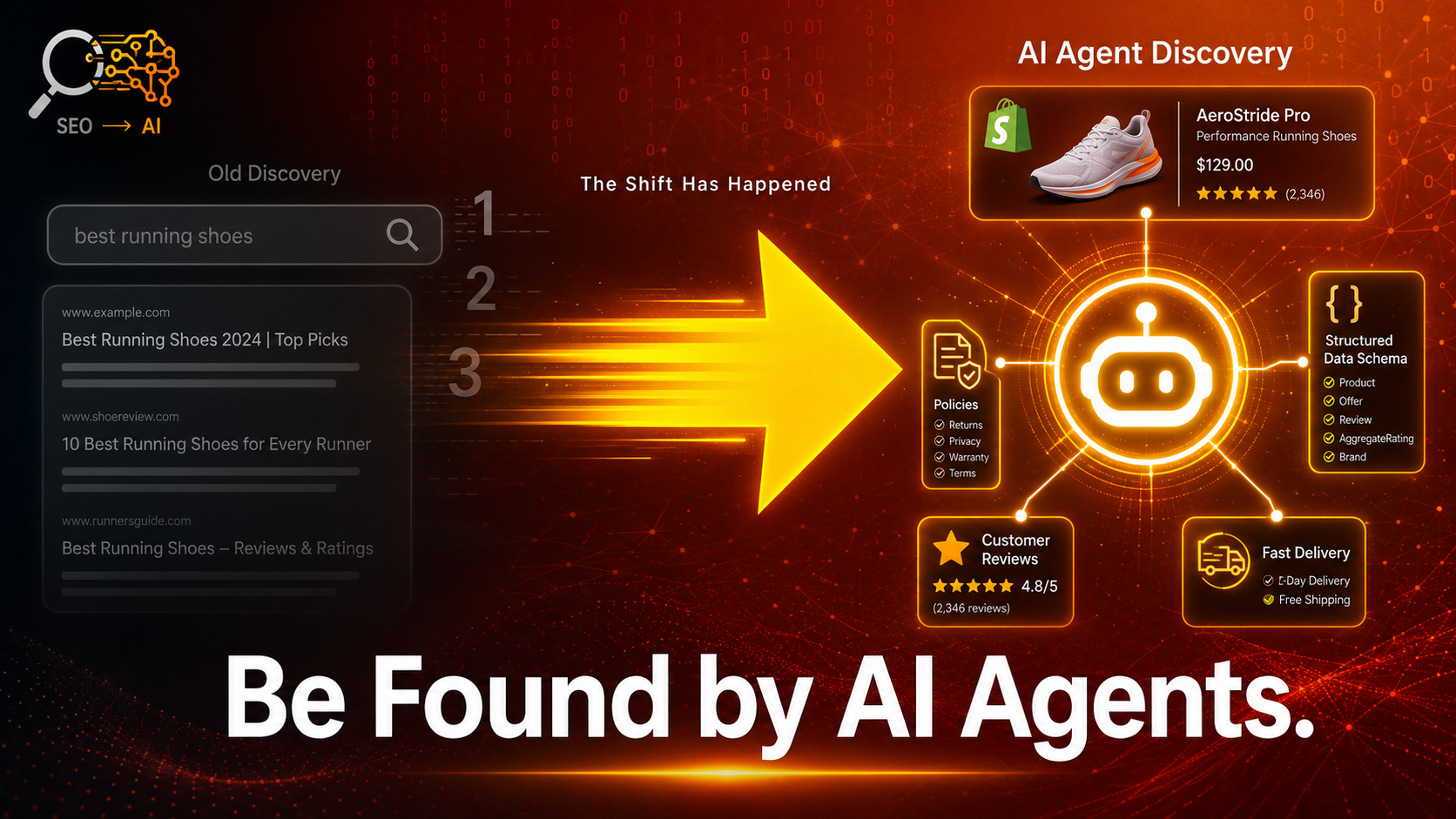
Customers are increasingly using ChatGPT, Perplexity, Gemini, Copilot, and other AI-powered systems to ask product questions in natural language, compare options, shortlist brands, and sometimes let the system decide what to buy next. AI shopping agents are moving beyond search assistance into product matching, recommendation, and purchase support, which changes what it means for a store to be discoverable.
That means the old SEO question - "How do we rank for this keyword?" - is being joined by a new one:
How do we become visible, understandable, and trustworthy to AI shopping agents?
That is a very different problem.
Search engines were already moving toward structured understanding, but AI shopping agents take this much further. They are not only retrieving pages. They are trying to interpret user intent, compare products across merchants, verify facts quickly, and recommend the option that best fits the request.
This is why Shopify and DTC brands need to move beyond SEO alone and start thinking in terms of AI visibility.
AI visibility means your catalog, content, policies, and operational signals are clear enough for machine systems to parse, trust, and surface. That is what this blog is about - not abstract theory, a practical guide.
SEO Is Still Necessary, But It Is No Longer Sufficient
It would be a mistake to frame this as SEO versus AEO. You need both.
SEO still helps search engines discover, index, and rank your pages. But AEO and AI-search optimization focus on something different: being included in AI-generated answers, citations, and recommendation flows, not just traditional search results.
This distinction matters because AI systems behave differently from classic search engines.
- A search engine shows a ranked list.
- An AI system often tries to synthesize an answer.
- A shopping agent tries to narrow choices.
That means the winning brand is not always the one with the best headline tag or the highest backlink count. It is often the one with the cleanest, most extractable, most trustworthy product information.
So the new optimisation model looks like this:
- SEO helps you get found.
- AEO helps you get cited.
- AI shopping optimization helps you get selected.
That third layer is where many Shopify brands are still underprepared.
What AI Shopping Agents Need to Understand a Product
A human can infer a lot from context. An AI shopping agent prefers explicit structure.
When an agent is evaluating a product, it is looking for evidence it can parse reliably and compare against the user's request. That usually includes:
- Product title clarity
- Category and taxonomy logic
- Specific attributes and specifications
- Brand entity signals
- Price and currency
- Availability
- Variants
- Reviews and ratings
- Shipping and return information
- FAQs and explanation content
Current guidance on AI-shopping readiness consistently points to structured product information, complete attributes, schema markup, and fresh availability/pricing data as foundational.
This means a product page must do more than persuade. It must be machine-readable. And not only in code - in language too.
If the page is vague, thin, inconsistent, or missing core facts, the AI system has less confidence. Less confidence means lower visibility or lower selection probability.
The Shift From Search Visibility to AI Visibility
Traditional SEO asked:
- Can the crawler index this page?
- Does the page match the keyword?
- Does the site have authority?
AI visibility asks a more operational set of questions:
- Can the system extract the facts quickly?
- Are the product attributes complete and consistent?
- Are the price and availability trustworthy?
- Is the policy language clear enough to reduce uncertainty?
- Are the answers aligned across product pages, FAQs, feeds, and external references?
For Shopify and DTC brands, that creates a new operational reality.
Your product catalog is no longer just a merchandising asset. It is a machine communication layer.
The Practical Optimization Framework - 5 Layers
The easiest way to think about AI shopping agent readiness is through five layers.
Layer 1: Structured Data
Structured data is the foundation because it tells machines what is on the page in a standardized format.
For Shopify stores, this usually starts with Product, Organization, and Breadcrumb schema that Shopify already adds to standard pages, but that is rarely the whole job. FAQPage, Article, HowTo, and other schema types often need to be added manually or through apps depending on the page type and content strategy.
For AI shopping agent readiness, you want structured signals for:
- Product name, Brand, SKU
- Price, Currency, Availability
- Reviews and ratings
- FAQs
- Breadcrumbs and site structure
- Shipping/returns relationships where possible
Advanced guidance also points to the value of including GTIN or UPC data, real-time availability, and relational entities that connect products to brand, shipping, and return policies.
The most important point: if the machine has to guess, you are already behind.
Layer 2: Product Attribute Completeness
Many Shopify product pages still depend too much on marketing copy and too little on structured facts. That was already weak for conversion. For AI shopping agents, it is worse.
Agents need attributes that let them compare options cleanly: material, dimensions, skin type, size, ingredients, compatibility, age range, usage, fit, pack count, and whatever else matters in the category.
A simple test: if a customer asked ChatGPT "Which one is better for my specific use case?" would your page provide enough exact facts for the system to answer confidently? If not, the page is not AI-ready.
Layer 3: Policy Clarity
Humans may tolerate partial policy information and clarify later. AI shopping agents do not like ambiguity.
If shipping timelines are vague, return windows are buried, exchange rules are confusing, or refund logic is inconsistent, the system has less confidence recommending the merchant.
That means these pages matter much more than most brands think: shipping policy, returns policy, refund policy, exchange policy, FAQ pages, delivery estimates on product pages.
These are not just support documents anymore. They are part of the product's machine trust layer.
Layer 4: Content Consistency Across Surfaces
AI systems do not evaluate one URL in isolation. They synthesize across surfaces - product pages, collection pages, FAQs, blogs, knowledge-base articles, review content, feeds, citations, and external references.
If the information differs across those sources, confidence drops.
For example:
- Product page says 5-day shipping
- FAQ says 7 to 10 days
- AI citation source says delivery varies by region without specifics
That kind of inconsistency creates uncertainty. In AI-driven discovery, uncertainty is expensive.
Layer 5: Operational Freshness
This is where AI visibility becomes more than content work. A product is harder to trust if the underlying signals are stale.
Current AI-commerce guidance repeatedly stresses that pricing, stock status, product feeds, and technical architecture need to support fast verification because AI systems are increasingly trying to validate facts in near-real time.
That means the store needs reliable freshness in: Inventory availability, Pricing, Variant status, Merchant feeds, Delivery expectations.
If your product page says one thing and your actual commerce layer says another, the AI system may stop trusting you.
The AI Visibility Checklist for Shopify Brands
If your team cannot confidently say yes to most of these, your store is not yet optimized for AI shopping agents.
- Do product pages have complete, category-specific attributes?
- Is Product schema present and valid on key product pages?
- Are FAQs marked up properly where relevant?
- Are price, stock, and availability accurate and updated reliably?
- Are brand, SKU, variant, and taxonomy fields standardized across the catalog?
- Are shipping, returns, and refund policies explicit and easy to interpret?
- Is the same product information consistent across product pages, feeds, FAQs, and support content?
- Have you tested whether your brand shows up in ChatGPT, Perplexity, and Gemini for category prompts?
This is the shift from "we have SEO pages" to "we have machine-readable commerce assets."
What Most DTC Brands Still Get Wrong
The most common mistakes are not technical edge cases. They are basic readiness failures.
- Writing product pages for persuasion only, not extraction
- Treating policy pages as legal pages instead of trust pages
- Assuming Shopify's default schema is enough for every important use case
- Ignoring FAQ and answer-first content
- Letting product feeds and site content drift apart
- Measuring only keyword rankings while AI visibility goes untracked
Each of these weakens machine trust. And in AI shopping environments, trust is what gets you surfaced, cited, or selected.
How to Make Shopify Catalogs More Agent-Ready
If a Shopify brand wants to become more visible to AI shopping agents, the first move is not to publish more generic SEO content. It is to clean the catalog and connect it to clearer machine signals.
Step 1: Fix the Product Data Layer
Start with your top revenue-driving products. For each one, improve title specificity, attribute completeness, variant clarity, use-case language, specification depth, SKU and brand consistency.
Do not start by rewriting everything. Start by making the most important products fully legible to a machine system.
Step 2: Expand Structured Data Beyond the Defaults
Shopify gives you some schema by default, but AI visibility usually requires more than that. Add missing FAQPage, Article, and other relevant schema types where they materially improve extraction and answer generation.
Use Google's Rich Results Test, Search Console enhancements, and schema validation tools to confirm that the markup is not just present, but valid.
Step 3: Rewrite Policies for Clarity, Not Legal Padding
Shipping, returns, refunds, exchanges, and delivery rules should be explicit, scannable, and consistent. A machine system should not need to infer whether the brand offers returns in 7 days, 14 days, or only for specific product categories.
The clearer the rule, the lower the recommendation uncertainty.
Step 4: Build Answer-First Support Content
AEO guidance consistently recommends answer-first structure for pages that need to be cited in AI-generated responses. That means direct answers, followed by supporting detail, instead of long introductory padding.
This applies especially to: Product FAQs, Category FAQs, Shipping FAQs, Returns questions, How-to usage content, Comparison pages.
Answer-first content does not just help AI systems. It usually improves human clarity too.
Step 5: Test AI Visibility Directly
Go to the AI systems your customers actually use and test them directly. Search for category prompts, comparison prompts, and buying-intent prompts. See which brands appear, how they are described, and where your own store disappears.
That gives you a real baseline. Without testing, most brands are guessing.
A Simple Audit Model for Founders
Score your brand across five categories from 1 to 5:
| Category | What to evaluate |
|---|---|
| Product data | Attribute completeness, taxonomy clarity, variant structure |
| Structured data | Product schema, FAQ schema, validation quality |
| Policy trust | Shipping clarity, returns clarity, refund logic |
| Content alignment | Consistency across pages, FAQs, feeds, blogs, support docs |
| Operational freshness | Inventory accuracy, pricing reliability, delivery signal quality |
A store that scores poorly in even two of these areas may still rank for some keywords, but it will struggle to be consistently selected by AI shopping agents.
That is the difference between search-era optimization and agent-era optimization.
Why This Is Bigger Than SEO
The optimization surface has expanded.
You now need to optimize for search engines, answer engines, shopping agents, retrieval systems, and machine trust signals.
That means the team responsible cannot just be the SEO team. It has to include ecommerce ops, merchandising, content, CX, and whoever owns the product catalog and policies.
This is exactly why many brands will struggle to adapt. The work cuts across functions. But that is also why the upside is meaningful for early movers.
Where InovaBeing Fits
Most agencies will talk about SEO. Some will talk about AEO. Very few will connect AI visibility to product-data architecture, policy clarity, and operational trust.
That is the opportunity.
The real problem is not "how do we rank for AI?" The real problem is:
How do we make a Shopify store easy for AI systems to understand, trust, and recommend?
InovaBeing owns this with an AI Readiness Audit that covers:
- Structured data coverage
- Attribute completeness
- FAQ and answer-first content gaps
- Policy clarity
- Feed consistency
- Inventory and pricing freshness
- Prompt-level AI visibility across major AI surfaces
This is valuable because it translates a vague trend into a practical roadmap. It also aligns directly with agentic commerce and broader operational intelligence work.
AI visibility is not just a content problem. It is a systems problem.
Conclusion
The next phase of ecommerce optimization will not be won by SEO alone.
It will be won by brands that make their products easy for AI systems to understand and safe for AI systems to recommend.
That means better structure. Better attributes. Clearer policies. Cleaner content alignment. And fresher operational signals.
For Shopify and DTC brands, this is not a future problem. It is already becoming part of how discovery works. The earlier the store becomes agent-ready, the stronger the compounding advantage will be.
Ready to see how AI-visible your store really is? In one working session, InovaBeing can identify missing structured data and schema gaps, weak product attributes and taxonomy issues, policy pages that reduce machine trust, content inconsistencies across your store, and AI-search and AI-shopping visibility gaps across major AI surfaces. Book an AI Readiness Audit.