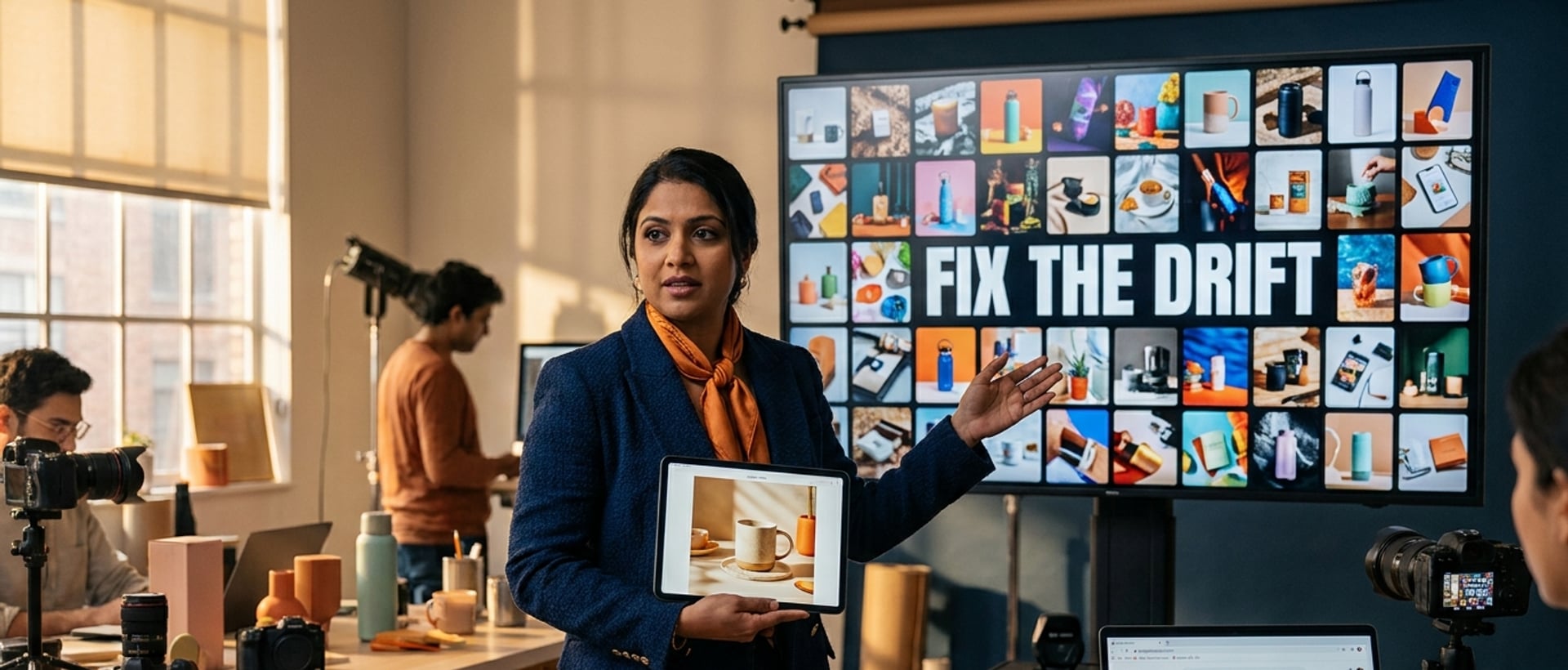
You need 50 lifestyle images of a single product. For your PDP secondary gallery, for Meta ad variants, for Instagram carousels, for a seasonal Diwali refresh, for the newsletter, for the reel B-roll. Every AI photography tool you've tried can generate a lifestyle image. None of them, apparently, can generate fifty images that look like the same brand took them.
That's the specific problem most brands hit within the first 30 days of trying to scale AI lifestyle photography. The tools work per-image. The workflow doesn't produce consistent per-brand. Fifty images later, your PDP looks like a mood board someone else assembled. Your Meta ads look off-brand. Your seasonal campaign feels stitched-together.
The failure isn't the AI model. It's the missing recipe layer. Lock a specific set of visual variables per-brand and the same fifty images become fifty consistent-brand images. Fail to lock them and you get 50 different brands. Here's what the recipe layer actually contains and how it gets built.
Why do 50 AI-generated lifestyle images usually look like different brands?
Quick Answer: Because each generation runs independently without a shared reference. Lighting temperature varies across images. Background palette drifts. Framing conventions shift. Prop density is inconsistent. If there's a model, model choice and style vary. The AI does its job well on each individual generation; brand consistency is a workflow problem the tools don't solve by default. Two identical prompts run 30 minutes apart produce visibly different aesthetics. Scale that to 50 prompts and the drift is dramatic.
The specific mechanism is that generation models sample from a very broad style distribution unless explicitly constrained. Without constraints, each generation samples slightly differently. Even with a well-crafted prompt, run the same prompt three times and get three visibly different images. This is why prompt engineering alone doesn't solve consistency at scale - the model's sampling variance overpowers prompt-level control.
The workaround most brands attempt is more detailed prompts. "Same as previous, but with X" language. This helps marginally, doesn't solve the drift. What actually solves it is a reference image locked into the workflow - either as image-to-image generation with the reference, or as strong style-transfer priors baked into the pipeline. Both require workflow infrastructure the DIY-AI tools don't provide.
The recipe-layer approach fixes this systematically. Rather than trying to describe the brand grammar in every prompt, you document it once and every subsequent generation inherits it. This is the specific workflow decision that separates "AI photography that works for one image" from "AI photography that works for a catalog."
What actually goes into a brand recipe?
Quick Answer: Six documented style variables, locked per-brand or per-product-family. Lighting (temperature: warm/cool/neutral, direction: upper-left/upper-right/overhead, quality: hard/soft/diffused). Background (palette hex codes, material: paper/wood/marble/fabric, complexity: minimal/textured/scenic). Framing (crop ratio, subject placement, negative space percentage). Prop language (allowed props by category, prop density: minimal/moderate/rich). Model style (if models are used - age range, ethnicity mix, posing conventions). Colour rendering rules (brand palette hex codes, saturation targets, contrast preferences). Together these constitute the brand grammar the AI generation inherits.
Each variable gets documented with concrete specificity, not adjectives. "Warm lighting" is not enough. "Colour temperature 3200K to 3800K, warm-tungsten cast, diffused single-source from upper-left at 60 degrees, minimal fill" is enough. The specificity is what makes the recipe portable across generation sessions and reproducible over months.
Building the recipe is a 3-5 day process for most brands. Day 1 - reference collection (pull 20-30 reference images that represent the desired brand grammar). Day 2 - variable extraction (analyse the references, extract the specific patterns across lighting/background/framing/etc.). Day 3 - initial recipe draft (document the variables with specific values). Days 4-5 - test-and-refine (generate images against the recipe, compare to references, tighten the values that drift).
Once locked, the recipe is a durable brand asset - reused indefinitely, updated only when the brand identity changes. This is the specific piece that makes managed AI photography compound in value over time. A brand a year into a locked recipe has a visual grammar that's tighter, more recognisable, and easier to scale than a brand generating each image independently.
How does one product actually produce 50 images through this workflow?
Quick Answer: The 50 images decompose across five use categories, generated in phases. Category 1 - PDP secondary imagery (8-12 shots: white-background angles, in-use scenes, lifestyle context, detail texture). Category 2 - Ad creative variants (15-25 shots: 3-4 concepts × 4-5 aspect ratios each for Meta/Google/TikTok formats). Category 3 - Seasonal recontextualisation (8-10 shots: same product placed in Diwali, wedding, monsoon, festive contexts). Category 4 - Marketplace format cuts (6-8 shots: Amazon 2000x2000, Flipkart, Meesho, marketplace-mandatory ratios). Category 5 - Long-tail marketing (6-10 shots: newsletter headers, blog post imagery, WhatsApp broadcast headers). Total: 43-65 images, sourced from one product recipe-locked generation pipeline.
The category split matters because different categories have different quality bars. PDP imagery gets the tightest QA - it's what buyers see when deciding to purchase. Ad creative gets the widest experimentation - 20 variants get tested, 3-4 become winners, the rest die. Seasonal gets locked recipes-per-season. Marketplace format cuts get auto-generated once the base composition is fixed. Long-tail marketing gets treated as consumable content.
The workflow economics change based on category. PDP imagery is high-QA, moderate volume. Ad creative is medium-QA, high volume (because most variants die). Seasonal is high-QA, low volume. Marketplace cuts are automated (no per-image QA needed). Long-tail is medium-QA, high volume. Priced together, the aggregate blends into a managed monthly fee that's far below equivalent studio production.
For most Indian D2C brands running paid social, the ad creative category is where the workflow earns back its cost fastest. A brand producing 4-5 creative variants per quarter traditionally versus 30-40 with a managed AI workflow sees CAC compression measurable in the first 60 days.
What does 'brand consistency' actually mean in the AI photography context?
Quick Answer: Not just palette matching. Real brand consistency means an untrained observer can pick your product out of a lineup of 20 competitors' images because your grammar is recognisable. Palette + lighting + framing + prop language + model style + colour rendering all working together to create a distinctive visual identity. Palette-only consistency (matching your brand colours) is necessary but insufficient - most brands miss the framing and prop layers, which is why palette-matched images still feel off-brand.
The observable test - show 5 lifestyle images from your brand plus 5 from a competitor to someone unfamiliar with either brand. Ask them to sort the 10 into two piles by "same brand." If they can't reliably do it, your grammar isn't distinctive enough. If they can, your recipe is working. This is a better real-world test than checking whether individual images "look on-brand" in isolation.
The specific consistency variables that most brands miss - framing (how tight is the crop relative to the product), prop density (how much other stuff is in frame), and model pose conventions (if models are used). These three variables often account for more perceived-brand-feel than palette or lighting choices, and they're the ones DIY AI generation drifts on most.
Brand consistency is also a compounding asset. Six months into a locked recipe, your customer starts recognising your imagery before they see the logo. This is what "brand equity" means at the image layer - visual recognisability that reduces the friction of every subsequent marketing touch. Underrated moat.
How does this change ad creative velocity and CAC?
Quick Answer: For brands running meaningful paid social spend, the constraint is almost never creative-idea capacity - it's production velocity. Traditional ad creative production caps out at 4-6 variants per quarter for most brands with in-house teams. Managed AI against a locked recipe produces 30-50 variants per quarter with no proportional cost increase. This creative-variety expansion typically improves ad-account performance 20-40 percent within 2 quarters purely from having more shots on goal for the algorithm to optimise against.
The mechanism is that Meta and Google ad algorithms need creative variety to optimise properly. With 4 variants, the algorithm has 4 signals to work with. With 40 variants, it has 40. The best variants earn more spend; the worst variants get filtered out. The account performance ceiling is directly tied to how many creative signals you feed the algorithm.
The specific pattern is visible in the first 45-60 days of the workflow. Ad-set CPMs stabilise lower because relevance scores improve (better creative resonates). CTR climbs on the winning variants. CVR climbs because more of the traffic is arriving with matched creative-audience fit. Compounded, CAC drops 15-30 percent in most cases.
For most beauty, apparel, and lifestyle-adjacent D2C brands, this is the fastest single ROI unlock from managed AI photography - not the per-image cost saving, but the ad-account velocity that becomes possible when creative production stops being the bottleneck. This is the pattern we run for CodeSkin and similar brands.
What should you do next?
Start with a recipe audit of your current imagery. Pull 20 of your recent-most product images (across PDP, ads, social). Score them on the 6 recipe variables - lighting, background, framing, props, model style, colour rendering. If you can't articulate a specific spec for each variable that all 20 images match, your recipe is unlocked and drifting.
Then build a formal recipe or brief someone to. The 3-5 day process is the highest-leverage one-time investment for scaling AI photography. Skipping it and hoping DIY tools solve consistency at 50-image scale is the specific mistake that kills most AI photography initiatives inside 60 days.
Then decide the scope - PDP-first or ads-first. If your PDP conversion is where the biggest revenue opportunity sits, start with 8-12 lifestyle images per top-20 SKU. If your paid-social CAC is where the biggest opportunity sits, start with 20-30 ad variants against your top 5 products. Different priority sequences for different bottlenecks.
If you want a scoped assessment of your specific brand recipe gaps, catalog scale, and ad-creative velocity opportunity, book an AI imagery audit - we come back with your recipe brief, the 50-image-per-product production plan for your top SKUs, and the estimated managed spend against your current photography plus design-team costs.