You run a beauty or skincare brand. Your catalog has 40-120 SKUs. Every launch needs a photoshoot. Every ad campaign needs a shoot. Every seasonal refresh needs a shoot. Your studio quotes have been going up every year and your ad account is asking for more creative variants than any traditional shoot cycle can produce.
Every AI photography vendor pitch you've seen says "we can generate beauty imagery at 90 percent lower cost." Some of that is true. Some of it isn't, and the parts that aren't true will get your Amazon listing suspended, undermine your brand quality signal, or create marketing images that customers won't trust.
The honest workflow for beauty is a specific split. Some categories of imagery move to AI cleanly and produce enormous economic leverage. Some categories are still firmly studio territory in 2026 and pretending otherwise creates real business risk. This post walks through both, in the order that matters for your actual catalog.
Where does AI photography clearly WIN for beauty brands in 2026?
Quick Answer: Colour variants (one shade shot, thirty rendered), lifestyle context imagery (product-in-hand, on-vanity, in-bathroom scenes), seasonal creative (same product recontextualised for summer, winter, festive), ad iteration at velocity (200 asset variants against one brand recipe in a week), and format-cut delivery (Amazon square, Instagram vertical, Meta ad ratios, all auto-generated). Together these represent 60-80 percent of a beauty catalog's total image output requirement.
Colour cosmetics is where the workflow economics land hardest. A lipstick brand launching a 24-shade palette used to shoot every shade individually - 24 studio setups, ₹30,000-60,000 depending on complexity. The managed AI workflow shoots ONE reference shade in studio, locks a recipe for how that packaging renders under the brand's lighting, and generates the other 23 shades against the recipe. Buyer-facing quality is indistinguishable from full studio. Cost delta is dramatic.
Lifestyle context is the second big win. Beauty PDP imagery increasingly needs contextual shots - the serum on a marble bathroom counter, the moisturiser tube in morning light, the palette on a vanity with tools. According to beauty imagery benchmarks, lifestyle images boost ecommerce CTR by up to 125 percent versus standalone packshots. Producing these traditionally requires styled shoots. Producing them with AI against a locked brand recipe cuts turnaround from weeks to days.
Ad iteration is where the real growth-team leverage lives. A beauty brand running Meta and Google Shopping campaigns benefits from 5-10x more creative variants than most brands actually produce. The bottleneck is production, not creative direction. A managed AI pipeline against the brand recipe produces the creative volume that the growth team can actually A/B test properly. Brands that shift here typically see 20-40 percent CAC improvement inside the first two quarters, not because the creative is objectively better, but because there's finally enough variety to find the winners.
Where does AI photography still clearly FAIL for beauty brands in 2026?
Quick Answer: Skin texture and product-on-skin shots (foundation coverage, mascara on lashes, serum absorption, before-after imagery), regulated dermatologist-claim visuals, marketplace hero images where the platform mandates real photography (Amazon Beauty, Sephora, Ulta primary listing images), and macro texture close-ups where AI rendering artefacts break the trust signal. This is roughly 20-30 percent of a beauty catalog's total imagery need, but it includes the highest-conversion assets.
Skin is the specific place AI still fails. The uncanny-valley problem on human skin is unforgiving - even minor rendering artefacts (pore inconsistency, unnatural highlights, slightly wrong translucency) undermine trust in a product whose value proposition is about how it looks ON skin. In 2026 the best AI models can handle full-body lifestyle shots convincingly, but close-up product-on-skin still fails inspection for most buyers.
Marketplace moderation is the second hard limit. Amazon Beauty's automated moderation is now trained to detect AI-generated primary images and flag them at listing creation. Getting a beauty listing suspended for a policy violation is expensive - reinstatement takes 1-3 weeks and buyer trust takes longer. The primary hero image on Amazon Beauty must be a real photograph on plain white. Period. AI cannot serve this.
Regulated claims are the third. Any claim that requires visual proof - "reduces wrinkles by 40 percent," "improves skin hydration," clinical before-after imagery - must be substantiated with real photography and, in many cases, third-party clinical documentation. AI cannot generate this and the legal exposure of trying is real. Skincare brands with clinical claims manage these assets as regulated content, distinct from marketing.
The category-specific split is worth naming. Colour cosmetics benefits most from AI (shade variants, lifestyle context). Skincare benefits selectively (packaging lifestyle wins, product-on-skin doesn't). Fragrance benefits fully on packaging and lifestyle (there's no application-to-skin problem to solve). Makeup application videos and demos remain studio-first because motion + skin + product is beyond what current AI reliably renders.
What does the honest managed AI beauty workflow actually look like?
Quick Answer: Four stages. One - a studio pack of the hero photography for marketplace-mandatory shots and any skin-on imagery (roughly 15-25 percent of the catalog). Two - a brand recipe locked per product family - skincare tubes, dropper bottles, palettes, sprays - governing lighting, background, colour rendering, and shadow style. Three - the AI generation pipeline handling colour variants, lifestyle context, seasonal creative, and format cuts against the recipe. Four - a human QA loop on every asset before it ships, catching drift before it reaches production.
The studio pack is the foundation. Traditional beauty photography for the hero SKUs happens on 1-2 shoot days depending on catalog size. The output is a locked source-of-truth photograph per hero SKU that every AI variant renders against. This is where the packaging colour reference, lighting angle, and shadow behaviour get locked in.
The brand recipe layer captures the visual grammar of the specific brand. A minimal-luxe skincare brand shoots differently from a colourful colour-cosmetics brand. The recipe documents lighting temperature, background palette, prop density, model style, colour rendering conventions. Every AI generation inherits the recipe, so a lipstick shade rendered in April looks identical to the same shade re-rendered for a September campaign.
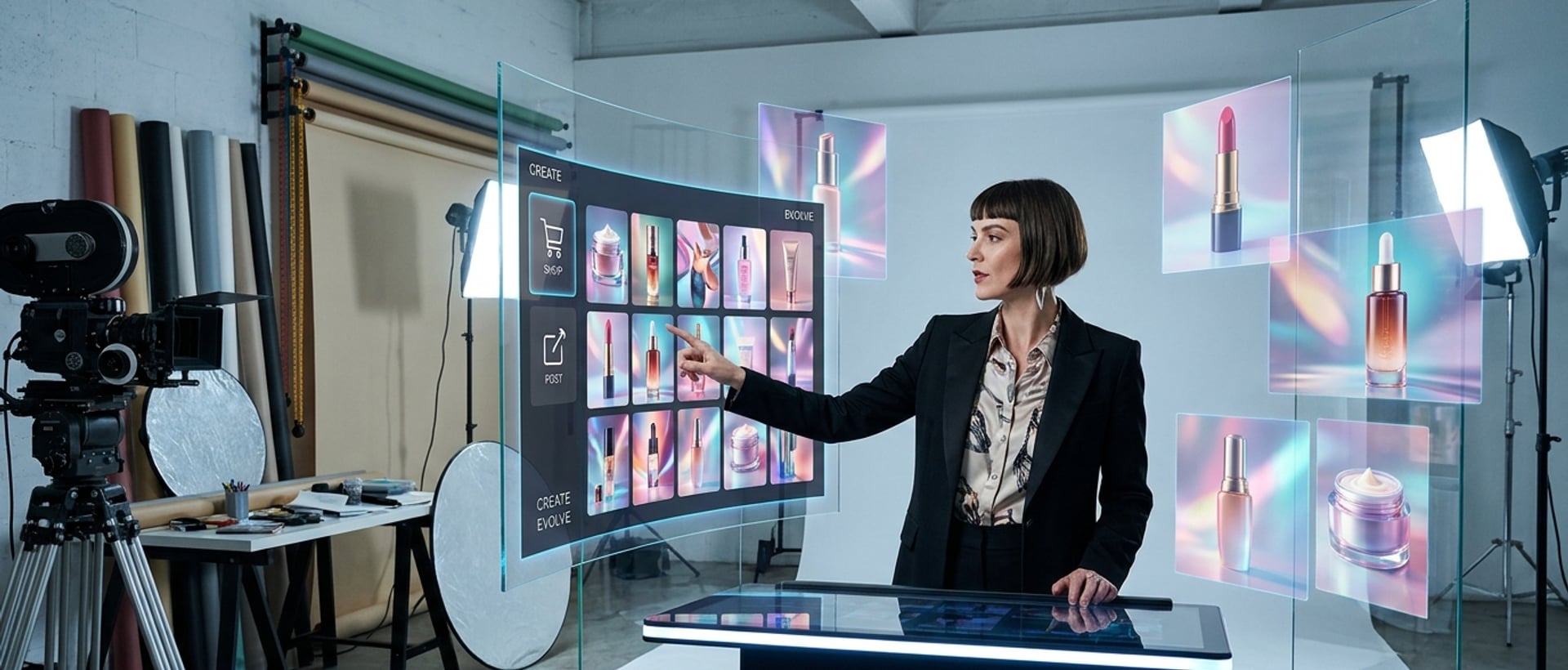
The AI generation pipeline is where volume happens. Colour variants generate in minutes per SKU. Lifestyle contexts render in the same window. Ad campaign iterations get produced at the velocity the growth team can absorb. Seasonal recontextualisations happen without a new shoot. The volume that used to require a permanent in-house production team gets absorbed by the pipeline.
The QA loop is what separates managed AI from DIY AI. Every asset gets reviewed - is the packaging colour on-brand, does the shadow behave, does the composition serve the placement, are there any visible rendering artefacts. Assets that fail get sent back for regen. This is the discipline that keeps quality production-ready and prevents the brand-drift that DIY workflows silently accumulate.
How does this workflow change ad iteration and creative velocity?
Quick Answer: By roughly an order of magnitude. A traditional beauty brand shoots 20-40 creative variants per quarter across ads, PDP, and organic content. A brand running managed AI against a locked brand recipe produces 200-400 variants across the same categories in the same window, without proportional production cost increase. This unlocks A/B testing at a volume most brands never had access to, which typically compresses CAC 20-40 percent inside two quarters.
The economic mechanism is the recipe layer. Once locked, incremental image production is bounded by generation cost (minor) and QA time (moderate), not by studio day rate (expensive) and scheduling (slow). Growth teams that were rationing creative allocation because of production bottlenecks stop rationing. They start requesting the variants the ad platform can actually optimise against.
The compounding effect shows up in the second quarter. Brands typically discover 3-5 creative angles they'd never have tested at the previous production cadence. Some of those angles outperform the previous champions. The brand recipe absorbs the learning and re-renders more of what's working. This is the pattern we see repeatedly across D2C beauty brands where managed AI has been part of the operational stack for 12+ months.
The other side of this is production-team retraining. Studios that were producing 40 variants per quarter aren't needed for the extra 200+ variants. The team either moves up-stack to art direction and campaign strategy, or the studio budget reallocates entirely. This is a real organisational shift and one that most brands under-plan for.
What does this cost, and what's the honest ROI window?
Quick Answer: Initial setup for a 60-100 SKU beauty catalog runs 4-6 weeks, delivering a full studio pack of 15-25 hero SKUs, the brand recipe, and the initial catalog imagery. Ongoing operational cost is significantly less than half typical studio+ad-production spend for equivalent volume, and delivers 5-10x more creative variants. ROI typically shows up as 20-40 percent CAC improvement within 6 months for brands with meaningful paid-social spend, driven by higher creative variant velocity rather than lower cost per image.
The initial setup is the moment where a brand goes from ad-hoc production to systematic production. The 4-6 weeks covers the discovery, hero shoot, recipe lock, and first catalog wave. This is where the disciplines get built that make the ongoing pipeline sustainable.
The ongoing operational cost varies by catalog size and creative volume. For most Indian-domiciled beauty brands producing US-facing content, we position this in the range of a fraction of studio spend for equivalent output. We don't publish per-image economics because that mis-frames the value - the workflow, the recipe, and the QA discipline are what earn the fee, not the raw generation cost.
The ROI window depends on the growth-team velocity. Brands running heavy paid social see it within 6 months, because creative iteration is directly measurable in CAC. Brands running mostly organic and PDP see it in 9-12 months, because the ROI comes from cumulative catalog quality and PDP conversion improvements rather than immediate CAC wins.
This is the specific workflow we run for D2C skincare brands where the AI imagery layer is one part of a broader operational intelligence system that handles inventory, orders, and customer flow. The imagery pipeline pattern applies to any US-facing D2C beauty operation with a real catalog and meaningful paid-media presence.
What should you do next?
Audit your current image production spend before evaluating any tooling. Pull the last 90 days of studio invoices, freelance creative spend, and internal design team allocation. Split it by category - hero photography, PDP variants, lifestyle context, ad iteration, seasonal. That baseline is your comparison anchor.
Then map your marketplace obligations. If Amazon Beauty is a meaningful revenue channel, the hero photography stays in studio - non-negotiable. If your revenue is Shopify + Meta + organic, the split shifts significantly toward AI and the workflow economics land faster.
Then identify the creative bottleneck honestly. If your growth team is asking for more creative and getting fewer variants than they can test, AI production velocity is your leverage. If your PDP conversion is fine but your ad account is starving for iteration, AI ad-variant production is where to start.
If you want a scoped assessment against your specific catalog, category mix, and paid-media velocity, book an AI imagery audit - we'll come back with the honest studio-vs-AI split for your brand, the recipe brief, and the estimated managed spend against your current production costs. Not a tool pitch. The workflow that fits your beauty business.