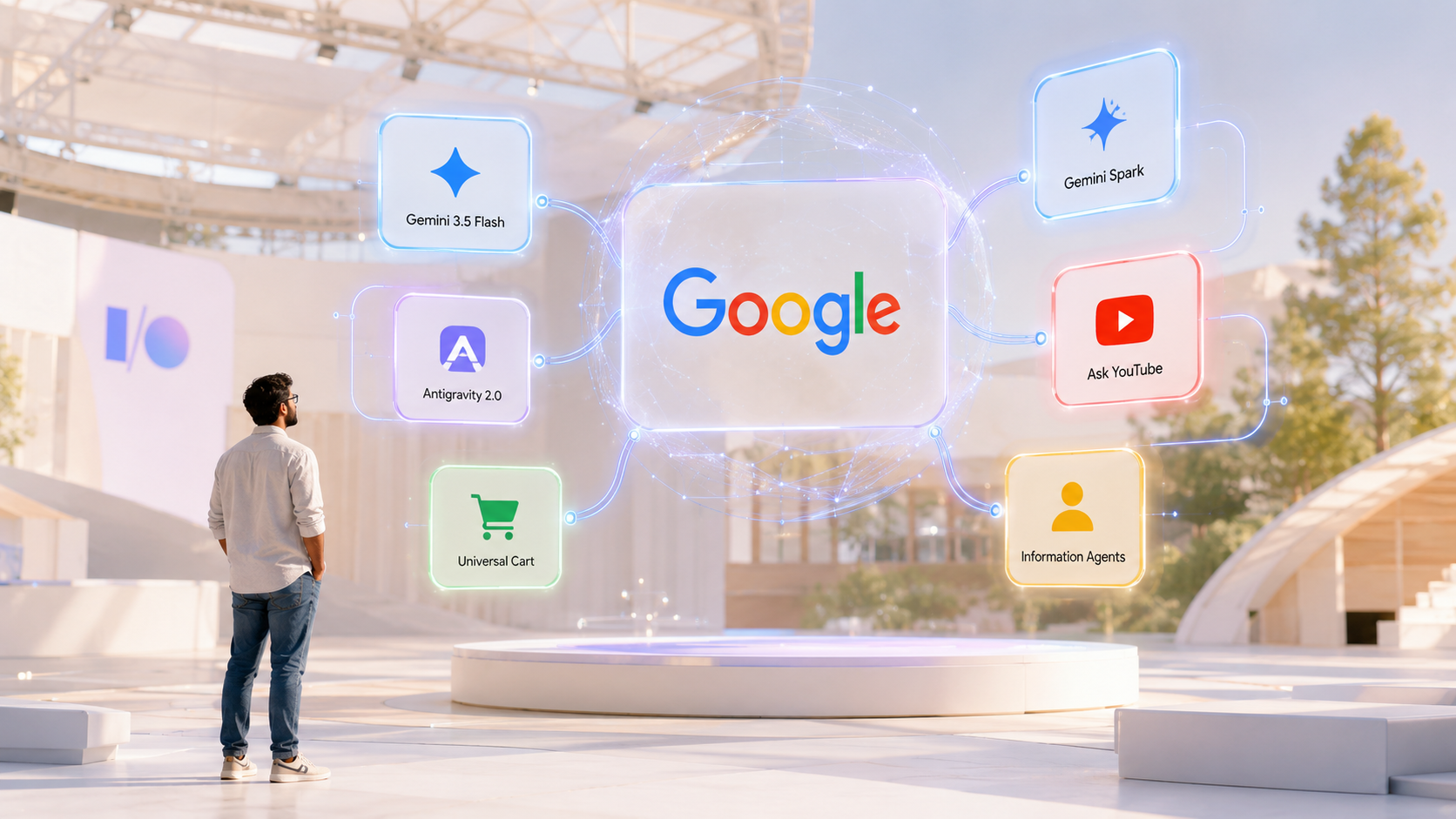
Google I/O 2026 was not a subtle product refresh. On May 19–20, Google officially declared what it is calling the "agentic Gemini era": a moment where AI stops being a tool you prompt and becomes an agent that acts on your behalf, continuously, across Search, Gmail, Shopping, voice, Chrome, and Android.
For small and medium businesses and startups, this is not background noise. Every major announcement directly affects how customers will find you, how your team can automate work, how commerce will change, and what your competitors will be doing inside their operations over the next 12 months.
Here is a complete breakdown of every major update, what it actually means, and where INovaBeing can help your business take action now.
1. Gemini 3.5 Flash Is Now the Default Brain Behind Google Search
What Google Announced
Google launched Gemini 3.5 Flash as the new default model powering AI Mode in Google Search globally, effective immediately. According to Google, Gemini 3.5 Flash outperforms Gemini 3.1 Pro across almost all benchmarks while running four times faster than comparable frontier models. Gemini 3.5 Pro is being tested internally and is expected next month.
What This Actually Means
AI Mode in Search - the interface that generates direct, synthesized answers instead of a list of links - just got materially smarter and faster for every user globally. This matters for SMBs for one very specific reason: the bar for your content to appear in AI-generated answers just went up.
Search is no longer primarily a ranking game. It is increasingly an answer synthesis game. Gemini 3.5 Flash reads, evaluates, and synthesizes content from multiple sources to generate responses. If your content is not structured clearly, does not answer specific questions directly, and does not demonstrate genuine expertise and depth, it will not be sourced in AI Mode responses regardless of your backlink profile.
What SMBs and Startups Should Do
- Rewrite your top landing pages and blog posts to answer specific questions directly in the first 2–3 sentences of each section.
- Add FAQ sections to every blog post and key service page with schema markup so Google's models can parse them cleanly.
- Structure your content around entities and outcomes, not just keywords: "what does X do," "how does X help," "what is the cost of X" formats are now core content architecture.
How INovaBeing Helps
At INovaBeing, every piece of content we help clients build for their AI Ops Architecture is structured for AEO and LLM readability by default. We design content to be synthesized, not just ranked, because that is the environment Search is now operating in.
2. Google Search Is Now an Agent Platform - Information Agents Launch This Summer
What Google Announced
Google's Head of Search Liz Reid announced that Search is entering the "era of Search agents." Users will be able to create, customize, and manage multiple AI agents directly inside Google Search. The first rollout is information agents: background agents that continuously monitor topics, news, blogs, social media, and data sources 24/7 and surface relevant information proactively, even when you are not searching.
As Google stated: "Simply ask Google to keep you informed about anything, and our agents can continue to assist you even when you're not actively using Google." Information agents launch first for Google AI Pro and Ultra subscribers this summer.
What This Actually Means
This is a fundamental shift in what Search is. It is no longer reactive - you type, it responds. It is now proactive and persistent: agents operate in the background, learn your interests, and push curated intelligence to you.
For SMBs and startups, this creates two realities at once:
Opportunity: Your content, blogs, press mentions, case studies, and social posts can now be surfaced proactively by information agents to users who are tracking topics relevant to your business. If you write about "AI ops for small business" or "AI voice agents for customer support," information agents can find and surface that content to people actively researching those areas, even if they never typed your brand name.
Threat: The same agents will surface your competitors just as readily. If your competitors are publishing consistently, structuring content well, and building topical authority in your niche, their content will be surfaced to your potential customers around the clock.
What SMBs and Startups Should Do
- Build a topic cluster strategy around 3–5 core themes your ICP is actively researching. Publish consistently within those clusters, not one-off articles.
- Ensure your content answers intent at multiple levels: awareness ("what is agentic AI"), consideration ("how does agentic AI reduce costs"), and decision ("which AI ops platform is right for my SMB").
- Be present across multiple indexed sources: your blog, LinkedIn articles, press mentions, and partner sites all become inputs for information agent synthesis.
How INovaBeing Helps
Our AI Ops Architecture approach helps SMBs think about content and operations as interconnected systems. We help you map the topics your buyers are researching and build the content infrastructure to show up consistently where Google's information agents are looking.
3. Google Antigravity 2.0 - A Full Agent-First Development Platform Is Now Live
What Google Announced
Google launched Antigravity 2.0, a standalone agent-first development platform that allows developers and businesses to build, orchestrate, and deploy multi-agent workflows. Antigravity 2.0 includes:
- A standalone desktop application for orchestrating multiple parallel agents and subagents.
- An Antigravity CLI replacing the Gemini CLI for terminal-based agent development.
- An Antigravity SDK giving programmatic access to the same agent harness that powers Google's own products.
- Managed Agents in the Gemini API: with a single API call, you can spin up a fully provisioned agent in an isolated Linux environment with persistent state across multi-turn sessions.
- Antigravity in the Gemini Enterprise Agent Platform: direct connection for Google Cloud customers.
Google AI Ultra, now starting at $100/month, includes 5x the Antigravity usage limits compared to the Pro plan.
What This Actually Means
Antigravity 2.0 is Google's answer to the question: "How do we give every developer and business the infrastructure to build production-grade AI agents without managing MLOps from scratch?"
For startups and developers inside the SMB ecosystem, this is significant. Managed Agents mean that building a multi-step AI agent - one that reasons, calls tools, and executes code in a sandboxed environment - now requires a single API call instead of weeks of infrastructure work. That dramatically lowers the barrier to agent deployment.
For SMB operators who are not developers, this matters because the tools their vendors and internal teams use to build automations are becoming dramatically more capable. The gap between "we have an idea" and "we have a working agent" is shrinking fast.
What SMBs and Startups Should Do
- If you have a development team, evaluate Antigravity 2.0 and the Managed Agents API as the foundation for any new agentic workflow you are building.
- If you are not building internally, work with a partner like INovaBeing that already builds on these platforms and can move you from concept to deployed agent in weeks.
- Prioritize agent use cases where persistent state matters: multi-turn customer conversations, order tracking, or ongoing follow-up sequences are natural fits for Managed Agent architecture.
How INovaBeing Helps
INovaBeing's Agentic System is built precisely for this layer. We design orchestrated multi-agent workflows using the same architectural principles Antigravity 2.0 is now formalizing: specialized subagents for distinct missions, parallel execution, persistent context, and human-on-the-loop oversight. We take this infrastructure and apply it directly to your SMB operations so you get the benefit of agent-first architecture without managing the platform yourself.
4. Gemini Spark - Google's 24/7 Personal AI Agent Is Here
What Google Announced
Google introduced Gemini Spark, a new "24/7 personal AI agent" powered by Gemini 3.5 designed to proactively manage tasks for users. Spark handles logistics, purchases, scheduling, and tasks shared vocally. It operates in the background using virtual machines on Google Cloud and integrates with Google Workspace (Gmail, Sheets, Slides) as well as third-party apps like Canva and Instacart.
Google also launched Daily Brief, a personalized daily digest that aggregates your calendar, emails, tasks, and relevant news to give you a prioritized morning summary.
What This Actually Means
Gemini Spark is Google's first mainstream, always-on AI agent for individual users. It is not a chatbot you open. It is a background operator that integrates with your tools, understands your context, and acts on instructions.
For SMBs and startups, this signals something important about user behavior: your customers are going to start delegating tasks to AI agents. Purchase decisions, research, appointment booking, and service comparisons will increasingly be handled by agents acting on behalf of users, not by users themselves typing queries.
This means your business needs to be agent-friendly, not just mobile-friendly:
- Your website and services need to be discoverable and actionable by agents, not just humans.
- Your pricing, availability, and product data needs to be structured and accessible via APIs or well-indexed content.
- Your booking, support, and commerce flows need to be simple enough for an agent to complete without getting stuck on ambiguous UI.
What SMBs and Startups Should Do
- Audit your website for structured data: do you have schema markup for your services, prices, FAQs, and availability?
- Ensure your booking or contact flow is clean, fast, and completable in 2–3 steps. Agents abandon complex or ambiguous flows.
- Start thinking about your business as a service that AI agents will call on behalf of your customers, not just a destination humans browse.
How INovaBeing Helps
Our INova AI Voice Receptionist and Agentic System are built to be the operational counterpart to tools like Gemini Spark. When a customer's AI agent reaches out to your business, our voice agent can handle the intake, verify information, check availability, and respond in real time - no hold queues, no staffing gaps. We help your business respond at agent speed.
5. Universal Cart and Universal Commerce Protocol - Agentic Shopping Is Live
What Google Announced
Google introduced the Universal Cart, an intelligent shopping cart that works across retailers and Google services including YouTube, Gmail, and Gemini. Universal Cart launches in Google Search this summer, with YouTube and Gmail support to follow.
Alongside it, Google announced the Universal Commerce Protocol (UCP): a standard that empowers AI agents to make purchases, place orders, and reserve accommodations on behalf of users. The Agent Payments Protocol 2 (AP2) lets users set strict guardrails on what and how much an AI agent can buy, with accountability built in.
What This Actually Means
This is the most commercially significant announcement of Google I/O 2026 for SMBs in ecommerce, retail, and service businesses. Google is building the infrastructure for AI-agent-to-business transactions at scale. Instead of a customer browsing your store, an AI agent will evaluate your products, compare options across retailers, and complete a purchase - all without the human touching a browser.
The businesses that benefit first are those already on Google Shopping, Shopify, and other platforms that will integrate UCP early. The businesses that get left behind are those whose products are not properly listed, priced, and structured for machine-readable commerce.
What SMBs and Startups Should Do
- Ensure your products and services are properly listed and updated in Google Merchant Center.
- If you are on Shopify or retailers already announced as UCP partners, start preparing your product catalog for agent-driven discovery.
- For service businesses, focus on making your pricing, availability, and service scope machine-readable through structured data and clean API responses.
How INovaBeing Helps
Our OMS - Order Management System is designed exactly for this shift. As AI agents increasingly drive order and fulfillment logic, you need an order management layer that can receive, process, and confirm agent-initiated transactions the same way it handles human-initiated ones. Our OMS combined with AI Ops Architecture gives SMBs the backend readiness to participate in agentic commerce, not just traditional ecommerce.
6. Google Search Gets Generative UI - The End of One-Size-Fits-All Results
What Google Announced
Google is introducing Generative UI in Search: the ability to generate custom visual layouts, interactive tables, graphs, simulations, and even mini-apps directly inside Search responses, tailored to the specific query and user context. This also includes a redesigned Search box - described as the most significant redesign in 25 years - that expands for longer queries, accepts images, files, and Chrome tabs as inputs, and generates AI-powered suggestions beyond simple autocomplete.
What This Actually Means
Search results are no longer uniform. Two people searching the same query can receive completely different visual experiences depending on their context, history, and intent. For SMBs, this accelerates the shift away from ranking position as a meaningful metric in isolation. What matters now is whether your content contributes to the synthesized, visual, contextual response Google generates.
What SMBs and Startups Should Do
- Invest in structured, well-formatted content that Google's Generative UI can pull into tables, comparisons, and visual summaries.
- Use data, comparison formats, checklists, and numbered frameworks in your content. These are the building blocks Generative UI draws from.
- Stop thinking about "page 1 rankings" as your North Star. Start thinking about "appearing in the generated answer."
How INovaBeing Helps
We build every piece of content and blog infrastructure for INovaBeing clients around AEO and LLM readability principles: clear question-answer structure, schema markup, FAQ sections, numbered lists, and entity-level depth. That is the exact format Generative UI and AI Mode source from.
7. Ask YouTube - Conversational Search Comes to Video
What Google Announced
YouTube is getting Ask YouTube: a conversational AI search feature that lets users input complex natural language queries and receive curated video responses, jumping directly to the relevant moment in the video. Initially available for Premium members with broader rollout to follow.
What This Actually Means
YouTube has always been the second-largest search engine. Ask YouTube makes it a conversational AI engine. Your video content - product explainers, tutorials, case studies, demo walkthroughs - can now be surfaced and cited by an AI agent in response to specific questions, not just general topic searches.
For SMBs, this means video content is no longer optional for visibility. A 5-minute explainer about your product or service can now answer a specific question a potential customer asks YouTube's AI and jump directly to the relevant moment.
What SMBs and Startups Should Do
- Prioritize YouTube content creation alongside blog content. These are now two equally important channels for AI-driven discovery.
- Structure your videos with clear chapters and titles so Ask YouTube can identify and cite specific moments.
- Create videos that answer specific questions your ICP asks, not just broad brand awareness content.
How INovaBeing Helps
Our content and operations frameworks help SMBs build video-first and blog-first discovery strategies together. We help you identify the exact questions your ICP is asking and turn those into structured video and written content that both Ask YouTube and Google information agents can surface proactively.