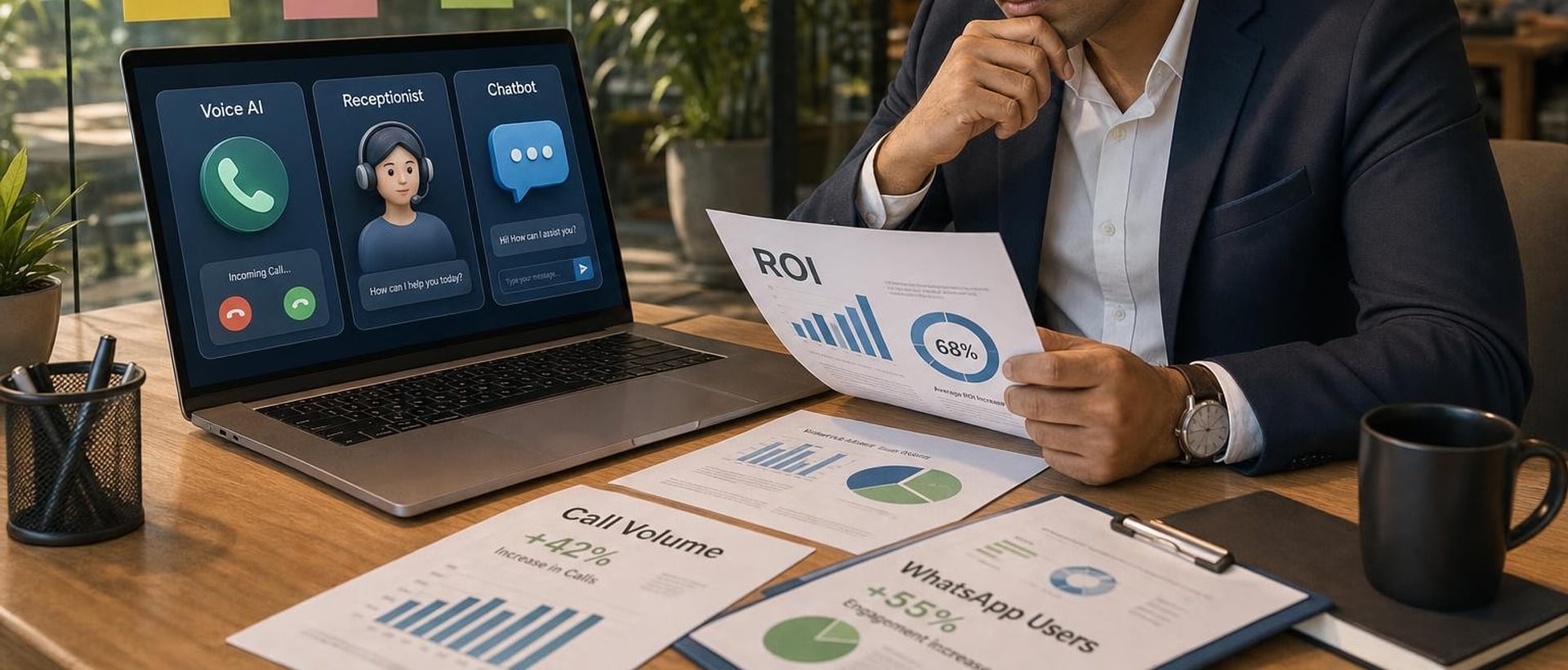
Three AI vendor pitches landed in your inbox this week. One for an AI voice agent - "cut your call handling cost by 70 percent." One for an AI receptionist - "24/7 coverage, never miss another call." One for an AI chatbot - "convert 3x more website visitors." Each vendor claims their category is essential. Each has case studies. None gives you the honest math for YOUR specific call and message volume, because that math would sometimes suggest you don't need their product at all.
You're not stupid for being confused. The three categories overlap in the pitch and diverge in reality. AI voice agent, AI receptionist, and AI chatbot are three different products solving three different problems. Most Indian D2C brands need one of them. A few need two. Almost none need three. This post is the honest decision matrix - what each actually does, at what volume each earns its subscription, and how to figure out which one (if any) fits YOUR business without buying all three to find out.
What's actually the difference between these three AI categories?
Quick Answer: AI voice agent handles inbound PHONE calls - real conversation over voice, transactional resolution (bookings, order status, hours), transfer to humans for complex issues. AI receptionist is a lighter version - typically voicemail-style flow, front-desk routing, less conversational depth than a full voice agent. AI chatbot handles TEXT - website chat widget, WhatsApp automation, in-app messaging. Different channel, different tech, different economics. Confusing them (or letting a vendor confuse you) is how brands end up buying three subscriptions and using one.
The specific technical difference is that AI voice agents need real-time speech recognition, natural conversation flow, and low-latency response generation. This is dramatically harder than text chat and reflects in the pricing - voice AI infrastructure costs meaningfully more than text AI infrastructure per interaction. Vendors bundling both as "AI communication" gloss over this cost asymmetry.
The specific channel difference is that voice and text serve different customer intents. Someone calling wants immediate answer to a specific question (usually transactional). Someone texting wants asynchronous conversation and can wait. AI that treats these as the same channel handles both poorly. Products that recognise the channel difference build differently for each.
The specific business difference is that voice call volume and text message volume scale differently for most Indian D2C brands. Voice tends to be lower-volume, higher-value-per-interaction (booking-based businesses, high-consideration purchases). Text tends to be higher-volume, lower-value-per-interaction (order status, product questions, follow-ups). This asymmetry affects which one's automation payback comes first for your specific business.
What's the specific volume threshold where each category starts winning?
Quick Answer: AI voice agent - crosses into positive ROI around 40-50 inbound calls per day; almost always the right answer above 100 daily calls. AI receptionist (lighter version) - can work as low as 15-25 daily calls where you mostly need coverage and routing, not real conversation. AI chatbot on website - basically never wins purely on ROI for Indian D2C under 5,000 daily orders; the specific value case is very narrow. WhatsApp Business automation - crosses into positive ROI around 100-150 daily WhatsApp conversations (which most brands hit at 300+ daily orders). Below these thresholds, either simpler alternatives (human answering service, shared inbox with humans) or doing nothing at all beats the AI subscription.
The specific reason 40-50 daily calls is the AI voice threshold is that fixed setup + integration costs need to amortise across enough conversations to justify the subscription. Below 40 daily calls, an answering service costs less. Above 40, AI voice starts scaling favourably. Above 100, the human answering service can't provide the coverage AI voice provides at the same cost.
The specific reason website chatbots rarely earn their cost for Indian D2C is that Indian customers overwhelmingly prefer WhatsApp over website chat. A visitor who has a question typically WhatsApps the business rather than using the website chat widget, regardless of how prominent the widget is. Website chatbots optimise for the wrong channel for Indian customer behaviour.
The specific reason WhatsApp Business automation has a higher threshold than voice AI (100-150 daily WhatsApp conversations vs 40-50 daily calls) is that human handling of WhatsApp scales further than human handling of voice. A team member can juggle 40-60 WhatsApp threads simultaneously; that same team member can only handle one voice call at a time. So the labour math tilts toward automation later for WhatsApp than for voice.
What does the honest decision tree actually look like?
Quick Answer: Start with the channel your customers actually use most. If most inbound is phone calls - evaluate AI voice at 40+ daily calls, forwarding at under 15, answering service in between. If most inbound is WhatsApp - evaluate a shared WhatsApp Business inbox first (with humans), then WhatsApp automation at 100+ daily conversations. If most inbound is website chat - your customers are probably not chatting on your site because Indian customers prefer WhatsApp; the ROI on website chatbot is usually negative. Almost no Indian D2C brand needs all three. Most need one.
The specific mistake is picking the AI category the vendor pitches, not the AI category your customer volume justifies. If you're at 200 daily WhatsApp conversations and 15 daily calls, buying an AI voice agent is buying the wrong tool - the WhatsApp automation would deliver 5-10x the ROI. Vendors selling voice pitch voice; that doesn't make voice right for you.
The specific test to validate channel dominance is to pull your last 30 days of customer inbound. WhatsApp conversation count. Phone call count (missed + answered). Website chat count (if you have one running). Email support count. Whichever is the biggest by 3-5x is your primary channel and where automation ROI is highest. Everything else is secondary.
When does a website chatbot actually deliver ROI for Indian D2C?
Quick Answer: Rarely, and the exceptions are specific. Website chatbots earn ROI when - (1) your website traffic is dominated by international customers who prefer chat over WhatsApp, (2) your product has genuinely complex pre-purchase questions that need real-time answers (specific categories: high-consideration hardware, technical products, SaaS), (3) you're above 10,000 daily website sessions where even a small conversion lift justifies subscription cost. Below these conditions, the website chatbot is either duplicating what WhatsApp already does OR sitting idle because customers aren't engaging with it. Most Indian D2C brands under ₹5 crore monthly revenue don't hit any of these conditions.
The specific measurement to run - if you have a website chatbot currently, turn it off for 30 days. Measure conversion rate on the same traffic mix. If conversion doesn't drop, the chatbot wasn't earning its cost. This test costs nothing and typically reveals that the chatbot was vanity infrastructure.
The specific replacement for most Indian D2C brands is a prominent WhatsApp click-to-chat button on PDPs. This performs 3-5x better than website chat for Indian customer behaviour, costs nothing (WhatsApp business link is free), and routes conversations to the channel where your team is already responding.
What's the honest way AI voice + human hybrid actually works?
Quick Answer: AI voice handles the 70-80 percent transactional call volume - bookings, order status, hours, directions, appointment reschedule, basic FAQ. Complex, emotional, high-stakes, or escalated calls transfer to a human agent WITH conversation context passed along. The AI does the volume; humans do the value. Total cost is lower than full human staffing, coverage is 24/7 (which humans can't cost-effectively provide), and consistency is higher. This is the production pattern most successful Indian D2C AI voice deployments actually run. Not "AI replaces humans" - "AI handles the routine so humans handle the important."
The specific implementation quality that separates good hybrid from bad hybrid is the context-passing at transfer. Bad implementations transfer the customer to a human who asks them to repeat everything from scratch. Good implementations pass the AI transcript and inferred customer intent to the human, so the human continues naturally from where the AI left off. This design detail is what makes hybrid experiences feel good vs frustrating.
The specific business advantage of hybrid over AI-only is escalation handling. Complex customer situations (complaints, high-value account issues, sensitive service problems) still need genuine human judgment. Trying to force AI to handle these damages customer relationships in ways that cost more than the AI saved. The hybrid pattern preserves human escalation for the situations that need it.
The specific business advantage of hybrid over human-only is 24/7 coverage and consistency. Human-only teams can't cost-effectively cover 24/7. Human teams have inconsistent script adherence, varying moods, sick days, and turnover. AI handles the routine consistently, humans handle the exceptions. Together, better than either alone.
What specific vendor categories should I ignore in 2026 pitches?
Quick Answer: Three specific categories where the pitch consistently exceeds the delivered value at Indian D2C scale. One - generic global chatbot platforms optimised for enterprise Western customers, then localised superficially for India (English-only, tone-deaf for Indian customer conversation style). Two - "AI receptionist" products that are really just voicemail with a friendly voice, priced as a full AI voice agent. Three - AI ticket-routing platforms that layer "AI" on top of existing helpdesk systems where the routing improvements are marginal but the subscription cost is real. All three are being sold aggressively and delivering marginal ROI.
The specific test for these categories is asking the vendor for Indian D2C case studies at your revenue scale. Vendors selling category-real value have specific case studies. Vendors selling category-oversold value pivot to "our enterprise clients" or "productivity improvements" or "general market data." The pivot is diagnostic. Real value has specific customers to name.
For most Indian D2C brands, the honest sequence is - solve the channel your customers actually use first (usually WhatsApp), evaluate voice AI only if inbound calls are meaningful volume, ignore website chatbots unless you're above 10K daily sessions with complex products. This sequencing avoids the "three subscriptions, using one" pattern that most brands end up in.
What should you do next?
Count your last 30 days of inbound customer contact. WhatsApp conversations, phone calls answered + missed, website chats, emails. Note which is 3-5x bigger than the others - that's your primary channel and where automation ROI is highest. Everything else is secondary or noise.
Then check the volume threshold. For your primary channel, are you at the volume where AI automation crosses into positive ROI, or below? If below, either grow into it first or use simpler alternatives (shared inbox with humans, answering service, manual response). If above, run the specific vendor evaluation using the three questions - Indian D2C case studies at your scale, clear pilot exit criteria, honest data ownership.
Then commit to ONE deployment if the volume justifies it. Not three. One. Measure ROI over 60-90 days. Only add a second AI category after the first is delivering measurable value. Sequential works; simultaneous doesn't.
If you want an honest evaluation of your specific channel mix, the AI category (if any) that would genuinely earn ROI for your volume, and the vendor shortlist that fits your Indian D2C context specifically, book a voice/support ops diagnostic. We come back with your channel-by-volume analysis, the honest recommendation (which is sometimes "don't buy any of them yet"), and the phased sequence for whichever one fits. Not a vendor pitch. The honest AI category and volume math for your business.