At 50 orders a day, everything is fine. The founder answers WhatsApps personally. Someone in the team packs orders. Returns get handled ad-hoc. Nobody thinks about "systems" because there are no meaningful systems to think about.
At 5,000 orders a day, everyone knows they need systems. The founder isn't answering WhatsApps anymore. There's a proper operations lead, a WMS, a helpdesk platform, maybe an OMS layer. Nobody argues about whether the operational infrastructure was worth building.
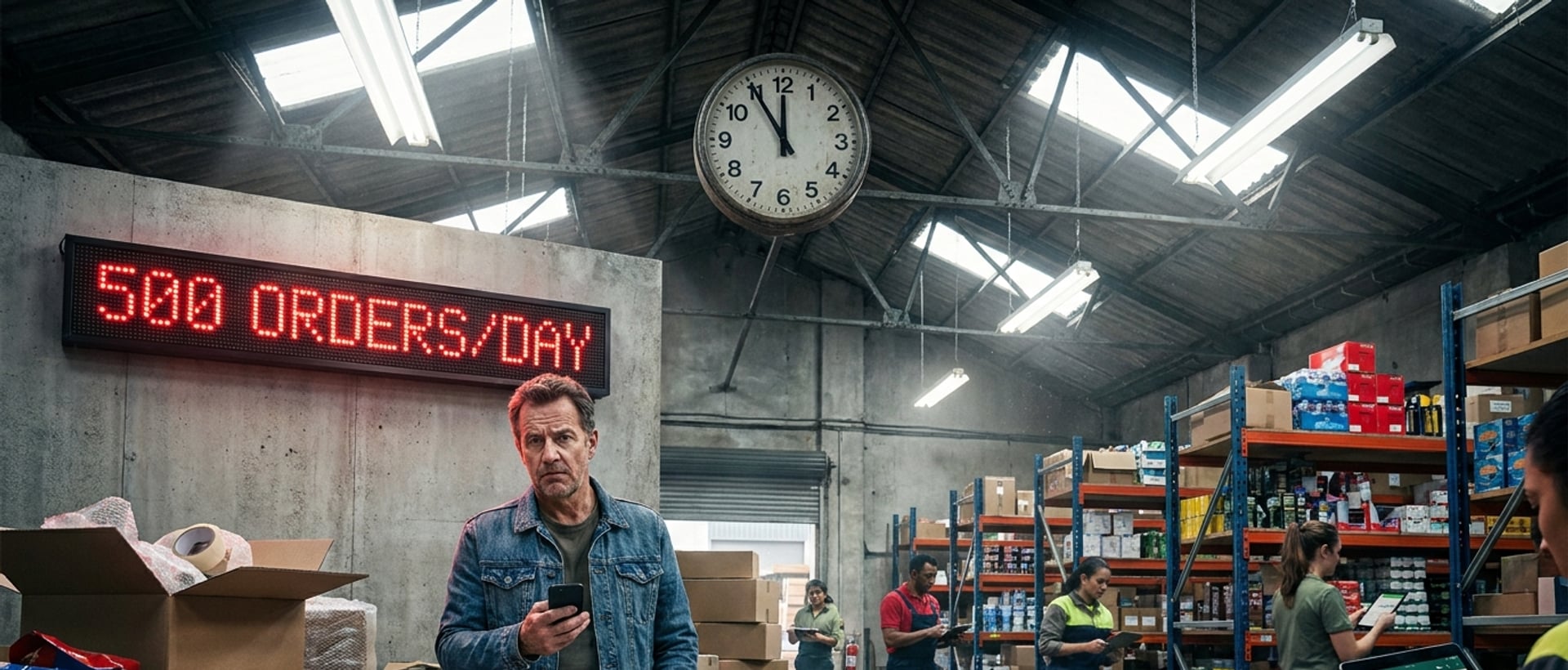
At 500 orders a day, both of those states are false. The operation feels manageable most days. The founder still knows the top customers by name. The team still Zoom-calls each other when something goes wrong. But underneath, something is breaking. RTO is climbing but hasn't fully hit yet. WISMO tickets are eating support time but nobody's counted them properly. Customer messages die in personal WhatsApps and nobody notices until three weeks later when a big buyer complains. The operation is silently disintegrating and the founder doesn't know it yet.
500 orders a day is the specific inflection point where the operational spine that carried you from 50 to 500 will not carry you from 500 to 2,000. Here's what breaks, why it breaks there specifically, and what the fix looks like before it costs you a customer cohort you can't get back.
Why does 500 orders a day break specifically what it breaks?
Quick Answer: Because the operational stack that works below 500 depends on the founder or a small team holding context in memory. Above 500, human memory capacity is exceeded but systematic infrastructure hasn't been built yet, because it never felt necessary at 200 or 300. The result is a widening gap between operational reality (500+ daily orders) and operational infrastructure (still built for 100). Every unresolved gap is a fragility that compounds until something visible breaks.
According to D2C scaling data, the operational failures at this scale follow a predictable sequence - manual order processing that worked at 50 orders creates duplicate entries and missed orders at 500, RTO handling becomes unmanageable, WhatsApp support fragments across personal accounts, and marketplace seller scores start slipping from inventory sync lag.
The specific human cognitive limit is roughly 150-250 concurrent operational items in active memory - which maps to about 150-300 daily orders where a single ops lead can hold every exception, every customer relationship, and every vendor context in their head. Above that, memory-based operations start dropping items silently. The founder doesn't experience it as failure; they experience it as "getting more forgetful." The forgetfulness is actually operational overflow.
The founder's next instinct is usually to hire another operational person. This helps briefly but doesn't scale - two people holding overlapping context in memory creates coordination overhead that eats the productivity gain. Three people is worse. The right fix at this scale is not more headcount but a systematic operational layer that reduces the memory dependency of each individual.
What breaks first, second, third, and fourth as you cross 500?
Quick Answer: First (usually inside the first 60 days above 500) - order state fragmentation. Shopify order status contradicts courier scan status contradicts what the customer was told over WhatsApp. Second (days 60-120) - WISMO ticket volume jumps from 5-8 percent of orders to 15-25 percent as contradictions surface. Third (days 90-150) - RTO handling breaks; exceptions accumulate faster than the team can process them. Fourth (days 120-180) - customer conversation history fragments across personal WhatsApp accounts and starts costing repeat purchase rate. Total window: 4-6 months from crossing 500 to reaching operational crisis.
Order state fragmentation is the first failure because it's downstream of every other system. Shopify marks an order as fulfilled when the label is generated. The customer sees "shipped" three seconds later. But the physical package hasn't moved yet. Twelve hours later, still no courier scan. Customer WhatsApps "where is my order." Team member checks Shopify, says "your order shipped yesterday." Customer clicks tracking link, sees courier tracking hasn't updated in 24 hours. Now angry. Repeat for 20-40 orders per day at 500-order scale.
WISMO explosion is the second failure and follows directly from the first. At 500 daily orders with 15 percent WISMO contact rate, you're taking 75 daily "where is my order" tickets. This is roughly 4-5 hours of daily support labour on the same repeated pattern. According to WISMO analysis, the underlying problem is architectural (the four systems disagreeing), not support-team performance. Adding support headcount doesn't fix it; unifying order state does.
RTO handling is the third failure. At 500 daily orders with 22 percent RTO on COD (India baseline), you're seeing 60-70 daily RTO exceptions. Each one requires courier communication, customer outreach, refund processing, inventory return, and reconciliation. Manually, that's 6-8 hours of daily work. If your team can't keep up, RTO turns into RTU (return to unknown - packages that came back but nobody logged) and inventory reconciliation breaks. This is where the invisible losses start compounding.
Customer conversation fragmentation is the fourth failure and hurts the longest. At 500 daily orders with 3-4 support team members holding customer WhatsApp threads on personal numbers, the operational reality is that customer relationships live in individuals' personal accounts. When one team member leaves - or takes leave during Diwali - dozens of active buyer relationships silently die. The revenue impact shows up 2-3 quarters later as declining repeat rate that nobody attributes to the actual cause.
What is the specific fix for the 500-order breaking point?
Quick Answer: Three architectural moves executed together, not sequentially. Move one - a unified order-state layer that reconciles Shopify, courier scans, WhatsApp broadcasts, and helpdesk into ONE version of truth for every downstream system. Move two - a shared WhatsApp Business inbox on a company number so customer conversations live in the operation, not in individuals' personal accounts. Move three - risk-scored RTO defence at checkout plus automated NDR handling so exceptions get processed as they happen, not accumulated. Together these take 8-12 weeks to implement and reduce operational load by 40-60 percent.
The unified order-state layer is the largest and highest-value move. It's the operational spine that everything else runs on. Without it, moves two and three help but don't reach their full impact. The layer ingests order events from every source (Shopify webhooks, courier API polls, WhatsApp Business events, helpdesk actions), resolves contradictions with an authoritative rule set, and exposes ONE version of the order to every downstream consumer.
The shared inbox move is smallest and quickest, but hits the biggest emotional pain point (support team members drowning in personal WhatsApp overload). Migrating from personal WhatsApp accounts to WhatsApp Business API through a shared inbox platform (Interakt, Wati, Gallabox) takes 3-4 hours of setup and about 2 weeks of team retraining. Cost is ₹1,500-4,000 monthly platform fee. Payback shows up in the first week.
The RTO defence layer is the biggest immediate revenue protector. Risk-scoring COD orders at checkout (pincode risk + customer history + order value + product category), automated NDR outreach when the first delivery attempt fails, and instant refund processing when the courier confirms pickup. This alone typically cuts RTO rate 20-30 percent within 60 days, which for a 500-order brand is ₹4-8 lakh monthly gross margin recovery.
For most Indian D2C brands crossing this inflection point, the three moves together are what FlowCore is built for - the persistent operational layer that handles all three architectural changes without forcing a rip-and-replace of the existing tool stack. Shopify stays. Shiprocket stays. Freshdesk or Gorgias stays. The layer underneath reconciles them.
What does the cost of NOT fixing it actually look like at 500 orders?
Quick Answer: For a typical Indian D2C brand at 500 daily orders (roughly ₹1.5-3 crore monthly revenue depending on AOV), unfixed operational fragmentation costs ₹8-15 lakh monthly in RTO leakage from delayed exception handling, lost LTV from support failures, refund friction from state contradictions, and 1-2 headcount worth of manual reconciliation labour. Fixing it costs ₹3-6 lakh monthly in tooling + services. Net gain ₹5-9 lakh monthly, plus dramatically better founder sleep quality.
The RTO leakage number is the biggest. At 22 percent baseline RTO on COD, a ₹2 crore monthly revenue brand has roughly ₹40-50 lakh going out as COD and roughly ₹8-11 lakh coming back as RTO. Delayed exception handling (not intervening on NDR within 24 hours) turns a portion of recoverable exceptions into hard RTO. Fixing this recovers roughly ₹3-5 lakh monthly.
The customer LTV loss is the hardest to see and biggest to feel over time. Support failures during the 4-6 month operational-crisis window damage the buyer relationship on 5-15 percent of customer touchpoints. For a brand at 500 daily orders with 25 percent repeat rate, that's roughly 100-300 lost repeat purchases monthly. At ₹1,500 AOV, that's ₹1.5-4.5 lakh in monthly repeat revenue that just stops happening. Compounds over quarters.
The reconciliation labour cost is often 1-2 full FTEs at ₹4-6 lakh annual cost each. This is the person or people whose actual daily job is holding the four disagreeing systems together with manual work. Removing this need doesn't necessarily mean removing the headcount (they usually shift to higher-value work), but it removes the operational fragility that came with the manual work.
How do you know you're actually at the inflection versus just having a rough month?
Quick Answer: Three signals firing simultaneously for 4+ consecutive weeks. First - WISMO ticket volume above 15 percent of daily order count. Second - founder or ops lead personally intervening in operational execution (not strategy) more than 5 times per week. Third - the team keeps discovering last week's problems this week (unresolved items persist through the weekly cycle). One signal alone is normal variance. Two signals together suggest early inflection. Three signals sustained for a month is definitive.
The WISMO signal is the most measurable. Count total support tickets that include "where is my order," "delivery update," "tracking," "not received." Divide by daily order count. Track weekly. Above 15 percent sustained is the operational-fragmentation flag.
The founder-intervention signal is the most personal. If you as founder are being pulled into individual order issues, individual customer complaints, individual RTO cases more than once a day - the operational infrastructure is delegating what should be automated back to you. Track it for a week and count honestly.
The persistent-problems signal is the most damaging. In a healthy operation, this week's incidents get resolved this week; next week has different incidents. In a broken operation, this week's incidents are still open next week AND next week has its own. The queue keeps growing. That's the signal that the operation is losing ground on itself.
What should you do next?
Measure the three signals for the past 30 days. Not vibe-check them. Pull the numbers. WISMO ticket count as percent of orders. Days per week you personally intervened operationally. Percent of last week's incidents still unresolved this week. If any two are in the danger zone, you're at the inflection. If all three are, you're past it and every week of delay costs 5-9 lakh in preventable loss.
Then pick the first move. If WISMO is the dominant pain, unified order state is move one. If personal-WhatsApp customer chaos is the dominant pain, shared inbox is move one. If RTO burn is the dominant pain, risk-scored checkout is move one. Don't try all three at once with an under-strength team - sequence them.
Then commit the 8-12 week window. This is not a project you do in your spare time; it's the architectural investment that determines whether you go from 500 to 2,000 orders sustainably or spend 12 months at 500 slowly bleeding gross margin.
If you want an operational audit against your specific order volume, tool stack, and current failure signals - and the honest phased sequence to implement the fix - book a FlowCore ops diagnostic. We come back with your specific fragility map, the three moves in the right sequence for your team, and the honest cost-of-inaction estimate for each month of delay.