You keep missing calls. Some are customers asking about product availability. Some are booking appointments. Some are checking on delivery. You know each missed call is a small revenue leak, but you don't know how big the total leak is until you actually count. When you count, it's bigger than you expected.
You have three options. Hire someone in-house to answer calls. Use a call-centre answering service. Install an AI voice agent. Every vendor pitching each of the three tells you theirs is the obvious answer. None of them is telling you the honest cost math at your specific call volume, because the honest math changes the recommendation.
This post is the honest math. Not a vendor pitch. What each option actually costs. Where each one works and where each one breaks. And the specific call-volume thresholds where the correct answer shifts from one to another.
How much does each option actually cost per month in India in 2026?
Quick Answer: Realistic monthly ranges for a business handling 50-150 calls per day. In-house receptionist - ₹18-35K monthly (salary + benefits + phone/tools), covers 8-9 hours only. Answering service - ₹8-25K monthly for basic coverage, ₹25-50K for extended hours or specialised scripts. Managed AI voice agent - significantly less than half typical dedicated answering service costs at equivalent quality, with 24/7 coverage baked in. The AI wins on economics above 40-50 daily calls; below that, an answering service is often more cost-effective; below 20 calls, forwarding to your own phone still works.
The in-house option has non-obvious costs beyond salary. Payroll compliance (PF, ESI, gratuity accruals) adds 15-20 percent to gross salary. Sick days and leaves mean either 24/7 gaps or a second person for coverage. Training on your specific products/services takes 30-60 days. Turnover means repeating this cycle every 12-18 months. All-in cost of an in-house receptionist for a solo-coverage role is closer to ₹25-40K monthly, not the ₹18-25K salary line.
The answering service option is simpler but has coverage limitations. Basic packages (₹8-15K monthly) typically cover 9am-6pm on weekdays only. Extended coverage (evenings + weekends) doubles the cost. After-hours or 24/7 coverage often triples it. For a business that misses calls specifically because they come outside business hours (which most do), the extended-hours package is what actually solves the problem.
The AI voice agent option has one-time integration cost plus ongoing per-conversation cost. Integration is typically ₹40-1.5 lakh one-time depending on complexity (CRM integration, WhatsApp follow-up, custom knowledge base). Ongoing costs are usage-based. For most Indian businesses at 50-200 daily calls, the total monthly spend sits well below equivalent 24/7 human coverage.
When does hiring in-house actually make sense in 2026?
Quick Answer: Three specific conditions together - (1) your business has physical foot-traffic that needs someone present anyway (clinic reception, salon, walk-in office), (2) call volume is above 60/day AND calls need local context (know the team, know past customers, know the schedule), (3) you can absorb the ₹25-40K all-in monthly cost sustainably. Under these three conditions, in-house is real value. Missing any one and the economics tip toward AI or answering service.
The specific mistake most small businesses make is hiring in-house because "we need someone to answer the phone" without honestly counting call volume. For a business getting 15 calls a day, an in-house hire spends 3-5 hours on the phone and 4-5 hours idle. The idle time isn't waste if they're doing other work, but if they're purely a receptionist, you're paying ₹25-40K for 3-5 hours of daily phone work.
The compounding cost is coverage gaps. In-house = one person = one shift. Calls outside 9am-6pm bounce. Weekend calls bounce. Sick days bounce. Diwali and Christmas bounce. For most Indian small businesses, 30-40 percent of missed calls are outside standard business hours precisely because those are the times customers can't call from work. In-house doesn't solve this problem structurally.
The best fit for in-house is a business with dual-purpose receptionist duties (front-desk + phone + admin) where the phone is only 40-60 percent of the role. Clinics, salons, and physical-services offices fit this. Pure phone-based businesses or ecommerce operations rarely fit it.
What can an AI voice agent actually do well in 2026 India?
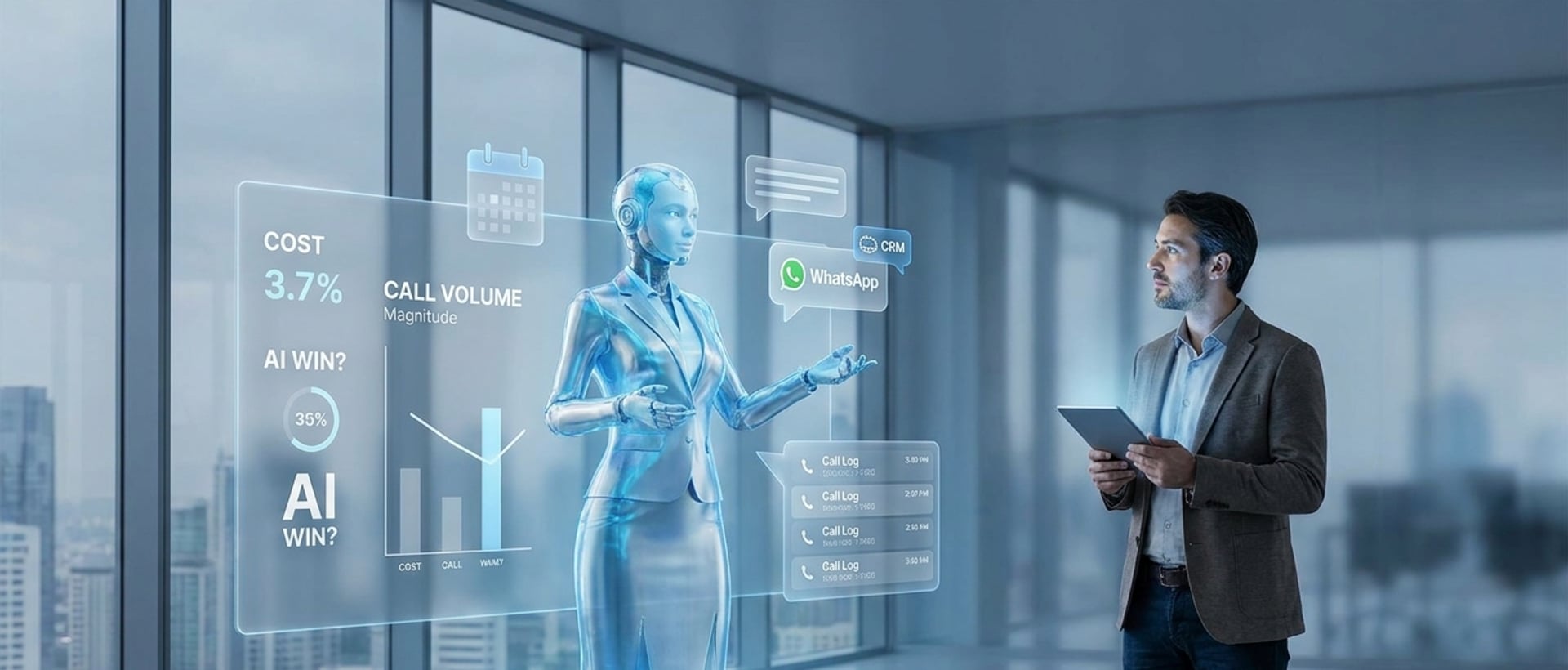
Quick Answer: Handle transactional inbound calls in Hindi, English, and increasingly regional languages (Tamil, Marathi, Kannada, Bengali). Answer FAQs about products, hours, pricing, services. Take orders and appointment bookings with real calendar integration. Transfer to a human when needed. Send WhatsApp follow-ups automatically. Log every conversation to your CRM. This covers 70-85 percent of typical Indian small business inbound call volume. The remaining 15-30 percent (complex emotional issues, escalations, high-stakes negotiations) still needs human handling.
The specific 2026 capability leap has been in regional language quality. AI voice agents in Hindi and English have been production-ready since 2024, but Tamil, Marathi, Kannada, Bengali reached production quality in late 2025. For Indian D2C brands with meaningful South and East India customer bases, this changes the addressable market coverage from 60-70 percent to 90+ percent.
The transactional-call coverage is what most businesses under-appreciate. A clinic gets a call - "what are your hours" or "can I book an appointment on Thursday afternoon" or "is Dr. Sharma available tomorrow" - these are 60-75 percent of typical clinic inbound calls. All three are AI-handleable at production quality. The receptionist's time was going 60-75 percent to scripted responses that AI does identically at 24/7 coverage.
The specific call types AI still fails at - complex complaint calls where the customer is emotionally activated, calls requiring genuine judgment on non-scripted situations, and B2B sales conversations with negotiation. Well-designed AI voice agent workflows transfer these to humans automatically based on intent detection. The AI handles the 75 percent easy volume; humans handle the 25 percent hard volume.
How does an answering service actually compare in 2026?
Quick Answer: Human answering services (call centres taking calls on your behalf) still work well and have specific advantages over AI - genuine emotional response, unscripted judgment, handling complex issues. Trade-offs - typically 9am-6pm coverage in the basic package, script consistency depends on agent training (varies), CRM integration typically weaker than AI options, and pricing scales linearly with call volume. Best fit for businesses that need human-quality response but not enough call volume to justify in-house or AI setup costs.
The specific cost breakdown for a mid-tier Indian answering service - ₹8-15K monthly for basic 9-6 weekday coverage, ₹18-30K monthly for extended-hours coverage, ₹35-60K for 24/7 coverage. Per-minute overage charges above call-count limits typically add 20-40 percent to the monthly base for high-volume months.
The specific advantage over AI - genuine emotional intelligence on high-stakes calls. A first-time customer calling with a complaint about a defective product needs a human who can genuinely empathise, not a script. Answering services staffed with trained agents handle this well; AI voice agents are getting better but still trip up on the highest-emotion calls.
The specific disadvantage vs AI - coverage gaps and cost scaling. A business growing from 50 daily calls to 150 daily calls sees answering service costs roughly triple; AI voice agent costs scale sub-linearly. For businesses expecting growth, this is a real consideration.
What's the honest decision framework by call volume?
Quick Answer: Under 15 calls/day - forward to your own phone or use a free call-forwarding app. 15-40 calls/day - basic answering service (₹8-15K) is usually the right economics. 40-100 calls/day - AI voice agent starts winning on both cost and coverage; still consider hybrid AI + human fallback for complex calls. 100+ calls/day - AI voice agent is almost always the correct answer, with dedicated human escalation for the complex 15-25 percent minority. 24/7 requirements at any volume - AI wins because human coverage costs 3x for 24/7 vs business hours.
The mechanical reason 40-100 calls/day is the shift point is that below that, the fixed integration cost of an AI voice agent doesn't amortise well. Above it, the marginal cost per call drops dramatically. At 40 daily calls you're paying ₹20-40 per handled call across all costs; at 200 daily calls that drops significantly.
The specific customer categories where the volume shift happens fast - D2C ecommerce during festive seasons (call volume 3-5x for 4-6 weeks), clinics adding new services or specialists (call volume doubles as bookings surge), and any business running major seasonal ad campaigns. In all three, the AI voice agent economics tip favourably during the peak windows.
The hybrid approach we recommend most often for Indian businesses at 40-100 daily calls - AI voice agent handles the 70-85 percent transactional volume 24/7, with automatic transfer to a small human team (2-3 people at ₹18-25K each) for the complex 15-30 percent that needs judgment. Total cost is often lower than a full-in-house team AND coverage is better AND consistency is higher.
What does a well-designed AI voice agent implementation actually include?
Quick Answer: Six components. (1) Voice AI model tuned to your business terminology (60-90 minutes of training on your product/service vocabulary). (2) Calendar/CRM integration for real-time appointment booking or order lookup. (3) WhatsApp follow-up automation after every call (confirmation, information, follow-up documents). (4) Human transfer workflow with context passing (customer name + call summary + prior interactions shown to agent). (5) Full conversation logging searchable by staff. (6) Weekly analytics dashboard showing volume, resolution rate, transfer rate, and specific call topics needing improvement. Together these turn 'AI answers phone' into 'AI is a genuine operational asset.'
The specific component most implementations skimp on is human transfer with context. Bad implementations transfer the customer to a human who then asks them to repeat everything from scratch - a worst-of-both-worlds experience. Good implementations pass the AI's transcript and inferred customer intent to the human, so the human continues the conversation naturally. This one design detail is what separates good AI voice agent experiences from frustrating ones.
The specific integration that unlocks the biggest ongoing value is WhatsApp follow-up. A booking confirmation sent to the customer's WhatsApp within seconds of the call ends is worth 5-10 percent lift in follow-through rate versus just a verbal confirmation. Reminder messages the day before the appointment lift show-up rates. Post-visit follow-up unlocks reviews and repeat bookings. The WhatsApp layer is where the AI voice agent becomes an actual customer relationship tool rather than a call-answering tool.
For most Indian businesses considering AI voice, this is part of a broader operational intelligence conversation - see our FlowCore product page for how AI voice fits with unified customer state, order management, and support automation.
What should you do next?
Count your calls first. For one week, log every inbound call - time, purpose, whether answered, whether resolved. Most small businesses under-count by 30-50 percent because unanswered rings don't feel like missed calls. The actual weekly count tells you which cost-comparison bucket you're in.
Then count the miss. Of the calls that went unanswered, estimate revenue impact. For appointment businesses, missed calls times booking value times conversion rate. For ecommerce, missed callbacks times RTO delta. For lead-gen, missed calls times lead value. The specific rupee number for one month makes the automation math concrete.
Then pick the option that matches your actual volume and business context. Don't over-engineer. If you're at 20 calls/day, an answering service beats an AI voice agent on economics. If you're at 80 calls/day, AI voice usually wins. If you're at 200+ or need 24/7, AI voice almost always wins.
If you want a scoped assessment of your specific call volume, missed-call economics, and the right option for your business category, book a voice-ops diagnostic - we come back with your specific monthly cost comparison across all three options, the fit recommendation for your specific business, and the implementation timeline for whichever path fits. Not a vendor pitch. Honest economics.