Last updated: April 20, 2026 | 12-min read | Category: AI Operations & Voice Architecture
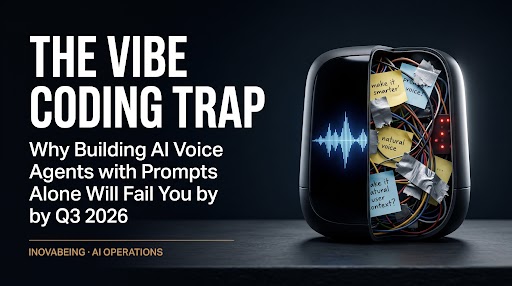
The AI world has fallen in love with a dangerous illusion: that you can build production-grade AI voice agents just by “talking to them better.”
Every week, founders and teams spin up impressive demos using natural language prompts and a single LLM-with no architecture, no state management, and no operational design. It looks magical in a Loom video. It collapses the moment it meets real customers.
At INovaBeing, we see this pattern repeat across industries: beautiful PoCs that die in the first 30 days of production. The gap is not “a smarter model.” The gap is operations.
This is your deep dive into why the prompt-only approach (“vibe coding”) is a dead end, what’s changed in 2026 with tools like Claude Code, Agent Teams, and managed agents, and how to design AI voice systems that actually survive scale.
Part 1: What Is “Vibe Coding” and Why Does It Break in Production?
“Vibe coding” is what happens when teams build AI voice agents by stacking prompts instead of designing systems.
A typical pattern looks like this:
- You grab a powerful LLM
- You describe your “ideal” agent in a big system prompt
- You wire a telephony or WhatsApp integration
- You test with a few sample calls and think: “This is ready for customers”
On a recorded demo, it sounds human, helpful, and even delightful. In production, three things immediately go wrong.
1. Edge Cases Swallow the Happy Path
Real users do not follow your script. They interrupt mid-sentence, switch languages halfway through the call, ask questions the agent has never seen before, or refer to prior calls and emails.
A single prompt cannot encode every branch AND every exception AND every escalation rule. By week two, you’re duct-taping more instructions into an already bloated system prompt-and making the model more brittle each time.
2. No Memory, No Trust
Most prompt-only agents treat each call as a fresh conversation. That means they do not remember the last complaint, do not know if this user already paid, and repeat the same KYC questions again and again.
Users feel like they’re talking to a polite but forgetful stranger. For high-stakes use cases-healthcare, finance, logistics-this breaks trust instantly.
3. Hidden Complexity Lives Outside the Agent
With vibe coding, all the “hard stuff” quietly gets pushed onto humans: Ops teams manually fix wrong bookings, finance teams adjust invoices after bad payment flows, and agents escalate to human staff far too often.
You haven’t automated the process; you’ve added a fragile layer on top that increases noise and creates new failure modes.
Part 2: The 2026 Shift – From Single Models to Agent Systems
In 2026, the tooling around AI agents made one thing clear: you are not supposed to do everything with one big prompt anymore.
Several shifts are converging:
- Claude Code launched powerful multi-step “Auto” modes and agent orchestration features, including Agent Teams that can spin up specialized sub-agents on demand.
- Managed agent platforms emerged that handle tool calling, retries, and long-running workflows for you.
- a16z and others published theses framing AI agents as the layer that will consume a massive chunk of the global “labor” market, not just the software market.
What This Means for Voice Agents
A production-ready AI voice agent in 2026 is never just “the voice model.” It is a coordinated stack of capabilities, often mapped to different agents:
- A conversation agent managing dialog, tone, and turn-taking
- A state agent tracking context across calls and channels
- A tools agent calling CRMs, ERPs, payment APIs, and schedulers
- A guardrail/compliance agent checking what can or cannot be said
- A supervisor/orchestrator agent deciding who does what next
Part 3: The Five Failure Modes of Prompt-Only Voice Agents
Failure Mode 1: Infinite Apologies, Zero Resolution
The agent is great at saying “I’m sorry for the inconvenience,” but cannot fix the billing error or change the appointment slot. Because it doesn’t have robust, tested tool integrations, it falls back to generic empathy. Users leave angrier than before.
Failure Mode 2: Stateless Conversations, Fragmented Experience
With no persistent state layer, the agent ignores prior promises or SLAs. Internally, this creates duplicate tickets and conflicting instructions. You’ve added a “smart IVR” that generates more work downstream.
Failure Mode 3: Non-Deterministic Behavior in Critical Flows
Small prompt edits cause big behavioral shifts. There is no reliable way to test and roll back safely. Regulated industries cannot tolerate this.
Failure Mode 4: Human Ops Becomes the Real Orchestrator
In vibe-coded setups, humans quietly become the orchestrators, logging into systems and reconciling data. Management teams celebrate “AI automation” while headcount quietly rises.
Failure Mode 5: Cost Blow-Ups from Overusing Frontier Models
Because everything runs through one big, expensive model, every simple FAQ call is billed at frontier-model rates. Costs spike just as you begin to scale usage.
Part 4: How INovaBeing Solves the Vibe Coding Trap
This is exactly the design problem INovaBeing was built to solve. We design multi-agent operational systems with clear roles, explicit workflows, and smart model routing.
1. Multi-Agent Voice Architecture by Design
Instead of one mega-prompt, an INovaBeing deployment typically uses specialized agents: Conversation Agent, Orchestrator Agent, State & Memory Agent, Tools Agent, and Guardrail Agent.
2. Multi-Model Routing: Frontier Intelligence Only Where It Pays
Like in our Claude 4.7 architecture, we separate thinking from doing. We use high-end models only for high-stakes reasoning, while routing simple FAQs and basic data collection to smaller, faster models.
3. Workflow-First, Prompt-Second
Every serious INovaBeing deployment starts with workflows. We define states, events, allowed actions, and constraints first. Prompts then sit on top of this structure as the interface, not the system.
Part 5: Three Concrete Examples of Vibe Coding vs. INovaBeing
Example 1: Appointment Scheduling for a Clinic
Vibe-coded agent: Can book appointments… until doctors change availability or insurance rules shift. Result: double-bookings.
INovaBeing agent: Reads real-time availability, enforces doctor-specific rules, and remembers past visits to schedule the correct follow-up type.
Example 2: Failed Payment Recovery for a SaaS Product
Vibe-coded agent: Politely asks the customer to “try again later.”
INovaBeing agent: Pulls payment history and risk profile, chooses the right action (retry, change method, or downgrade), and integrates with Stripe/Razorpay.
Example 3: Logistics Delay Notification
Vibe-coded agent: Calls to say: “Your shipment is delayed, sorry.” No more context.
INovaBeing agent: Reads carrier data, calculates new delivery window, checks SLA, and applies compensation if needed-without human intervention.
Connecting It Back: The INovaBeing Philosophy
At INovaBeing, our philosophy is simple: Prompts create demos. Architecture creates operations.
We don’t believe in “just talk to the model better.” We believe in explicit multi-agent designs, smart multi-model routing, and workflow-first implementations.
Want to see where your current agent sits on the demo–to–production spectrum?
Book an Ops Diagnostic