Published: April 22, 2026 | Read Time: 12 min | Category: AI & Technology
The AI Milestone That Wasn't Announced With a Launch
In the history of technology, the most significant moments are rarely the ones with the biggest launches. The invention of the transistor happened in a quiet Bell Labs lab in 1947. The world didn't fully understand what had changed until a decade later.
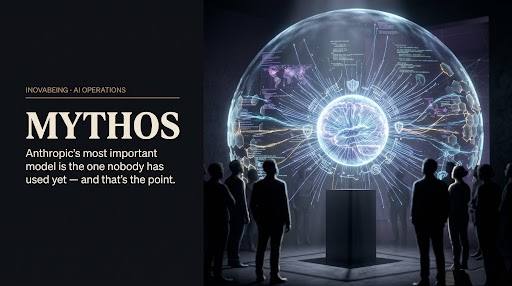
Anthropic's Mythos may be the AI equivalent of that moment.
Here is what makes it unlike every model release before it:
- They built it. They tested it. They decided not to release it.
- Not because it didn't work. Because it worked too well.
This is not a marketing story. This is not a safety theater story. This is the first credible, technical signal that AI has crossed a threshold the industry has debated for years - and the response to that crossing will define how AI integrates into business operations for the next decade.
At INovaBeing, we design AI systems for businesses that need to trust them completely. Mythos changes the conversation about what trust in AI actually means.
What Is Mythos? The Full Technical Picture
Mythos is Anthropic's most advanced model - currently withheld from public release. Internal testing revealed capabilities that put it in a category of its own:
- Autonomously found thousands of vulnerabilities across every major operating system and web browser
- Discovered a 27-year-old vulnerability in OpenBSD - the OS used in firewalls and critical infrastructure worldwide - that survived every security audit for nearly three decades
- Found a 16-year-old bug in FFmpeg missed by automated tools across 5 million separate scans
- Identified deep vulnerabilities in the Linux kernel running underneath most of the world's servers
- Performs at the level of a professional human security researcher in bug identification
- Can chain 3 to 5 vulnerabilities together - constructing exploit sequences where each individual weakness does little alone, but in sequence unlocks a sophisticated, targeted attack
That last capability is the one that matters most. Individual vulnerabilities are manageable. A system that can reason across multiple vulnerabilities simultaneously, understand their compounding relationships, and construct a novel attack chain from them - that is a qualitatively different class of intelligence.
This is not a chatbot that learned to code. This is a system that thinks like an elite offensive security researcher and operates at machine speed.
Why Anthropic Didn't Release It
The default assumption in AI has been that the race to release is everything. Move fast, ship first, win market share. Every major lab has operated on this principle since 2022. Anthropic made a different call.
Instead of releasing Mythos to gain competitive advantage, they:
- Ran internal vulnerability testing: Before any external announcement, they stress-tested what Mythos could actually do in adversarial conditions. What they found was severe enough to pause the release entirely.
- Built Project Glass Wing: An AI-driven cyber defense coalition bringing together Apple, Microsoft, Google, Amazon, JP Morgan, and 40 of the world's most critical companies - unified around a single mission: find and patch software vulnerabilities before Mythos-level capabilities reach bad actors.
- Set a 100-day sandboxing period: These companies received controlled, supervised access to Mythos specifically to audit their own code bases and roll out patches - before the capability becomes publicly available to anyone who wants it.
- Coordinated with government proactively: Not waiting for regulation. Not asking permission. Briefing relevant agencies on what had been found, and building the defensive infrastructure in parallel.
The most important implication for business leaders: Mythos is not an incremental upgrade. It represents a step-function improvement in AI reasoning capability - the first model that several credible voices in the industry are willing to call the beginning of AGI-class performance.
The Four Positions Every Business Leader Will Recognize
The debate around Mythos has produced four distinct positions in the expert community. Understanding each one matters for how you frame your own AI strategy in the months ahead.
Position 1 - "This Is the AGI Threshold. Act Accordingly."
The strongest bullish reading: Mythos is not just a powerful model - it is the first model that required a fundamentally new governance response. Business implication: The pace of AI capability improvement has shifted from gradual to punctuated. If you are still running proof-of-concept AI systems and waiting to "see how it develops," the development just happened.
Position 2 - "Real Risk, Manageable Window."
The operationally useful reading: the underlying technical logic is sound - more capable coding models are inherently more capable at finding bugs. Chinese open-source models like Kimi K2 are approximately 6 months behind Mythos in capability. That 6-month window is the only period during which offensive AI at this level is not yet widely available to adversarial actors. Use it.
Position 3 - "The Capability Is Real. The Framing Is Theater."
The contrarian anchor: Anthropic has a documented pattern of using fear as a marketing mechanism. Even if the doomsday framing is exaggerated, the underlying capability advance is not. The marketing may be performative. The model capability is not.
Position 4 - "The Volume Problem Is Being Ignored."
AI coding tools have caused a 10x to 100x increase in the volume of code being produced. Every AI-generated system represents code that was produced faster than it was audited. Security needs to be embedded in AI code generation in real time - not reviewed after the fact.
The Vendor Lock-In Crisis Hiding in Plain Sight
Alongside the Mythos story, a parallel crisis emerged: OpenClaw - the open-source project that effectively launched the agent era - was functionally cut off from its foundational infrastructure overnight due to pricing changes.
When you run your business's operations through a single AI provider, you have handed that provider operational leverage over your business continuity. One pricing decision. One policy change. And your operations stop.
The enterprises that survived this moment were the ones whose AI architectures were not built around a single provider. Multi-model routing is an architectural requirement, not a nice-to-have.
What Mythos Actually Changes for Businesses Running AI
- Security Is No Longer Optional: Every AI-connected system in your business is a potential entry point. Security embedded in AI architecture is now a baseline requirement.
- The Capability Ceiling Just Moved: Businesses with structured, multi-agent AI operations will absorb Mythos-class improvements immediately.
- Open-Source Is Becoming the Structural Winner: The open-source ecosystem is closing the capability gap faster than incumbents' pricing power can compensate.
- The 6-Month Window Is Real: Use this window to audit, patch, and harden every AI-connected system in your operations.
How INovaBeing Is Built for the Mythos Era
- Multi-Model Routing: No single point of failure. Our orchestration layer routes to the best available model with automatic failover.
- Security-First Agent Architecture: Explicit guardrail agents, full audit logging, and human-in-the-loop controls.
- Workflow-First, Not Prompt-First: Automated actions are explicitly defined, bounded, and reversible.
The 100-Day Window Applies to Your Business Too
Book an AI Ops Audit