Published: April 22, 2026 | Read Time: 12 min | Category: AI Operations
Author: Sathyarajan B
It Happened Overnight
No warning email. No transition period. No migration guide.
One morning, thousands of developers and businesses woke up to find that the AI agent system they had built their operations on - the tool they had structured their workflows, customer interactions, and automated pipelines around - had just become ten times more expensive to run.
Not because the technology failed. Not because they did anything wrong. Because a single pricing policy changed at a company they did not own.
This is not a cautionary tale about a startup that made a bad bet. This is the most important vendor risk story in the history of AI operations - and it happened in April 2026, in plain sight, while most of the business world was watching something else.
What OpenClaw Was - And Why It Mattered
To understand what happened, you need to understand what OpenClaw actually built. OpenClaw was an open-source autonomous agent framework. It gave AI models the ability to do what no chatbot had done before at scale:
- Browse the web independently
- Read, write, and manage files
- Execute code across environments
- Operate applications
- Handle multi-step workflows across multiple platforms simultaneously
It was not a better chatbot. It was the first tool that turned an AI model into an autonomous operator - a system that could receive a high-level objective and execute it across multiple tools and environments without human intervention at each step.
The response from the developer and business community was immediate. OpenClaw became the most starred project in the history of GitHub. Not the most starred AI project. The most starred project - across every category, every language, every era of open-source development.
What Happened - The Exact Sequence
Step 1: The Token Economics Break
AI subscriptions work on blended pricing. The majority of users consume less than their allocation. The top users consume significantly more. The provider sets a flat rate that works because the distribution averages out. OpenClaw broke that distribution entirely.
Autonomous agents are not conversational. They do not exchange a few hundred tokens per session. They operate - reading files, executing searches, running code, processing outputs, iterating across tasks. A single hour of serious autonomous agent operation consumes what a casual user might consume in weeks.
OpenClaw's power users were not consuming 2x or 5x the average subscription value. They were consuming $2,000 to $20,000 worth of tokens on a $200 per month subscription. That is a structural incompatibility between flat-rate subscription pricing and the actual economics of autonomous agent operation.
Step 2: The Access Cut
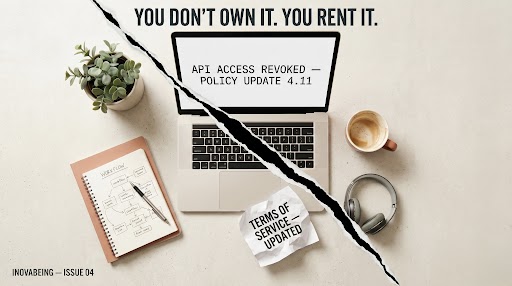
The provider's response was a pricing policy change: professional and enterprise flat-rate subscriptions could no longer be used with OpenClaw. Users who wanted to continue operating at the same level had to move to pay-per-API-token pricing. For most power users, that meant adding a zero to their monthly AI costs. Minimum.
Step 3: The Competitor Launch - 10 Days Later
Ten days after the access restriction, the same provider launched their own first-party autonomous agent product - positioned as a safer, more capable, enterprise-ready version of exactly what OpenClaw had built. The timing was not coincidental.
The Five Lessons Every Business Must Take From This
Lesson 1 - Flat-Rate AI Pricing and Autonomous Agents Are Structurally Incompatible
Autonomous agents consume tokens at a fundamentally different rate than conversational AI. If your business is running or planning to run agentic AI workflows - voice agents, automation pipelines, multi-step operational systems - flat-rate subscription pricing is not a stable foundation.
Lesson 2 - Your AI Provider Is Not Your Infrastructure Partner
Treating an AI model subscription as stable infrastructure is a category error. Your AI operations need an architecture layer between your business and any single AI provider - an orchestration layer that can route to alternatives when any provider's terms become unfavorable.
Lesson 3 - First-Party vs Third-Party Access Will Become the Defining AI Market Question
Providers will build first-party products in the categories where they see the highest commercial opportunity, and the terms of third-party access to the underlying model will reflect that commercial interest.
Lesson 4 - The Agent Layer Requires Architectural Independence
Architectural independence at the agent layer means multi-model routing with automatic failover, open-source model alternatives, and workflow logic that lives in your systems, not in provider-specific agent frameworks.
Lesson 5 - Open-Source Is Not a Compromise - It Is a Strategy
For most business use cases today, open-source models deliver 80 to 90% of the capability of frontier closed models at a fraction of the cost and with zero single-provider dependency.
How INovaBeing Architects Around This Reality
- Multi-Model Orchestration Layer: Every INovaBeing deployment runs on an orchestration layer that sits between your business operations and the underlying AI models.
- Workflow-First, Provider-Agnostic Design: Every workflow we build lives in your systems - not in a provider-specific agent framework.
- Open-Source Model Integration: We actively test, qualify, and integrate open-source models into every deployment stack.
- Data Portability and Governance: Every piece of institutional knowledge belongs to the client and lives in client-controlled infrastructure.
Ready to audit your current AI architecture for vendor lock-in risk?
Book an AI Ops Audit