Why Most AI Pilots Fail Before They Even Start
Here is the pattern we see repeatedly when we talk to founders and operators across India and Southeast Asia. A leadership team decides it is time to get serious about AI. They identify a use case, something practical, like automating customer support responses or building a pipeline tracker. They select a tool, usually something popular and well-marketed. They launch a pilot.
Then, three months later, the tool is being used by one person, two people at most. The rest of the team has quietly gone back to their old spreadsheets. Leadership is frustrated. The AI vendor says adoption takes time. Nobody knows what went wrong.
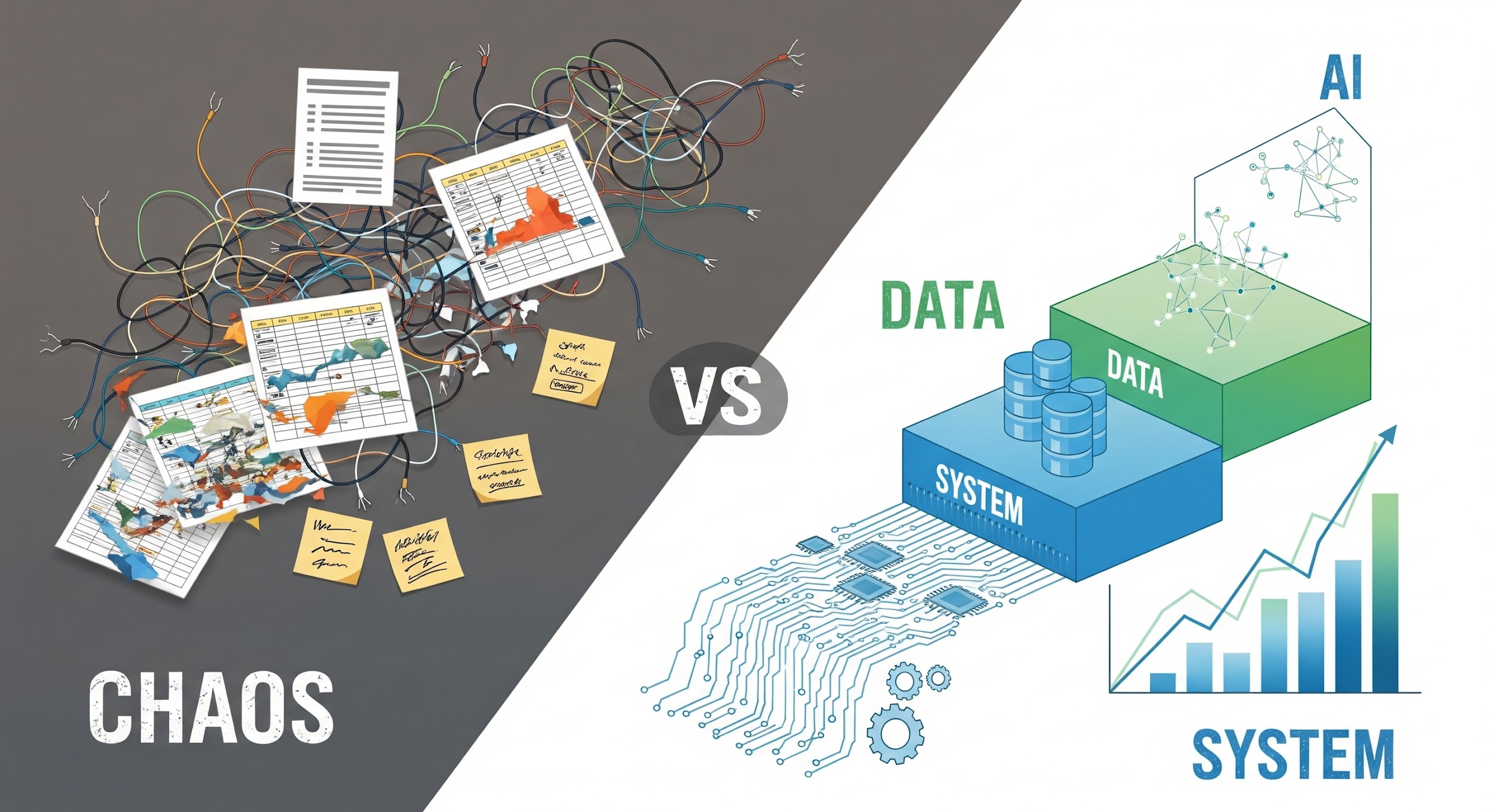
What went wrong is almost always the same thing: the AI was deployed on top of chaos. Messy, undocumented, person-dependent workflows. Data spread across five tools with no single source of truth. Processes that existed only in someone's head. In this environment, AI does not help. It amplifies the noise.
The Three-Layer Operational Architecture
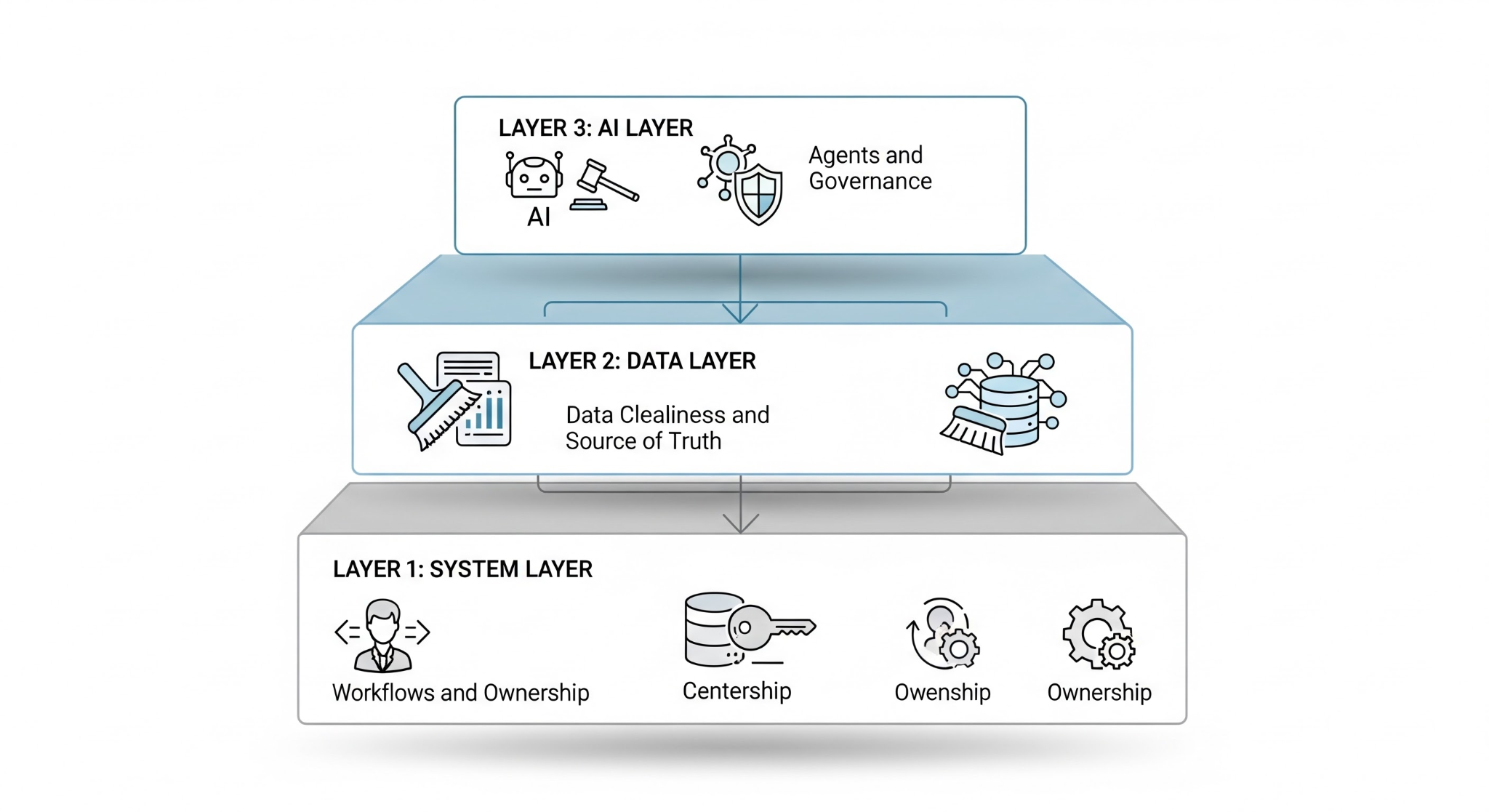
At INovaBeing, we approach every client engagement through what we call the three-layer operational architecture. Before we touch AI, we look at the three layers underneath it.
Layer 1: The System Layer
This is where work happens. Processes, roles, responsibilities, and handoffs. At this layer, we are asking: Do you have documented workflows? Is there a clear owner for each critical process? Are there shadow workflows happening in personal WhatsApp groups or individual spreadsheets that no one else can see?
If the system layer is fragmented, AI will make that fragmentation faster and harder to manage. We always map this layer first. Often, just doing this audit reveals quick wins that have nothing to do with AI at all.
Layer 2: The Data Layer
AI is only as good as the data it runs on. At this layer, we look at where your data lives, how clean it is, and how it flows between systems. Are your CRM records up to date, or are they filled with duplicates and missing fields? Is your financial data in one place, or split across three versions of a spreadsheet? Is there a defined source of truth for your key metrics?
Layer 3: The AI Layer
Only once the system and data layers are stable do we introduce AI. This is where agents, copilots, and automations sit. This is where multimodal capabilities come in: text, voice, vision, and structured data, depending on the use case. And critically, this is where governance architecture matters most.
AI deployed on a stable, clean system does not break. It improves over time. It earns trust across the organisation. It scales without requiring heroics from your team. That is the compounding advantage of building it in the right order.
A 30-Day Plan to Move from AI Hype to AI Execution
If you are a founder or operator who wants to move from reading about AI to actually running it in your organisation, here is a realistic thirty-day plan based on the INovaBeing engagement model.
- Week 1: Audit. Map your ten to fifteen highest-friction tasks. These are things your team does repeatedly that are time-consuming but do not require deep judgment. Rate each one on two dimensions: hours lost per week and closeness to a revenue or cost outcome. Prioritise the top three.
- Week 2: Pilot one workflow. Take your number one priority. Define what done looks like. What metric will change? What will the team stop doing manually? Build a contained, testable version of the AI workflow and run it alongside your existing process.
- Week 3: Optimise and harden. Look at where the AI got it wrong or where the team did not trust its outputs. Fix the prompts. Add the guardrails. Clarify the escalation path. Log everything. Your goal is a workflow that the team uses without needing to be reminded or pushed.
- Week 4: Scale to a second workflow. Because you built the architecture properly in weeks one through three, the second workflow moves at least twice as fast. Each new workflow compounds on the last. That is what INovaBeing calls the AI Execution Flywheel.
Take the Next Step With INovaBeing
If you are tired of AI pilots that never scale, we can help. At INovaBeing, we work with founders, CXOs, and operators who want to move from AI curiosity to AI advantage in thirty days or less.
Our System First AI Audit is a focused thirty-minute call where we map your operational landscape and identify the highest-ROI AI workflows for your specific business. No generic advice. No bloated transformation roadmaps. Just a clear, practical starting point.
Reply to this newsletter or visit inovabeing.com to book your audit.