Small and medium-sized businesses do not struggle with AI because the technology is unproven. They struggle because every AI decision carries a second-order cost: token bills, infrastructure overhead, workflow ownership, and the hidden expense of training people to manage tools that were supposed to save time in the first place.
That tension is exactly why agentic AI for SMB operations is becoming a more relevant conversation than generic "AI adoption." The winning question is no longer "Should a small business use AI?" It is "How can a small business deploy AI agents that automate work without creating runaway LLM costs, extra infrastructure, and another upskilling burden?"
For SMBs, the answer is not more AI tools. The answer is better AI Ops Architecture: a practical operating model where AI agents are scoped to high-value workflows, costs are measured at the token and workflow level, infrastructure is kept light, and expertise is bundled into the solution rather than pushed onto already-stretched internal teams.
Why SMBs Need a Different Agentic AI Strategy
Small businesses are adopting AI faster as barriers to entry fall. JPMorganChase Institute found that entry-level monthly AI spending among newer adopters fell from about $50 per month in 2019 to roughly $20–30 per month by 2025, helping broaden adoption across the small business market. Business.com reported that 57% of U.S. small businesses were investing in AI technology, up from 36% in 2023, showing that the category has moved into the mainstream.
But adoption is not the same as operational readiness. OECD research notes that smaller firms face greater constraints around financing, capabilities, and organizational readiness than larger enterprises, which makes scaling AI inside real workflows much harder than purchasing a few subscriptions. The 2025 SME Skills Horizon Barometer found that 90% of SMEs anticipate some kind of skills gap, with AI proficiency rising on the recruitment agenda.
This is the core SMB reality: AI is attractive at the point of entry, but difficult at the point of scale. A founder may be able to buy a chatbot subscription in minutes, but building dependable agentic workflows for support, order handling, or back-office operations still requires prompt design, model selection, orchestration, monitoring, exception handling, and team enablement.
What Is Agentic AI for Small Business Operations?
Agentic AI for small business operations means using AI agents that do more than generate answers. These systems are designed to observe context, decide what to do next, call tools or APIs, and complete multi-step business tasks such as routing a support issue, updating an order, qualifying an inbound lead, or answering and acting on a customer call.
This matters because the SMB problem is usually not "content generation." It is workflow completion. An SMB does not need ten disconnected AI assistants producing drafts. It needs one reliable layer of AI agents that can reduce repetitive work across support, CX, sales follow-up, scheduling, and operations without introducing fragile automation or new manual clean-up.
A practical agentic setup for SMBs usually includes four parts:
- A reasoning model that understands requests and chooses the next step.
- A tool layer that connects to systems like CRM, ticketing, telephony, email, ERP, or OMS.
- Rules and guardrails that limit what the agent can do without approval.
- Cost and workflow monitoring so the business can see whether the agent is actually saving money.
The Real Cost Problem: Why AI Can Quietly Eat SMB Margins
The biggest misconception in the market is that AI is expensive only when a business trains custom models or builds GPU clusters. In reality, many SMBs get surprised by cost long before that point. The surprise comes from accumulated subscription sprawl, verbose prompts, oversized context windows, retried agent loops, fragmented tooling, and the internal time required to supervise everything.
JPMorganChase Institute data suggests that small business AI spending has become more accessible at the point of entry, but that does not eliminate the broader operational cost of making AI useful in production. Practical guides on LLM economics emphasize that token usage is one of the biggest drivers of cost when proprietary models are involved, and that tracking input and output tokens by model, feature, and user is essential to prevent waste.
Redis notes that token optimization directly reduces API costs and latency, and estimates that semantic caching alone can cut API costs by up to 73% in some applications. Other optimization guidance shows that teams can significantly reduce spend through prompt compression, model routing, batching, caching, and output constraints rather than simply trying to negotiate lower model prices.
For SMBs, this changes the framing completely. The real cost issue is not just the sticker price of an LLM API. It is whether the business has designed workflows that keep token usage proportional to value created.
How to Reduce LLM Token Costs for Small Business Workflows
If the objective is to make agentic AI for SMB operations financially sustainable, then LLM cost optimization has to be built into the system design from day one. The highest-return cost controls are usually architectural rather than contractual.
1. Route simple work to smaller models
Not every task needs the most expensive model. Common workflows like FAQ answering, simple ticket classification, appointment confirmation, and order-status updates can often run on lower-cost models, while higher-end reasoning models are reserved for escalations and edge cases.
2. Reduce prompt bloat
Even simple wording changes can materially reduce token counts for the same intent. For SMB teams, prompt compression, removal of redundant instructions, and tighter output schemas can lower both cost and latency without hurting quality.
3. Cache repeated context
When workflows repeatedly use the same system prompts, policy instructions, or product context, caching becomes one of the fastest ways to reduce spend. Prompt or semantic caching can generate major savings in repetitive use cases such as support, RAG, and structured workflows.
4. Constrain output length and retries
Many AI systems overspend because outputs are too long or because failed structured outputs trigger expensive retries. Tight schemas, explicit output limits, and better validation reduce the number of wasteful loops that silently increase token bills.
5. Measure cost by workflow, not just by model
A founder does not care whether Model A is cheaper than Model B in isolation. The meaningful question is whether "resolve an L1 support issue" or "handle an inbound call" is profitable after AI costs. Tracking cost per successful workflow is more useful than tracking blended monthly AI spend.
Infrastructure Overhead: The Cost Nobody Budgets Properly
Many SMBs enter AI assuming that infrastructure costs are irrelevant if they are using APIs rather than self-hosting models. That is only partially true. Even API-first AI still requires orchestration, integrations, observability, workflow management, data pipelines, fallback logic, monitoring, and access controls if the business wants dependable automation.
This is where AI Ops for small business becomes critical. Instead of forcing every SMB to become an MLOps shop, the better approach is to centralize the operational layer: model routing, logging, API governance, workflow logic, agent monitoring, and handoff rules all live inside a managed AI Ops Architecture for SMBs.
For a smaller company, that matters more than raw model sophistication. The fastest way to burn time and margin is to let teams stitch together point tools with no unified monitoring or ownership. The fastest way to create leverage is to run AI through one controlled layer that connects to the systems the business already uses.
The Skills Gap Is an Operations Cost, Too
Upskilling is often discussed as a people issue, but for SMBs it is also a direct operating expense. Every hour spent teaching teams how to prompt, review outputs, design workflows, or debug broken automations is an hour not spent serving customers or closing business.
The 2025 SME Skills Horizon Barometer found that 90% of SMEs expect skills gaps, while government-backed reporting highlights ongoing employer interest in AI-related upskilling and recruitment. OECD research also stresses that smaller firms typically have fewer complementary capabilities available internally, which makes implementation friction more severe.
This is why AI operations without hiring an AI team has become such an important decision criterion. SMBs do not just want software; they want an operating model that includes the missing expertise. In practice, that means working with partners or platforms that package agent design, workflow logic, cost controls, and monitoring into the solution rather than expecting the internal team to invent those disciplines from scratch.
What Good Agentic AI Looks Like for SMBs
The best agentic AI for small business operations is not the most autonomous system. It is the most economically disciplined system. It knows which workflows are worth automating, when to escalate to a human, how to keep token usage under control, and how to produce measurable business outcomes.
For most SMBs, the right starting points are narrow, high-frequency workflows where the value is obvious and the risk is manageable:
- AI voice reception for common inbound call types, appointment handling, routing, and basic information capture.
- Support triage and L1 resolution for repeat issues with clear policies.
- Order status, inventory, and customer notification workflows where speed and consistency matter.
- Sales follow-up and qualification sequences for inbound leads that would otherwise sit untouched.
These use cases work because they are tied to real operating pain. They reduce time spent on repetitive tasks, shorten response cycles, and often free scarce human capacity for exception handling and revenue-generating work.
Where INovaBeing Fits
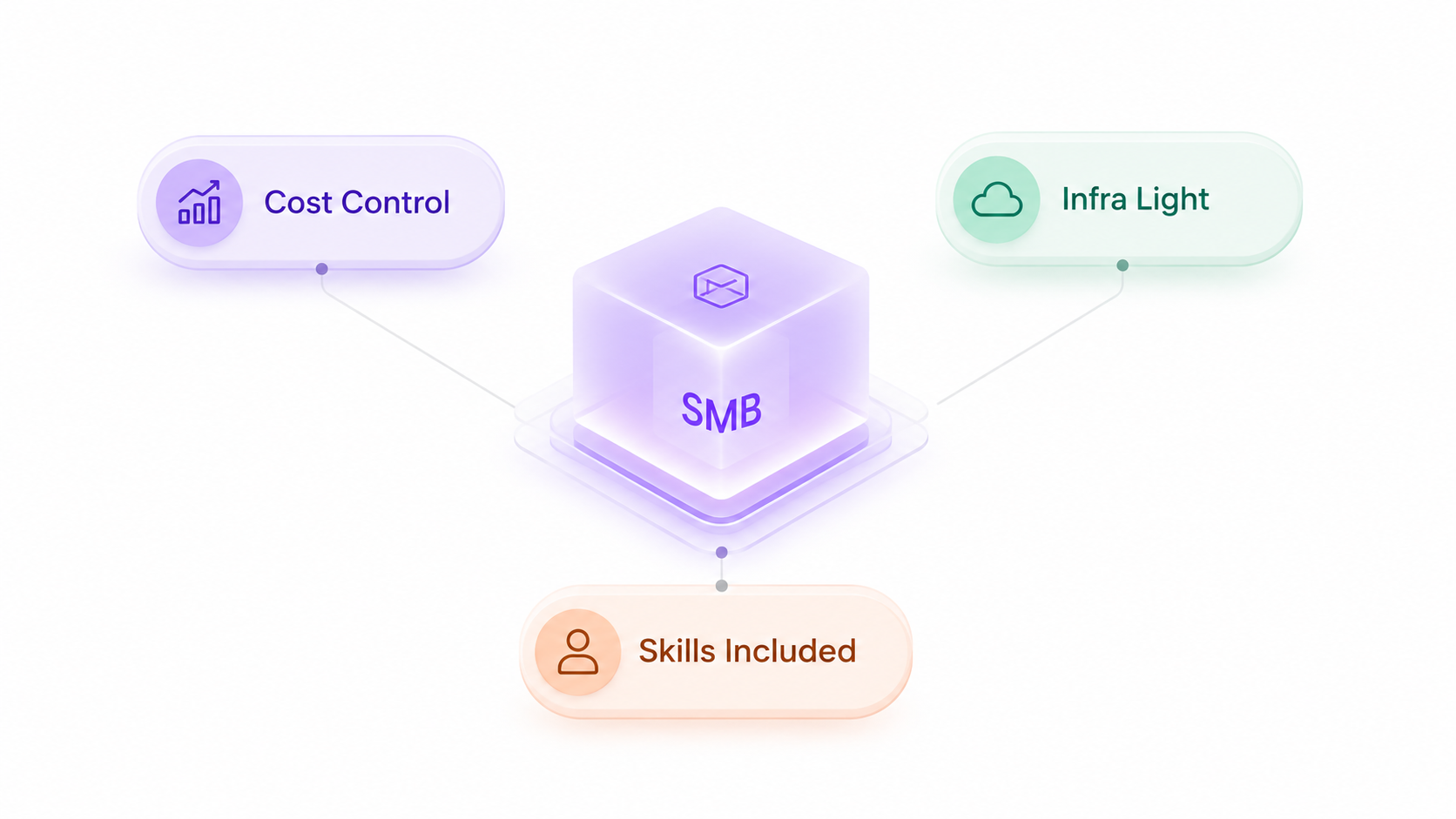
This is the gap that INovaBeing is well placed to address. The most compelling message is not "another AI product." It is a managed path to agentic AI for SMB operations that is token-aware, infra-light, and skills-included.
That positioning aligns naturally with an AI Ops Architecture approach:
- AI agents are deployed against high-value workflows rather than broad, fuzzy mandates.
- Token usage and workflow economics are measured from the start rather than after costs spiral.
- Infrastructure complexity is abstracted behind a managed orchestration layer.
- Human oversight is built in so autonomy expands only where it proves reliable.
- The client buys outcomes and operational leverage, not just model access.
For a company like INovaBeing, the strongest commercial angle is clear: help SMBs adopt AI without turning them into part-time AI operators. That is a much sharper promise than generic AI transformation language because it addresses the exact concerns founders and ops leaders already feel - cost creep, implementation drag, and team capability gaps.
A Practical 90-Day Plan for SMBs
A realistic SMB rollout does not begin with a sweeping AI vision. It begins with one or two workflows where cost, risk, and value are easy to measure.
Days 1–15: Find one profitable workflow
Choose a narrow operational use case with repeat volume and clear success criteria, such as inbound call handling, L1 support, order status requests, or lead qualification. Estimate the current human time, response delay, and cost of that workflow before introducing AI.
Days 16–45: Deploy with guardrails
Launch an AI agent in supervised mode with clear escalation rules, tool permissions, output constraints, and token monitoring. Avoid full autonomy at the start; the goal is to prove workflow value and cost discipline, not to maximize AI behavior.
Days 46–90: Optimize economics before expanding scope
Only after the first workflow shows acceptable quality and unit economics should the business expand to adjacent workflows. At this stage, optimization often matters more than new features: better model routing, reduced prompt bloat, caching, and clearer exception handling can materially improve margin.
Conclusion
For SMBs, the future of AI is not about buying the most advanced model or chasing the newest agent framework. It is about building AI operations for SMBs that protect margin while increasing throughput. That means focusing on agentic AI for small business operations that cuts repetitive work, controls LLM token costs, minimizes infrastructure overhead, and removes as much of the upskilling burden as possible.
The companies that win will not be the ones with the most AI tools. They will be the ones with the clearest economics, the lightest operational footprint, and the most disciplined path from automation hype to reliable workflow execution.